
Free Safe Operating Procedure (Self Retracting Lifeline) Template
Need a structured process for using self-retracting lifelines? Our free template helps you create a clear SOP. Download your customisable copy today.
Free Safe Operating Procedure (Self Retracting Lifeline) Template
DOCX • 126 KB + PDF
Updated Oct 2026
No signup required
Purpose of the Free Safe Operating Procedure (Self Retracting Lifeline) Template
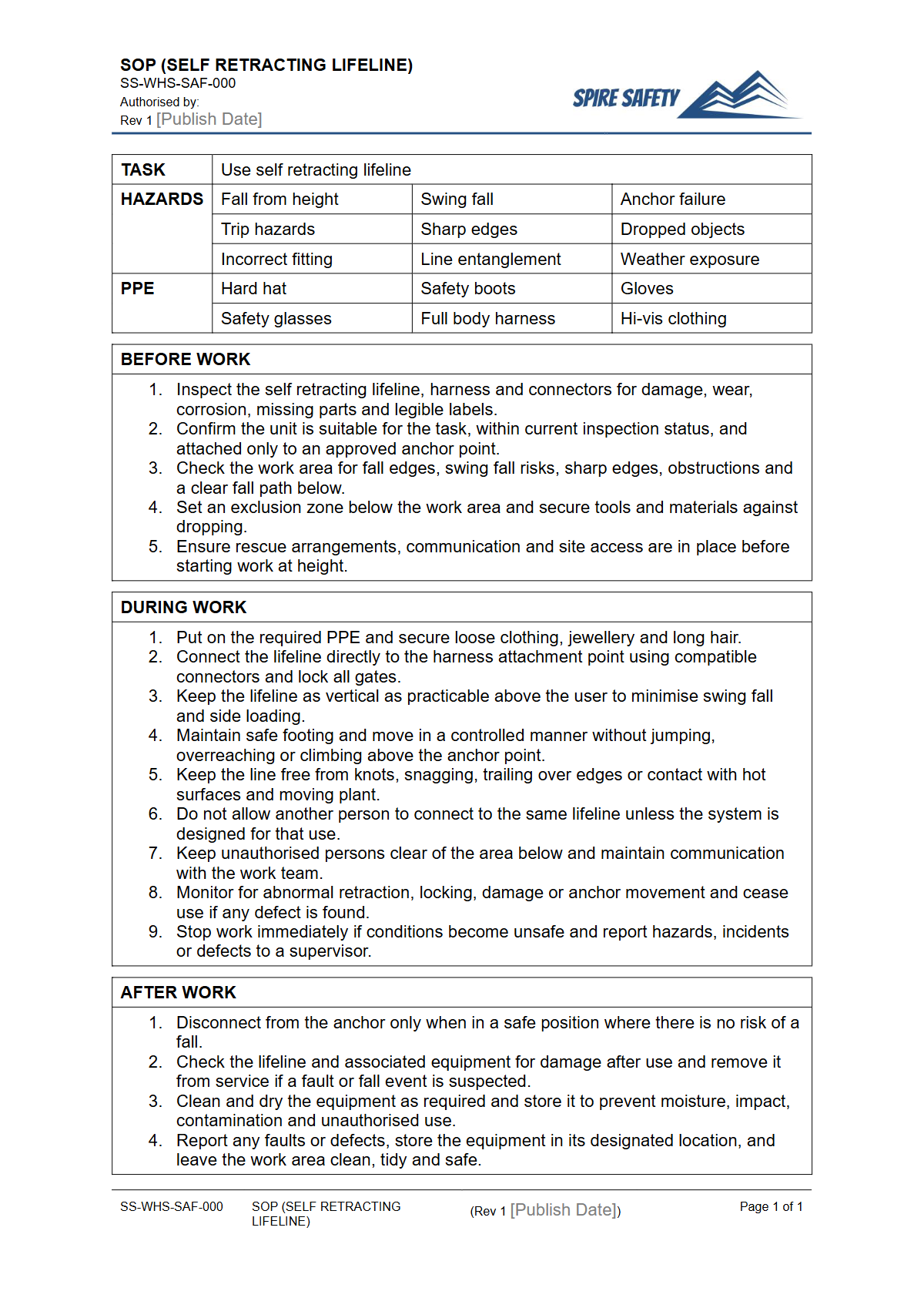
This Free Safe Operating Procedure (Self Retracting Lifeline) Template provides a structured foundation for documenting the safe use of SRLs in your workplace. Its primary purpose is to help you create a detailed procedure that identifies hazards, outlines control measures, and establishes a clear process for workers who perform tasks at height. Implementing a robust SOP is a key part of demonstrating due diligence and ensuring that fall risks are managed effectively, forming a critical component of broader WHS management systems.
The template guides you in detailing pre-use checks, proper connection techniques, and emergency procedures. By formalising these steps, you create a repeatable and trainable process that reduces the likelihood of misuse, equipment failure, or injury.
It is designed to be adapted to your specific site conditions, equipment models, and organisational requirements, helping to meet your duty of care under Australian WHS legislation.
Video walkthrough
How to use the Free Safe Operating Procedure (Self Retracting Lifeline) Template
Using this template effectively involves more than just filling in the blanks. It requires a thorough and site-specific approach to ensure the final document is practical and relevant.
Download the DOCX file to begin customisation, or use the PDF as a reference. The key is to adapt the content to reflect the unique environment and equipment your team uses, such as when operating mobile plant described in our FREE Telehandler SOP Template.
Follow these steps to customise the procedure:
- Consult with Workers: Engage with the operators, supervisors, and safety personnel who will use the SRLs. Their direct experience is invaluable for identifying practical challenges and effective control measures.
- Incorporate Manufacturer Specifications: Refer to the manufacturer's instructions for your specific SRL models. Include details on inspection schedules, weight limits, approved anchorages, and any operational limitations (e.g., use near sharp edges).
- Add Site-Specific Details: Detail the specific tasks where SRLs are used, identify the anchor points available at your workplace, and calculate the required fall clearance for each location. Include your site's specific emergency and rescue plan.
- Review and Approve: Once customised, the SOP should be reviewed and approved by a competent person within your organisation, such as a WHS Manager or supervisor.
- Train Your Team: Use the finalised Safe Operating Procedure as a central tool for training and assessing competency. Ensure all relevant workers understand its contents before they are permitted to use SRLs.
Note: Before you use this template, we must stress that it is a starting point, not a complete, ready-to-use document. Your organisation is responsible for ensuring the final, customised SOP is accurate, adequate for your needs, and compliant with current WHS laws and standards.
When to use a Safe Operating Procedure for a Self Retracting Lifeline
A Safe Operating Procedure for an SRL should be developed, implemented, and referenced before any work at height involving the device takes place. It is a proactive tool used during the planning stages to ensure risks are controlled.
The SOP should be readily available and used for pre-start meetings, toolbox talks, and worker training sessions. It also serves as a critical reference document during safety audits and incident investigations.
Regular reviews and WHS compliance auditing can verify that the SOP is being followed correctly and remains effective.
Who should use it
This SOP template is intended for use by multiple roles within an organisation to foster a comprehensive approach to fall protection.
- Persons Conducting a Business or Undertaking (PCBUs): Use the SOP to fulfil their primary duty of care by providing and maintaining a safe system of work.
- WHS Managers and Safety Officers: Use the template to develop, implement, and review workplace-specific procedures as part of the overall safety management system. For complex scenarios, engaging external experts through WHS consulting can provide valuable assurance.
- Supervisors and Team Leaders: Use the final SOP to train workers, conduct pre-start checks, monitor work practices, and enforce safety standards on-site.
- Workers: Should be trained on the SOP and use it as a step-by-step guide for safely inspecting, setting up, and using an SRL during their daily tasks.
By defining clear responsibilities and procedures for everyone involved, the SOP helps build a strong safety culture around working at height. Explore our complete free WHS resources library for more templates to support your safety framework.
Common mistakes
Common mistakes to avoid
- Failing to account for required fall clearance, leading to the worker hitting the level below.
- Using an SRL horizontally or over a sharp edge without confirming it is rated for that specific application.
- Neglecting pre-use inspections, missing damage like frayed lines, cracked casings, or malfunctioning indicators.
- Choosing an anchor point that is not rated to withstand fall arrest forces (typically 15kN for one person).
Legal references
Legal considerations
The following legal requirements may be relevant to this type of work.
- Work Health and Safety Act (Harmonised) — Provides the primary duties for protecting workers and other people from work health and safety risks.
- Work Health and Safety Regulations (Harmonised) — Sets out requirements supporting the management of workplace hazards and risks.
The following codes may be relevant to this type of work.
- Managing WHS Risks Code of Practice — Provides practical guidance on identifying hazards, assessing risks and applying effective controls.
- Work Health and Safety Consultation, Cooperation and Coordination Code of Practice — Provides practical guidance on consulting workers and coordinating with other duty holders.
- Managing the Work Environment and Facilities Code of Practice — Provides practical guidance on safe work environments, workplace facilities and related controls.
Did you know
SRL Lock-up Speed
Some self-retracting lifelines are designed to lock up at a specific speed (e.g., 1.4 m/s). This is faster than a free fall, ensuring the device activates quickly to arrest a fall with minimal drop distance.
Not a Leash
An SRL is not a restraint lanyard and should not be used to prevent a worker from reaching a fall hazard. It is a fall arrest device, designed to activate only after a fall has occurred.
FAQ
Frequently asked questions
01What should be included in a self-retracting lifeline SOP?
02How often do self-retracting lifelines need to be inspected?
03Is a Safe Operating Procedure a legal requirement in Australia?
04Can I use this template for any brand of SRL?
Share this resource
Free Safe Operating Procedure (Self Retracting Lifeline) Template
Browse Categories
How To Use It
- 1Download and open in Word or PDF.
- 2Replace the placeholders with your business details.
- 3Get it reviewed by a WHS specialist before rollout.
Need it customised?
Our WHS consultants can adapt this template to your site, run a gap analysis, or audit what you already have in place.
Book a Free Consultation WHS consulting servicesor call 1300 156 382
Related templates
- Free Safe Operating Procedure (Septic Tank Inspection) Template
- Free Safe Operating Procedure (Service Bay Cleaning) Template
- Free Safe Operating Procedure (Service Corridor Clean) Template
- Free Safe Operating Procedure (Service Door Cleaning) Template
- Free Safe Operating Procedure (Service Lift Cleaning) Template
- Free Safe Operating Procedure (Service Lift) Template