
Free Safe Operating Procedure (Service Door Cleaning) Template
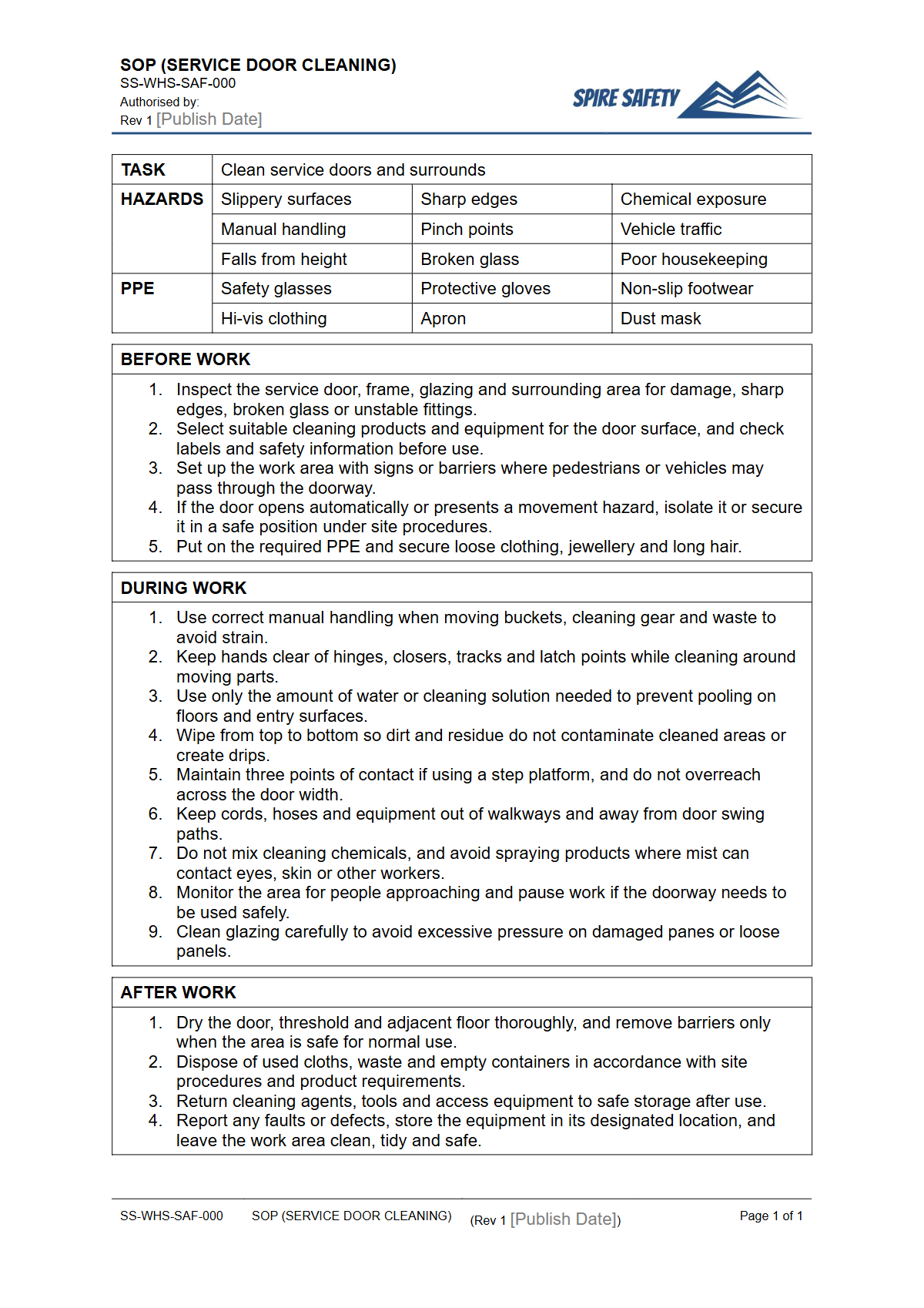
Download our free Safe Operating Procedure (Service Door Cleaning) template to document the step-by-step process for cleaning service doors safely.
Free Safe Operating Procedure (Service Door Cleaning) Template
DOCX • 126 KB + PDF
Updated Oct 2026
No signup required
Purpose of the Free Safe Operating Procedure (Service Door Cleaning) Template
Our Free Safe Operating Procedure (Service Door Cleaning) Template provides a structured framework for documenting the safe and efficient cleaning of service doors in your workplace. This task, while seemingly simple, can present numerous hazards, including slips from wet floors, ergonomic strains from awkward postures, and exposure to cleaning chemicals.
Using a standardised SOP ensures that all workers follow a consistent, safe method, reducing the risk of injury and demonstrating your organisation's commitment to a safe system of work.
A well-defined SOP is a fundamental tool for hazard management. It outlines the required personal protective equipment (PPE), step-by-step instructions, and emergency responses, forming a critical part of your overall safety strategy.
This template is designed to be a comprehensive starting point, aligned with Australian WHS principles, for businesses in sectors like hospitality, retail, and logistics.
Video walkthrough
How to use the Free Safe Operating Procedure (Service Door Cleaning) Template
This template is provided in both DOCX and PDF formats for your convenience. The DOCX version is fully editable, allowing you to tailor the content to your specific operational needs.
To use it effectively, download the file and systematically work through each section, replacing the placeholder text with details relevant to your site, equipment, and the specific cleaning agents you use. For example, your procedure for cleaning a loading dock roller door will differ significantly from cleaning glass entry doors in a cafe.
It's crucial to remember that this is a template, not a finished document. We have provided a solid foundation, but you must adapt it to reflect the specific hazards, equipment, chemicals, and processes unique to your organisation.
For instance, the safety controls outlined in our Free Safe Operating Procedure (Deep Fryer - Standard Operation) Template are highly specific to that appliance, and your door cleaning SOP must be equally detailed for its context.
Key Elements of a Service Door Cleaning SOP
A robust Safe Operating Procedure for service door cleaning should contain several key components to be effective. Our template prompts you to define:
- Hazard Identification: List all potential risks associated with the task, such as slippery surfaces, manual handling of buckets, and chemical splashes.
- Personal Protective Equipment (PPE): Specify the exact PPE required, like non-slip footwear, safety glasses, and chemical-resistant gloves.
- Pre-Operational Checks: Detail any checks needed before starting, such as ensuring proper ventilation and assembling all necessary cleaning supplies.
- Step-by-Step Instructions: Provide a clear, sequential guide for performing the cleaning task from start to finish. This should include details on diluting chemicals, application methods, and clean-up.
- Emergency Procedures: Outline the immediate actions to take in case of an incident, such as a chemical spill or a slip-and-fall injury.
Each of these sections helps to build a comprehensive picture of the task, similar to the detailed steps required in our FREE Conveyer System SOP (Safe Operating Procedure) Template, ensuring nothing is left to chance.
When to Use This Safe Operating Procedure
This SOP is a versatile document that should be used in several business-as-usual scenarios. It is essential for training new employees or for refresher training with existing staff to ensure consistent and safe practices.
It also serves as a critical reference document for supervisors overseeing work and for workers to consult before starting the task. Furthermore, the SOP is a valuable piece of evidence during safety reviews and audits, demonstrating that your organisation has established formal processes for managing workplace risks. A comprehensive set of SOPs can be a key point of review during a WHS compliance audit.
Who Should Use This Template
This resource is designed for any person responsible for workplace safety and operational procedures. This includes WHS Managers, Health and Safety Representatives (HSRs), Supervisors, and Team Leaders in industries where regular cleaning of service or high-traffic doors is required.
Small business owners in the retail, food service, or light industrial sectors will also find it invaluable for formalising their safety processes without starting from scratch. If you require expert assistance in developing and implementing task-specific procedures, our WHS consulting services can provide tailored support.
Integrating SOPs into Your WHS Management System
A Safe Operating Procedure should not exist in isolation. It is most effective when integrated into your broader WHS management systems. This means linking the SOP to your training register to track who has been trained, referencing it in your site risk assessments, and using it as a control measure for identified hazards.
When an incident or near-miss occurs, the SOP should be reviewed and updated as part of the investigation process to prevent recurrence. This holistic approach ensures that your safety documents are living tools that actively contribute to a safer workplace, whether you are documenting procedures for cleaning or for operating equipment like that covered in our Free Air Compressor SOP Template.
By embedding this SOP into your daily operations and safety culture, you create a more predictable and controlled work environment. We encourage you to explore our complete free WHS resources library for more templates and guides to support your safety objectives.
Common mistakes
Common mistakes to avoid
- Using a generic SOP that doesn't detail the specific cleaning chemicals or equipment in use.
- Failing to train workers on the SOP or verify their understanding before they perform the task.
- Not reviewing and updating the procedure after an incident, near-miss, or change in process.
- Storing the SOP in an office or on a server, making it inaccessible to workers at the point of work.
Legal references
Legal considerations
The following legal requirements may be relevant to this type of work.
- Work Health and Safety Act (Harmonised) — Provides the primary duties for protecting workers and other people from work health and safety risks.
- Work Health and Safety Regulations (Harmonised) — Sets out requirements supporting the management of workplace hazards and risks.
The following codes may be relevant to this type of work.
- Managing WHS Risks Code of Practice — Provides practical guidance on identifying hazards, assessing risks and applying effective controls.
- Work Health and Safety Consultation, Cooperation and Coordination Code of Practice — Provides practical guidance on consulting workers and coordinating with other duty holders.
- Managing the Work Environment and Facilities Code of Practice — Provides practical guidance on safe work environments, workplace facilities and related controls.
Did you know
A Leading Cause of Injury
Slips, trips, and falls are a leading cause of serious workplace injuries in Australia. Cleaning activities, which often involve wet and slippery surfaces, are a significant contributing factor.
Duty to Inform
The model WHS Act requires PCBUs to provide the necessary information, training, and instruction to protect workers. A documented SOP is a key tool for meeting this training and instruction obligation.
FAQ
Frequently asked questions
01What hazards are involved in cleaning service doors?
02How often should a Safe Operating Procedure be reviewed?
03Can this template be used for automatic service doors?
04Is a Safe Operating Procedure a legal requirement in Australia?
Share this resource
Free Safe Operating Procedure (Service Door Cleaning) Template
Browse Categories
How To Use It
- 1Download and open in Word or PDF.
- 2Replace the placeholders with your business details.
- 3Get it reviewed by a WHS specialist before rollout.
Need it customised?
Our WHS consultants can adapt this template to your site, run a gap analysis, or audit what you already have in place.
Book a Free Consultation WHS consulting servicesor call 1300 156 382
Related templates
- Free Safe Operating Procedure (Service Lift Cleaning) Template
- Free Safe Operating Procedure (Service Lift) Template
- Free Safe Operating Procedure (Settlement Gauge) Template
- Free Safe Operating Procedure (Sewer Access Check) Template
- Free Safe Operating Procedure (Sewer Jetting) Template
- Free Safe Operating Procedure (Sewer Overflow Cleanup) Template