
Free Safe Operating Procedure (Sewer Jetting) Template
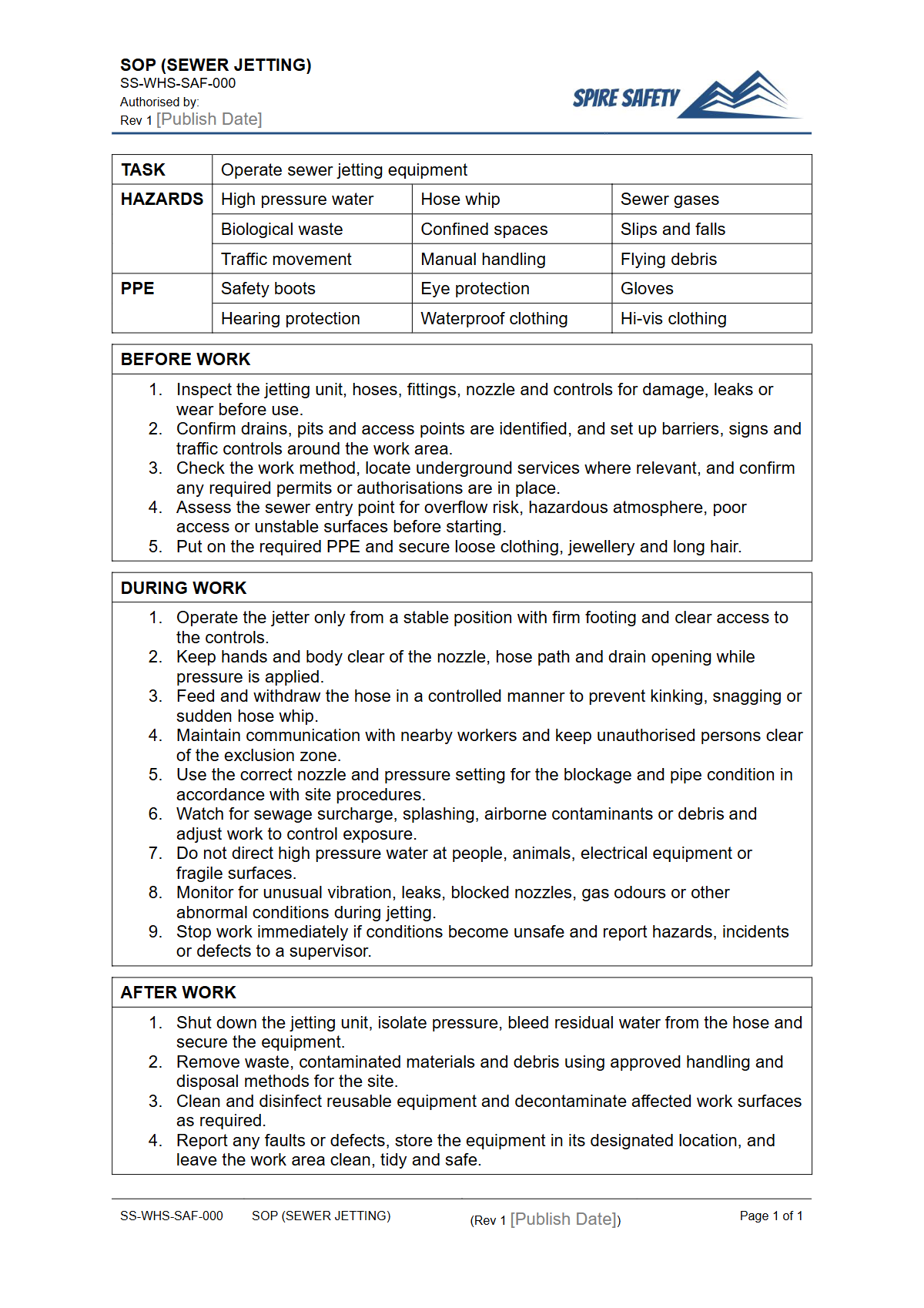
Download our free Safe Operating Procedure for sewer jetting. This customisable template helps you outline hazards and controls for high-pressure water jetting.
Free Safe Operating Procedure (Sewer Jetting) Template
DOCX • 126 KB + PDF
Updated Oct 2026
No signup required
Purpose of the Free Safe Operating Procedure (Sewer Jetting) Template
This Safe Operating Procedure (SOP) template is designed to help you create a formal document outlining the safest way to operate high-pressure sewer jetting equipment. Our free Safe Operating Procedure (Sewer Jetting) Template provides a structured starting point for identifying hazards and implementing control measures specific to your workplace.
Using this resource helps standardise your processes, ensuring every operator understands the risks and required precautions, such as preventing high-pressure injection injuries, managing exposure to biological hazards, and correctly isolating the work area.
A well-developed SOP is a critical component of a compliant safety framework. Integrating specific procedures like this one into broader WHS management systems demonstrates a commitment to proactive risk management and helps fulfil your duties under Australian WHS legislation.
It serves as an essential tool for training, inductions, and ongoing competency assessments for all personnel involved in drain and sewer cleaning operations.
Video walkthrough
How to use the Free Safe Operating Procedure (Sewer Jetting) Template
To get started, simply download the template in your preferred format (DOCX for easy editing or PDF for reference). The document is structured logically, guiding you through the essential components of a comprehensive SOP.
You will need to fill in the details specific to your equipment, work environment, and organisational policies. This includes listing the make and model of your jetter, the specific personal protective equipment (PPE) required, and your unique emergency response contacts.
Please note: We have designed this template as a foundational guide. You must customise it with your site-specific details, equipment models, and in consultation with your team to ensure it is effective for your workplace.
Effective procedures are not created in isolation; they require input from the workers who perform the task every day. Their practical experience is invaluable for identifying unforeseen hazards and workable controls, which may include safety measures for tasks often performed in conjunction with sewer jetting, such as excavation detailed in our FREE Trencher SOP Template.
When should you use a Safe Operating Procedure for Sewer Jetting?
A Safe Operating Procedure for sewer jetting should be developed and implemented before any worker operates the equipment for the first time. It is a foundational document that should be used in several key situations, including worker training and induction, pre-start meetings before a job commences, and as a reference guide during operations.
It forms the benchmark against which performance and compliance can be measured.
Furthermore, the SOP should be a living document, subject to regular review and updates. It should be reviewed whenever a new model of sewer jetter is introduced, if the work environment changes significantly, or after any incident or near-miss occurs.
Scheduling periodic reviews as part of your internal safety program, potentially alongside formal WHS compliance auditing, ensures your procedures remain relevant and effective.
Who should use this template?
This template is intended for use by Persons Conducting a Business or Undertaking (PCBUs), managers, supervisors, and WHS professionals in industries such as plumbing, civil construction, and facilities management. Anyone responsible for the health and safety of workers who operate high-pressure water jetting equipment will find this resource useful.
It provides a clear framework to help you meet your primary duty of care by providing and maintaining a safe system of work.
Key Hazards in Sewer Jetting
Sewer jetting is a high-risk activity with several significant hazards that must be managed. The most severe is high-pressure injection injury, where the water jet penetrates the skin, causing devastating internal damage that may not be immediately apparent.
Other major risks include hose or fitting failure leading to uncontrolled whipping, exposure to infectious biological agents from waste, electric shock if using electrical equipment near water, and noise-induced hearing loss from the engine and pump. If your team faces a combination of complex hazards, seeking external guidance through WHS consulting can provide clarity and ensure your control measures are robust.
What to Include in Your Customised SOP
When customising this template, ensure you address all critical safety elements. Your final document should clearly specify the required PPE, including impact-rated face shields, waterproof gloves, and protective boots.
It must detail a thorough pre-start inspection checklist for the jetter, hoses, and nozzles. The core of the SOP will be the step-by-step operational instructions, covering startup, pressure setting, nozzle insertion, jetting technique, and shutdown.
Crucially, you must also include emergency procedures, detailing the specific first aid response for a high-pressure injection injury and outlining your site's emergency communication plan.
By thoroughly documenting these steps, you create a powerful tool for ensuring safety and consistency. This template is just one of many resources available to help you build a safer workplace.
You can explore our complete free WHS resources library for more templates, checklists, and guides to support your safety management system.
Common mistakes
Common mistakes to avoid
- Using damaged or worn hoses, nozzles, or safety fittings.
- Failing to establish and maintain a proper exclusion zone around the work area.
- Neglecting to wear appropriate and correctly-rated personal protective equipment (PPE).
- Not having a specific first-aid plan for high-pressure injection injuries.
Legal references
Legal considerations
The following legal requirements may be relevant to this type of work.
- Work Health and Safety Act (Harmonised) — Provides the primary duties for protecting workers and other people from work health and safety risks.
- Work Health and Safety Regulations (Harmonised) — Sets out requirements supporting the management of workplace hazards and risks.
The following codes may be relevant to this type of work.
- Managing WHS Risks Code of Practice — Provides practical guidance on identifying hazards, assessing risks and applying effective controls.
- Work Health and Safety Consultation, Cooperation and Coordination Code of Practice — Provides practical guidance on consulting workers and coordinating with other duty holders.
- Managing the Work Environment and Facilities Code of Practice — Provides practical guidance on safe work environments, workplace facilities and related controls.
Did you know
Injection Injury Danger
A high-pressure water jetting injury from equipment operating above 100 bar (1450 psi) is a surgical emergency. The initial wound can look minor, but the fluid can cause severe internal tissue damage and life-threatening infections.
Australian Standard
Australia has a specific standard for this work: AS/NZS 4233.1:2013 'High pressure water jetting systems – Safe operation and maintenance'. It provides detailed guidance for employers and operators.
FAQ
Frequently asked questions
01What are the main hazards of sewer jetting?
02Is a Safe Work Method Statement (SWMS) required for sewer jetting?
03What personal protective equipment (PPE) is needed for sewer jetting?
04How often should a sewer jetting SOP be reviewed?
Share this resource
Free Safe Operating Procedure (Sewer Jetting) Template
Browse Categories
How To Use It
- 1Download and open in Word or PDF.
- 2Replace the placeholders with your business details.
- 3Get it reviewed by a WHS specialist before rollout.
Need it customised?
Our WHS consultants can adapt this template to your site, run a gap analysis, or audit what you already have in place.
Book a Free Consultation WHS consulting servicesor call 1300 156 382
Related templates
- Free Safe Operating Procedure (Sewer Overflow Cleanup) Template
- Free Safe Operating Procedure (Sewer Spill Response) Template
- Free Safe Operating Procedure (Sewer Vent Inspection) Template
- Free Safe Operating Procedure (Shackle Use) Template
- Free Safe Operating Procedure (Shade Cloth Installation) Template
- Free Safe Operating Procedure (Shale Shaker) Template