
Free Safe Operating Procedure (Sewer Vent Inspection) Template
Download our free Safe Operating Procedure for sewer vent inspections. This template provides a structured starting point for documenting your safety processes.
Free Safe Operating Procedure (Sewer Vent Inspection) Template
DOCX • 126 KB + PDF
Updated Oct 2026
No signup required
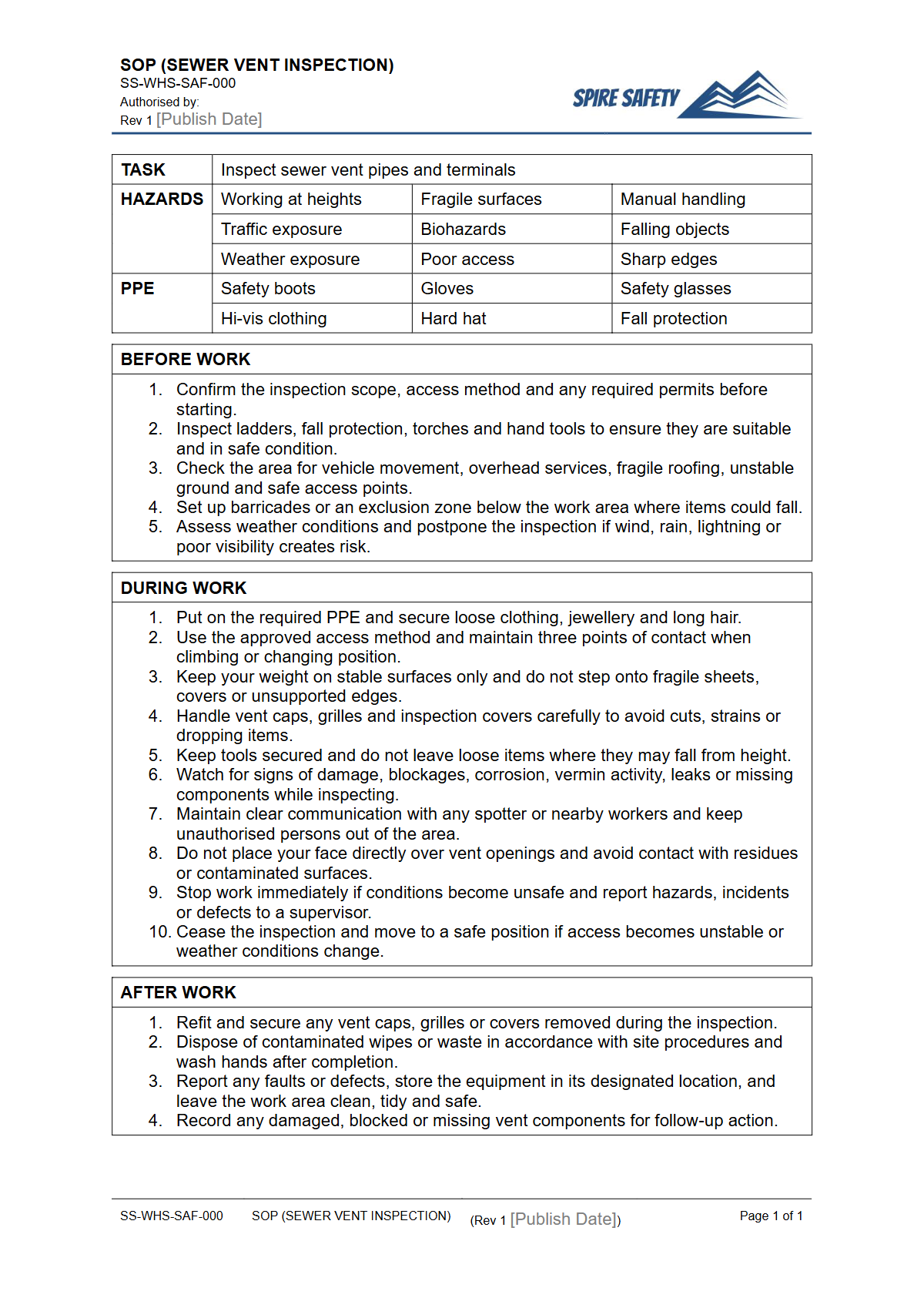
Purpose of the Free Safe Operating Procedure (Sewer Vent Inspection) Template
This Safe Operating Procedure (SOP) template provides a framework for documenting the steps and safety controls required for sewer vent inspections. Sewer vent inspection is a critical maintenance task that presents numerous hazards, including working at heights, exposure to biological agents, potential for hazardous atmospheres, and manual handling.
Using a structured SOP helps a Person Conducting a Business or Undertaking (PCBU) fulfil their primary duty of care by ensuring work is planned and executed safely, consistently, and in line with risk management principles.
A documented procedure ensures that all workers, from new trainees to experienced technicians, follow the same safety-verified steps. This reduces the likelihood of incidents, standardises training, and demonstrates a proactive approach to workplace health and safety.
Implementing this SOP helps your organisation manage risks, protect workers, and maintain the integrity of plumbing and drainage systems. This document serves as a crucial component within your broader WHS management systems, linking operational tasks directly to safety protocols.
Video walkthrough
How to use the Free Safe Operating Procedure (Sewer Vent Inspection) Template
Our Free Safe Operating Procedure (Sewer Vent Inspection) Template is provided as a starting point. It is not a complete, ready-to-use document.
To use it effectively, you must download the DOCX file and adapt it to the specific context of your workplace. This involves detailing your site's specific equipment, environmental conditions, and organisational safety rules.
Be sure to conduct a thorough risk assessment for the task and incorporate the identified control measures directly into the procedure.
Important: We have provided a comprehensive, but generic, template. You must customise this document with your own site-specific details, including machinery, PPE, and emergency procedures.
Finalise the document in consultation with the workers who will be performing the task to ensure it is practical and reflects how the work is actually done. Once customised, it can be saved as a PDF for controlled distribution and inclusion in training packages.
When to use this Safe Operating Procedure
This SOP should be used as the primary reference document for all sewer vent inspection activities. It is essential in several key situations:
- Before work commences: Workers must read and understand the SOP before starting any inspection task.
- Induction and training: Use the SOP as a core training tool for new employees or workers unfamiliar with the procedure.
- Refresher training: Periodically review the SOP with all relevant personnel to reinforce safe work practices.
- After an incident or near-miss: The SOP should be reviewed and updated as part of any incident investigation to prevent recurrence.
- During safety audits: The procedure serves as evidence of a formalised system of work during internal or external audits, such as a WHS compliance auditing process.
For related groundwork tasks that may occur alongside vent maintenance, such as clearing access paths, you might also require procedures for other equipment. Consider adapting our free Trencher SOP Template if any excavation is involved.
Who should use this Safe Operating Procedure
This document is intended for use by anyone involved in the lifecycle of sewer vent inspection tasks. The primary users include:
- Workers and Technicians: The personnel who physically perform the inspections. They rely on the SOP for step-by-step guidance on how to complete the job safely.
- Supervisors and Team Leaders: Responsible for ensuring their teams are trained on and adhere to the SOP. They use it to monitor work and conduct pre-start briefings.
- WHS Managers and Advisors: These professionals develop, review, and approve the SOP, ensuring it aligns with Australian WHS legislation and the organisation's safety management system.
- Maintenance Planners and Schedulers: Use the SOP to understand the time, equipment, and personnel requirements for safely planning the work.
Documenting procedures is a key element of safety management. You can find more examples of task-based safety documents in our free WHS resources library for other common workplace activities.
Common mistakes
Common mistakes to avoid
- Failing to conduct a pre-work risk assessment, especially for working at heights.
- Using a generic template without customising it for site-specific access points, equipment, and PPE requirements.
- Not providing adequate training on the finalised SOP, assuming workers will just 'read and understand' it.
- Neglecting to check atmospheric conditions where there is a risk of gas accumulation.
Legal references
Legal considerations
The following legal requirements may be relevant to this type of work.
- Work Health and Safety Act (Harmonised) — Provides the primary duties for protecting workers and other people from work health and safety risks.
- Work Health and Safety Regulations (Harmonised) — Sets out requirements supporting the management of workplace hazards and risks.
The following codes may be relevant to this type of work.
- Managing WHS Risks Code of Practice — Provides practical guidance on identifying hazards, assessing risks and applying effective controls.
- Work Health and Safety Consultation, Cooperation and Coordination Code of Practice — Provides practical guidance on consulting workers and coordinating with other duty holders.
- Managing the Work Environment and Facilities Code of Practice — Provides practical guidance on safe work environments, workplace facilities and related controls.
Did you know
Invisible Dangers
Sewer gas is not a single gas but a complex mixture that can include flammable and toxic components like hydrogen sulphide, ammonia, and methane, which are often undetectable by smell at dangerous concentrations.
Pressure Points
A primary function of a sewer vent is to allow air to enter the drainage system, which prevents a vacuum from forming and enables waste to flow freely while also venting dangerous gases safely above ground level.
FAQ
Frequently asked questions
01What are the main hazards in sewer vent inspection?
02Is a Safe Operating Procedure a legal requirement?
03How often should a Sewer Vent Inspection SOP be reviewed?
04What is the difference between an SOP and a SWMS?
Share this resource
Free Safe Operating Procedure (Sewer Vent Inspection) Template
Browse Categories
How To Use It
- 1Download and open in Word or PDF.
- 2Replace the placeholders with your business details.
- 3Get it reviewed by a WHS specialist before rollout.
Need it customised?
Our WHS consultants can adapt this template to your site, run a gap analysis, or audit what you already have in place.
Book a Free Consultation WHS consulting servicesor call 1300 156 382
Related templates
- Free Safe Operating Procedure (Shackle Use) Template
- Free Safe Operating Procedure (Shade Cloth Installation) Template
- Free Safe Operating Procedure (Shale Shaker) Template
- Free Safe Operating Procedure (Sharps Disposal) Template
- Free Safe Operating Procedure (Shearing Machine) Template
- Free Safe Operating Procedure (Sheep Crutching Stand) Template