
Free Safe Operating Procedure (Shade Cloth Installation) Template
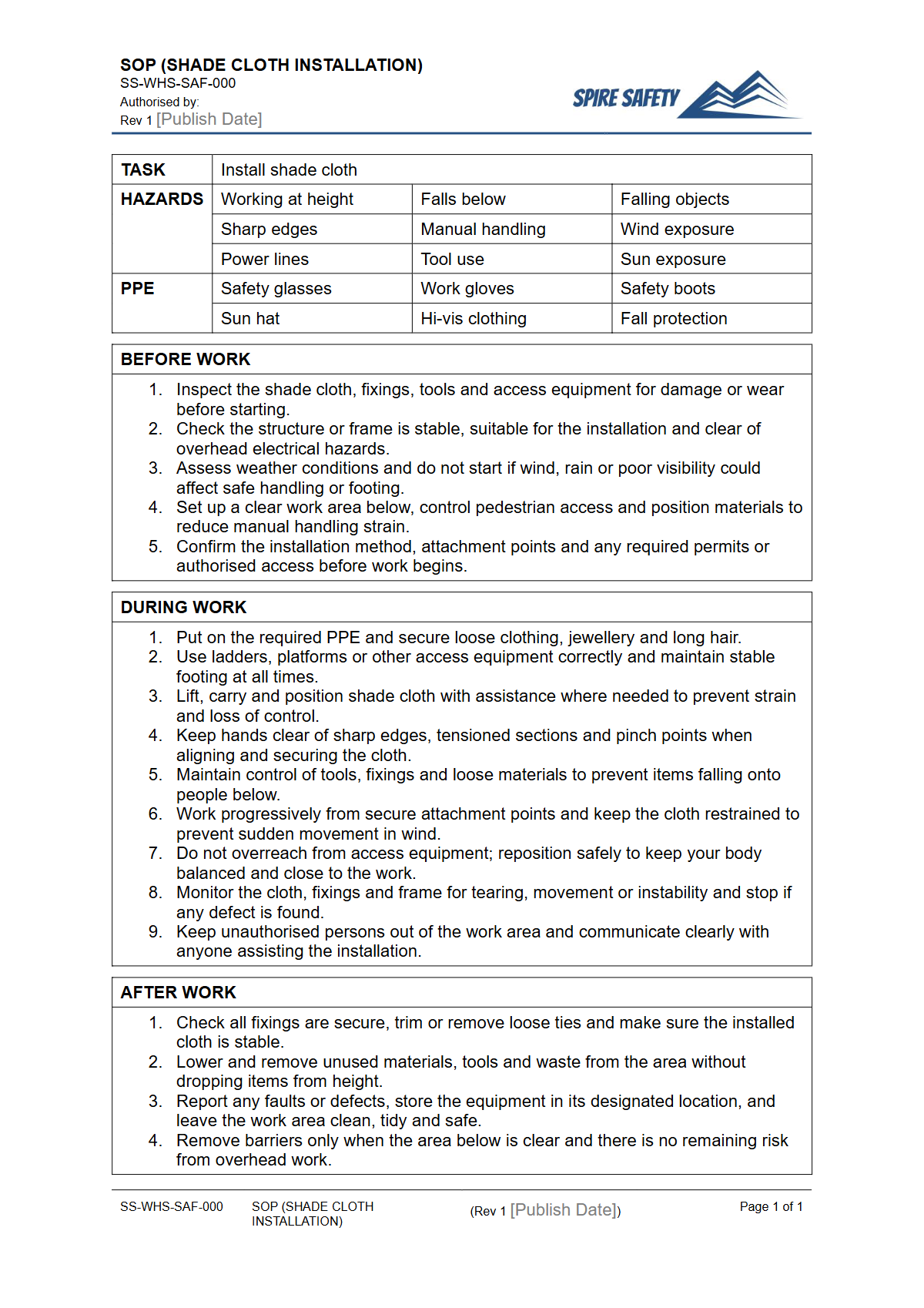
Download our free Safe Operating Procedure for shade cloth installation. This customisable template helps you outline step-by-step safety controls.
Free Safe Operating Procedure (Shade Cloth Installation) Template
DOCX • 126 KB + PDF
Updated Oct 2026
No signup required
Purpose of the Free Safe Operating Procedure (Shade Cloth Installation) Template
The primary purpose of this Safe Operating Procedure (SOP) is to provide a clear, step-by-step guide for safely installing shade cloth. It helps workers and supervisors identify potential hazards and implement effective control measures before and during the task.
Key risks addressed include working at heights, manual handling of large or heavy materials, exposure to environmental factors like sun and wind, and the structural integrity of posts and anchor points. By standardising the procedure, you can ensure a consistent and safe approach across all projects, reducing the likelihood of incidents. For complex lifts of materials or posts to elevated positions, you may also need task-specific procedures, such as those detailed in a Telehandler SOP template.
Video walkthrough
How to use the Free Safe Operating Procedure (Shade Cloth Installation) Template
This document is a template and must be adapted to the specific context of your workplace. To use it effectively, download the DOCX file and systematically work through each section.
You should consult with your team—the people actually doing the work—to ensure the steps reflect your real-world processes, equipment, and site conditions. Add or remove steps, detail the specific tools used, and list the names or positions of responsible personnel. Remember, a generic document offers little protection; we've provided the structure, but you must add the site-specific detail to make it a meaningful part of your WHS management systems.
When to use it
A Safe Operating Procedure for shade cloth installation should be used as a key planning and training tool. It should be reviewed before any installation project begins, especially during pre-start meetings or toolbox talks, to ensure everyone understands the process and associated risks.
It is also an essential document for inducting new workers or contractors who may be unfamiliar with your specific safety requirements. The SOP serves as a reference point on-site if any questions about the correct procedure arise during the work.
Who should use it
This template is designed for use by a range of personnel involved in construction, landscaping, agriculture, and property maintenance. Site Supervisors and Project Managers can use it to plan work, allocate resources, and ensure safety standards are met.
Workers and installation teams should use it as their primary guide for performing the task safely. WHS Managers and Safety Officers can integrate this procedure into the organisation's overall safety framework, using it for training, inspections, and incident investigations.
For businesses needing assistance tailoring and implementing such procedures, our WHS consulting services can provide expert guidance.
Key Elements of the Shade Cloth Installation SOP
Our template is structured to guide you through the entire installation lifecycle, prompting you to consider safety at each stage. It encourages a systematic approach to risk management.
- Pre-Operational Checks: Includes verifying the structural adequacy of anchor points, inspecting all tools and equipment (like tensioners and ladders), and assessing weather conditions, particularly wind speed.
- Site Preparation: Covers critical steps like cordoning off the work area to prevent unauthorised access and checking for underground utilities before any excavation. For tasks involving post hole creation, you may also need a procedure like our free Trencher SOP.
- Step-by-Step Installation Guide: A detailed sequence for safely unrolling, positioning, lifting, and attaching the shade cloth. This section should be customised to match the specific type of cloth and fixing system being used.
- Emergency Procedures: Outlines immediate actions to take in case of an incident, such as a fall from height, equipment failure, or sudden extreme weather.
The effectiveness of your safety procedures should be periodically verified. Incorporating them into a program of regular WHS compliance auditing ensures they remain current and are being followed correctly in practice.
Once you have tailored this SOP for your needs, you can explore other relevant documents in our free WHS resources library to build out your safety management system.
Common mistakes
Common mistakes to avoid
- Underestimating wind loads and using inadequate footings or anchor points.
- Failing to use correct fall prevention equipment, like EWPs or scaffolds, when working at height.
- Neglecting to check for underground services (e.g., pipes, cables) before excavating for posts.
- Improperly tensioning the cloth, which can cause flapping that leads to premature wear and failure.
Legal references
Legal considerations
The following legal requirements may be relevant to this type of work.
- Work Health and Safety Act (Harmonised) — Provides the primary duties for protecting workers and other people from work health and safety risks.
- Work Health and Safety Regulations (Harmonised) — Sets out requirements supporting the management of workplace hazards and risks.
The following codes may be relevant to this type of work.
- Managing WHS Risks Code of Practice — Provides practical guidance on identifying hazards, assessing risks and applying effective controls.
- Work Health and Safety Consultation, Cooperation and Coordination Code of Practice — Provides practical guidance on consulting workers and coordinating with other duty holders.
- Managing the Work Environment and Facilities Code of Practice — Provides practical guidance on safe work environments, workplace facilities and related controls.
Did you know
Wind Load Forces
A large shade sail can generate thousands of kilograms of force on its anchor points during strong winds. This is why professional engineering assessment of footings and support structures is not just best practice, but critical for preventing catastrophic failure.
UV Degradation
The thread used to stitch shade cloth seams is often the first point of failure. It can degrade under UV exposure faster than the cloth itself, so regular inspections of all stitching, especially on older installations, is vital.
FAQ
Frequently asked questions
01Is a SWMS required for installing shade cloth?
02What is the biggest hazard when installing shade cloth?
03What kind of PPE should be worn for shade cloth installation?
04How often should a Safe Operating Procedure be reviewed?
Share this resource
Free Safe Operating Procedure (Shade Cloth Installation) Template
Browse Categories
How To Use It
- 1Download and open in Word or PDF.
- 2Replace the placeholders with your business details.
- 3Get it reviewed by a WHS specialist before rollout.
Need it customised?
Our WHS consultants can adapt this template to your site, run a gap analysis, or audit what you already have in place.
Book a Free Consultation WHS consulting servicesor call 1300 156 382
Related templates
- Free Safe Operating Procedure (Shale Shaker) Template
- Free Safe Operating Procedure (Sharps Disposal) Template
- Free Safe Operating Procedure (Shearing Machine) Template
- Free Safe Operating Procedure (Sheep Crutching Stand) Template
- Free Safe Operating Procedure (Sheep Drafting) Template
- Free Safe Operating Procedure (Sheep Feeding) Template