
Free Safe Operating Procedure (Shearing Machine) Template
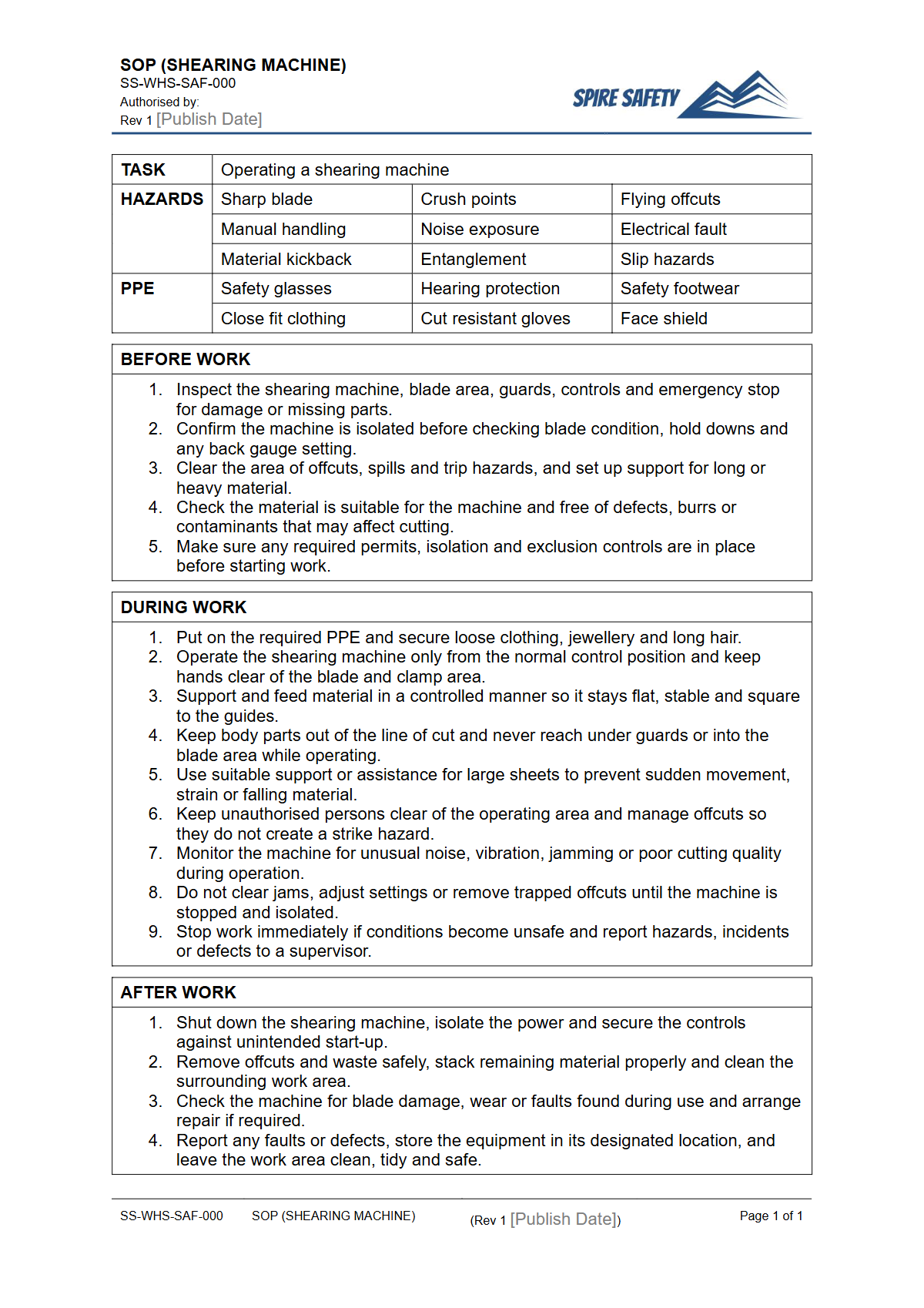
Download our free Safe Operating Procedure (SOP) template for shearing machines. This customisable document helps you outline key safety steps for your team.
Free Safe Operating Procedure (Shearing Machine) Template
DOCX • 126 KB + PDF
Updated Oct 2026
No signup required
Purpose of the Free Safe Operating Procedure (Shearing Machine) Template
Operating a shearing machine, often called a guillotine, presents significant risks, including amputation, crushing, and severe lacerations. A documented system of work is essential for managing these hazards effectively.
This Free Safe Operating Procedure (Shearing Machine) Template provides a structured starting point for your organisation to formalise its safety protocols. It is designed to help you detail the step-by-step process for safe operation, identify potential hazards, and specify the necessary control measures to protect your workers.
Using this template helps ensure that everyone who interacts with the shearing machine understands the required safety precautions, from pre-start checks to shutdown and maintenance. It is developed as a comprehensive guide aligned with Australian model WHS principles, promoting a consistent and safe approach to high-risk tasks.
Formalising your procedures also demonstrates a commitment to meeting your primary duty of care as a Person Conducting a Business or Undertaking (PCBU).
Video walkthrough
How to use the Free Safe Operating Procedure (Shearing Machine) Template
This document is available for immediate download as a DOCX file, allowing for full customisation, and as a PDF for easy distribution. To use it effectively, you must adapt its contents to the specific context of your workplace.
Every shearing machine model has unique features, and every work environment has a different layout and process flow.
Note: This template provides a framework, not a finished document. To be effective, we require that you customise it with your site-specific information, including machine make and model, specific hazards identified in your risk assessment, and your organisation's emergency procedures.
Just as you would tailor our free Injection Molding Machine SOP for a specific press, this document requires your input to be truly useful.
Key Customisation Steps:
- Review and Edit: Go through each section and replace the placeholder text with details relevant to your shearing machine.
- Consult with Workers: Involve the operators and maintenance personnel who use the machine daily. Their input is invaluable for creating a practical and effective procedure.
- Incorporate Risk Assessments: Ensure the SOP reflects the findings of your WHS consulting and risk assessment processes, particularly regarding required Personal Protective Equipment (PPE) and control measures like guarding and light curtains.
- Add Visuals: Insert photos of your actual machine, highlighting key components like the emergency stop, guards, and control panel.
When to use a Safe Operating Procedure
A Safe Operating Procedure (SOP) for a shearing machine is not just a document to be filed away. It is an active tool that should be integrated into your daily operations and safety management framework.
Consistent use is crucial for reinforcing safe work habits and minimising risk.
An SOP should be used during:
- New Worker Induction and Training: As a core training document for new operators.
- Refresher Training: For periodic review with experienced operators to prevent complacency.
- Pre-Operational Checks: As a checklist before starting the machine for a shift.
- Supervision and Monitoring: By supervisors to ensure the correct procedure is being followed.
- Incident Investigations: To determine if procedural deviations contributed to a near miss or injury.
Well-maintained SOPs are a fundamental part of effective WHS management systems, providing a clear and auditable reference for how high-risk tasks are to be performed safely.
Who should use this Safe Operating Procedure
This SOP is intended for all personnel who may interact with the shearing machine. Different roles will use the document for different purposes, contributing to a holistic safety culture.
- Machine Operators: To guide their work and ensure they follow all safety steps from setup to cleanup.
- Supervisors and Managers: To train staff, conduct competency assessments, and monitor compliance with safe work practices.
- Maintenance Personnel: To understand the correct isolation, lockout/tagout (LOTO), and shutdown procedures before performing maintenance or repairs. This is especially critical for tasks involving blade changes or adjustments.
- WHS Officers and Auditors: As a benchmark document when conducting workplace inspections and safety audits. A thorough WHS compliance audit will often review SOPs against actual work practices to identify any gaps.
Essentially, anyone whose role requires them to work on or near a shearing machine must be trained on the contents of the finalised SOP and have easy access to it. This also applies to other high-risk plant, where the principles of guarding and isolation are just as critical, such as those covered in our Conveyer System SOP.
Common mistakes
Common mistakes to avoid
- Using a generic template without customising it for the specific machine and workplace.
- Failing to include a detailed, machine-specific lockout/tagout (LOTO) procedure for cleaning and maintenance.
- Neglecting to train all operators on the SOP and verify their competency before authorising them to use the machine.
- Not reviewing or updating the SOP after a near miss, incident, or change in the work process.
Legal references
Legal considerations
The following legal requirements may be relevant to this type of work.
- Work Health and Safety Act (Harmonised) — Provides the primary duties for protecting workers and other people from work health and safety risks.
- Work Health and Safety Regulations (Harmonised) — Sets out requirements supporting the management of workplace hazards and risks.
The following codes may be relevant to this type of work.
- Managing WHS Risks Code of Practice — Provides practical guidance on identifying hazards, assessing risks and applying effective controls.
- Work Health and Safety Consultation, Cooperation and Coordination Code of Practice — Provides practical guidance on consulting workers and coordinating with other duty holders.
- Managing the Work Environment and Facilities Code of Practice — Provides practical guidance on safe work environments, workplace facilities and related controls.
Did you know
Shearing Force
A typical industrial metal shear can exert hundreds of tonnes of force to cut through thick steel plate. This immense power is why robust guarding and safe distances are non-negotiable safety requirements.
Point of Operation
The 'point of operation'—where the blade meets the material—is the most dangerous part of a shearing machine. Australian safety standards mandate that this area must be guarded to prevent any part of a worker's body from entering the hazard zone.
FAQ
Frequently asked questions
01What is a Safe Operating Procedure for a shearing machine?
02Is this shearing machine SOP template compliant with Australian WHS law?
03Who is responsible for writing a shearing machine SOP?
04How often should a Safe Operating Procedure be reviewed?
Share this resource
Free Safe Operating Procedure (Shearing Machine) Template
Browse Categories
How To Use It
- 1Download and open in Word or PDF.
- 2Replace the placeholders with your business details.
- 3Get it reviewed by a WHS specialist before rollout.
Need it customised?
Our WHS consultants can adapt this template to your site, run a gap analysis, or audit what you already have in place.
Book a Free Consultation WHS consulting servicesor call 1300 156 382
Related templates
- Free Safe Operating Procedure (Sheep Crutching Stand) Template
- Free Safe Operating Procedure (Sheep Drafting) Template
- Free Safe Operating Procedure (Sheep Feeding) Template
- Free Safe Operating Procedure (Sheep Footbath) Template
- Free Safe Operating Procedure (Sheep Loading) Template
- Free Safe Operating Procedure (Sheep Weighing) Template