
Free Safe Operating Procedure (Sheep Feeding) Template
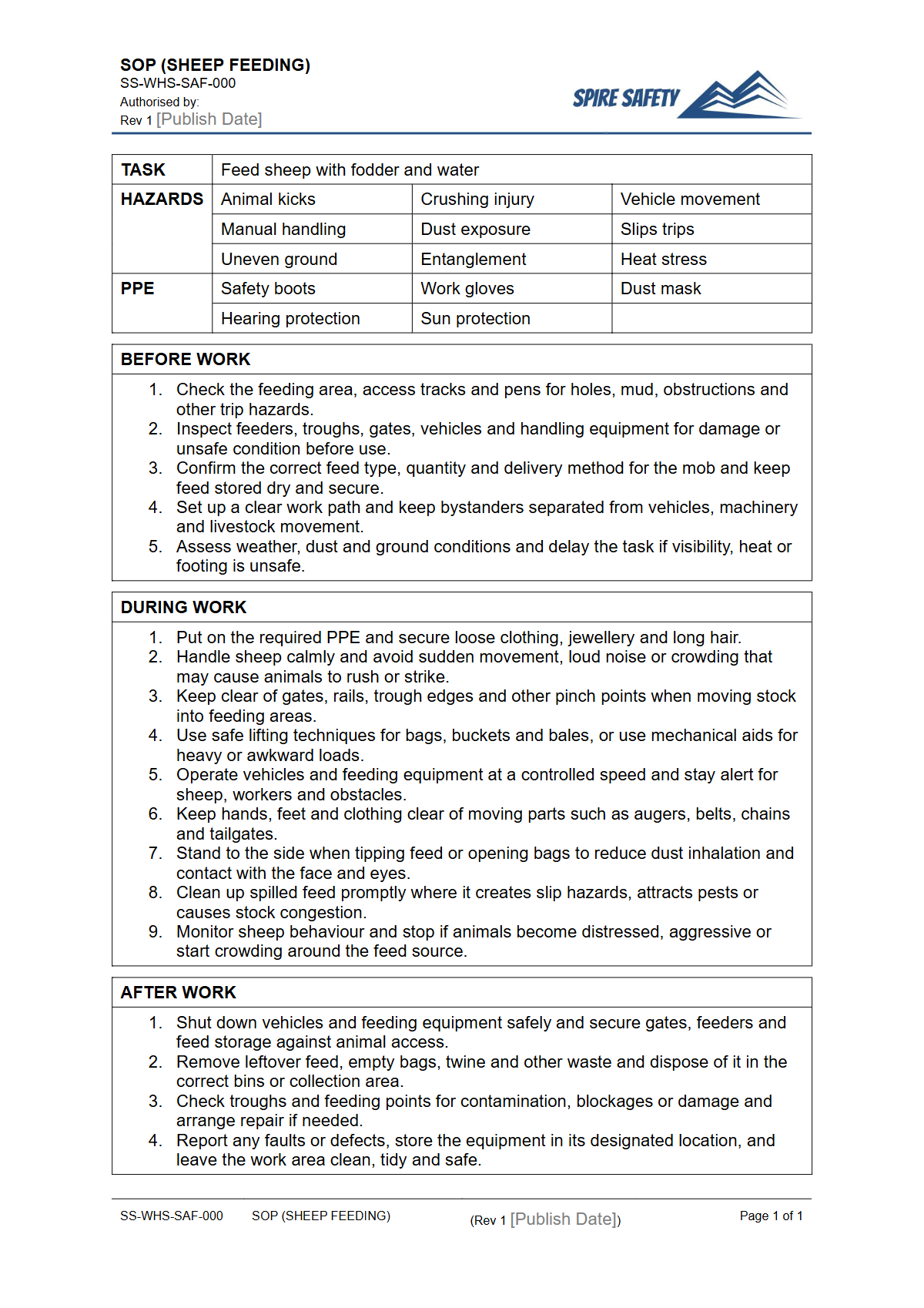
Formalise your farm's safety processes with our Safe Operating Procedure for sheep feeding. Download this free, customisable template to get started.
Free Safe Operating Procedure (Sheep Feeding) Template
DOCX • 126 KB + PDF
Updated Oct 2026
No signup required
Purpose of the Free Safe Operating Procedure (Sheep Feeding) Template
Feeding sheep involves interacting with livestock, potentially operating machinery, and handling feed materials, all of which present unique workplace health and safety risks. This Free Safe Operating Procedure (Sheep Feeding) Template provides a structured framework for documenting the safest, most efficient method for completing the task.
Using this SOP helps your agricultural business to manage hazards, standardise training, and demonstrate a commitment to safety. It serves as a vital component of your overall WHS management systems, ensuring that all workers understand and follow established safety protocols.
Video walkthrough
How to use the Free Safe Operating Procedure (Sheep Feeding) Template
This template is designed as a comprehensive starting point. To make it effective, you must customise it to reflect the specific equipment, environment, and processes at your worksite.
Download the DOCX file and walk through each section, consulting with workers who perform the task. Add details about your specific machinery (e.g., augers, tractors, feed-out wagons), the types of feed used, and the layout of your yards and paddocks. For related tasks, you might also benefit from reviewing procedures for other equipment, such as our free Grain Drill SOP.
Important: This is a template only. We are not WHS consultants, and this document does not constitute legal advice.
You must adapt this Safe Operating Procedure to the unique risks and operational context of your business and worksite. You are responsible for ensuring your final document is accurate, comprehensive, and implemented effectively.
When to use a Safe Operating Procedure
A Safe Operating Procedure for sheep feeding should be used consistently for all feeding activities, whether routine or infrequent. It is an essential tool for inducting new farm workers or contractors, providing a clear, step-by-step guide to performing the job safely.
It should also be used as a reference for refresher training and be readily accessible near the work area. Integrating this SOP into your daily pre-start checks ensures safety remains a priority. The principles here can also be adapted for other mobile plant, such as those covered in our free Spreader SOP template.
Who should use this Safe Operating Procedure
This SOP should be used by anyone involved in the sheep feeding process. This includes:
- Farm Workers and Station Hands: The primary users who perform the task and must follow the procedure to ensure their own safety and the safety of others.
- Supervisors and Farm Managers: Responsible for training workers, enforcing the procedure, and conducting reviews to ensure the SOP remains current and effective.
- Owners and Persons Conducting a Business or Undertaking (PCBUs): Accountable for providing a safe system of work and ensuring resources like this SOP are developed, implemented, and maintained.
By involving all levels of your organisation, you create a stronger safety culture. Clear procedures are especially critical when heavy machinery is involved, a principle that also applies to equipment like that detailed in our Telehandler SOP.
A well-drafted SOP is a practical tool for risk management. For businesses looking for expert guidance in developing comprehensive safety documentation, Spire Safety offers professional WHS consulting services to help you meet your obligations.
You can also explore our complete free WHS resources library for more templates and guides.
Common mistakes
Common mistakes to avoid
- Failing to consult with the workers who actually perform the task when drafting the procedure.
- Making the SOP too generic and not specific to the machinery, feed types, and site layout.
- Neglecting to provide proper training on the finalised SOP to all relevant workers.
- Not reviewing or updating the SOP after an incident or when a process changes.
Legal references
Legal considerations
The following legal requirements may be relevant to this type of work.
- Work Health and Safety Act (Harmonised) — Provides the primary duties for protecting workers and other people from work health and safety risks.
- Work Health and Safety Regulations (Harmonised) — Sets out requirements supporting the management of workplace hazards and risks.
The following codes may be relevant to this type of work.
- Managing WHS Risks Code of Practice — Provides practical guidance on identifying hazards, assessing risks and applying effective controls.
- Work Health and Safety Consultation, Cooperation and Coordination Code of Practice — Provides practical guidance on consulting workers and coordinating with other duty holders.
- Managing the Work Environment and Facilities Code of Practice — Provides practical guidance on safe work environments, workplace facilities and related controls.
Did you know
Farm Safety Statistics
The agriculture, forestry, and fishing industry consistently has one of the highest rates of worker fatalities in Australia. Tractors are the leading cause of farm-related deaths, highlighting the critical need for documented safety procedures around machinery.
FAQ
Frequently asked questions
01What are the main hazards involved in sheep feeding?
02Is a Safe Operating Procedure legally required for feeding sheep in Australia?
03How often should a sheep feeding SOP be reviewed?
04Can this sheep feeding SOP template be used for other livestock like cattle?
Share this resource
Free Safe Operating Procedure (Sheep Feeding) Template
Browse Categories
How To Use It
- 1Download and open in Word or PDF.
- 2Replace the placeholders with your business details.
- 3Get it reviewed by a WHS specialist before rollout.
Need it customised?
Our WHS consultants can adapt this template to your site, run a gap analysis, or audit what you already have in place.
Book a Free Consultation WHS consulting servicesor call 1300 156 382
Related templates
- Free Safe Operating Procedure (Sheep Footbath) Template
- Free Safe Operating Procedure (Sheep Loading) Template
- Free Safe Operating Procedure (Sheep Weighing) Template
- Free Safe Operating Procedure (Sheet Metal Brake) Template
- Free Safe Operating Procedure (Sheet Metal Roller) Template
- Free Safe Operating Procedure (Sheet Pile Driver) Template