
Free Safe Operating Procedure (Sheet Metal Roller) Template
Get a head start on managing workshop risks with our structured Safe Operating Procedure for sheet metal rollers. Download your free template today.
Free Safe Operating Procedure (Sheet Metal Roller) Template
DOCX • 126 KB + PDF
Updated Oct 2026
No signup required
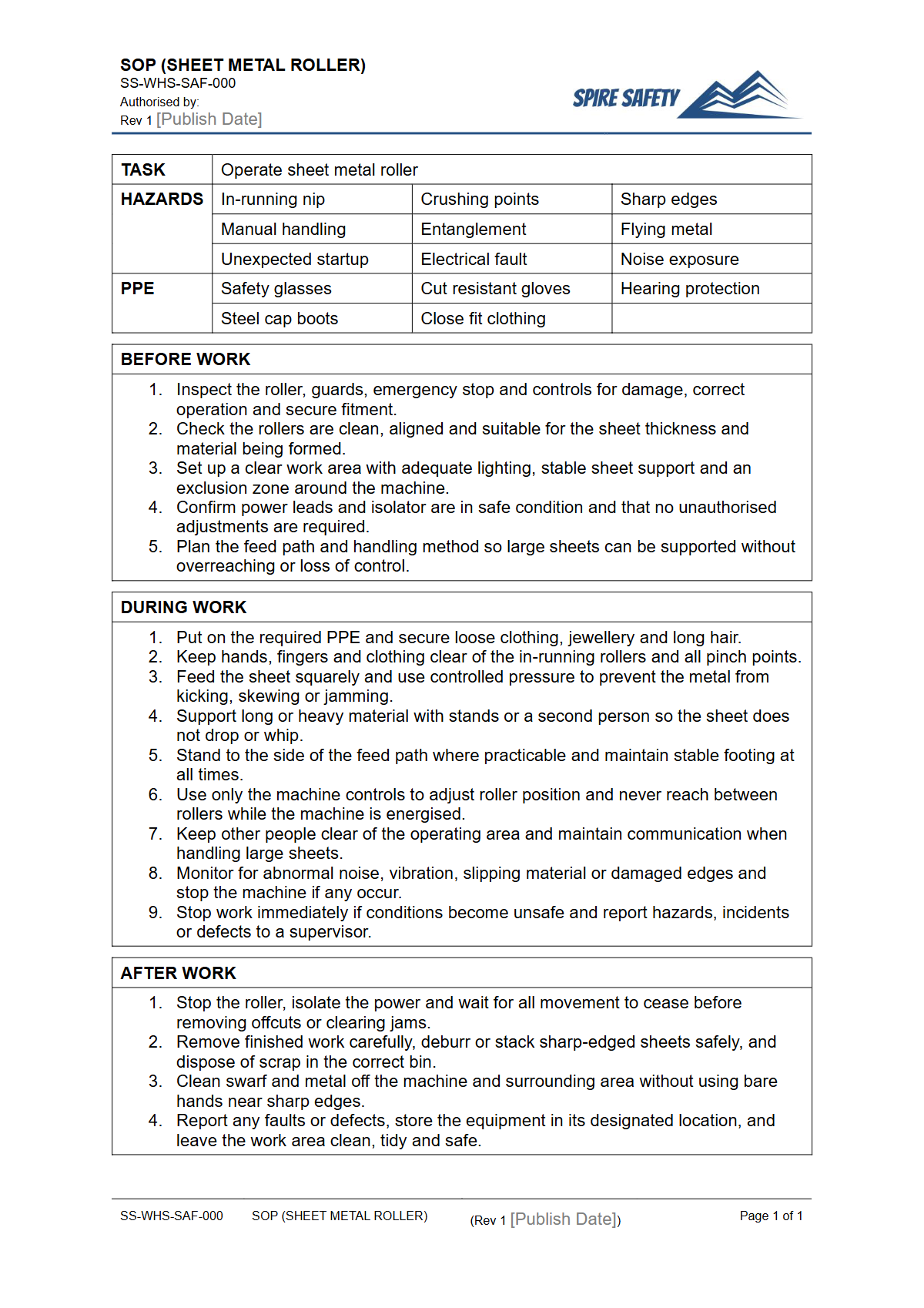
Purpose of the Free Safe Operating Procedure (Sheet Metal Roller) Template
Operating a sheet metal roller presents significant workplace hazards, primarily related to entanglement, crushing, and pinch points. This Free Safe Operating Procedure (Sheet Metal Roller) Template provides a structured framework for documenting the required safety controls and operational steps for this machinery.
Using a formalised SOP helps your organisation demonstrate its commitment to safety, standardise training, and provide clear, unambiguous instructions to operators.
A well-developed SOP is a critical administrative control measure and a fundamental component of effective WHS management systems. It serves as evidence that risks have been considered and that control measures have been communicated to workers. This template is designed as a starting point, aligned with Australian WHS principles, to help you create a site-specific document that protects your team.
Video walkthrough
How to use the Free Safe Operating Procedure (Sheet Metal Roller) Template
This resource is available for immediate download in both DOCX and PDF formats. The DOCX version is fully editable, allowing you to tailor the content to your specific operational context.
We recommend customising the document to include details such as the specific make and model of your sheet metal roller, the types of materials being processed, and any unique environmental factors in your workshop.
Important Note: This document is a template, not a finished product. We cannot know the specific hazards present in your workplace.
It is your responsibility to conduct a thorough risk assessment for the task and equipment, and to modify this Safe Operating Procedure to reflect your findings and establish a safe system of work. If you need assistance, our WHS consulting services can provide expert guidance.
The process of customisation should involve consultation with the workers who actually operate the equipment. Their hands-on experience is invaluable for identifying practical risks and effective control measures.
This collaborative approach also fosters a stronger safety culture and improves worker buy-in. While you're refining your workshop procedures, you might also find our air compressor SOP useful for other common equipment.
When to use a Sheet Metal Roller SOP
A Safe Operating Procedure for a sheet metal roller should be integrated into your daily operations. It is not a document to be filed away and forgotten. It should be used:
- During training and induction: Every new operator must be trained on the contents of the SOP before they are authorised to use the machine.
- For refresher training: Regular reviews of the SOP with existing staff help reinforce safe work habits and communicate any updates to the procedure.
- Before starting work: Operators should use the SOP as a checklist, particularly for pre-operational inspections, to ensure the machine is safe to use.
- After an incident or near-miss: The SOP should be a key document in any incident investigation to determine if the procedure was followed and if it needs revision.
Developing SOPs for all workshop equipment creates a consistent approach to safety. For example, the principles of pre-start checks and identifying no-go zones are just as relevant for a circular saw SOP as they are for a sheet metal roller.
The SOP can also serve as a foundational document when developing a Safe Work Method Statement (SWMS) if the task is identified as high-risk construction work. While an SOP details how to perform a task safely, a SWMS is a more rigorous document that details how high risks will be controlled.
The hazard identification within an SOP for equipment with powerful moving parts, similar to the risks outlined in a conveyer system SOP, is a crucial first step for any higher-level risk assessment.
Who should use this Safe Operating Procedure
Multiple roles within an organisation have a responsibility to use and enforce the Safe Operating Procedure:
- Persons Conducting a Business or Undertaking (PCBUs): Have the primary duty of care to ensure, so far as is reasonably practicable, the health and safety of workers. Providing and maintaining safe systems of work, like SOPs, is a key part of fulfilling this duty.
- Managers and Supervisors: Are responsible for implementing the SOP on the ground. This includes providing training, ensuring operators are competent, supervising work, and enforcing the documented safety rules.
- WHS Advisors and Professionals: Use the SOP as part of the overall safety management system, assisting with its development, review, and integration with other processes like risk assessments and incident investigations.
- Workers/Operators: Must follow the instructions outlined in the SOP, participate in training, wear the required PPE, and report any hazards or equipment faults immediately.
To ensure these procedures remain effective and are consistently applied, many organisations incorporate them into their internal audit schedule. Regular WHS compliance audits can verify that SOPs are current, understood by staff, and followed in practice, identifying any gaps before they lead to an incident.
This Safe Operating Procedure is one of many tools designed to make Australian workplaces safer. Feel free to explore our library of free WHS resources for more templates and guides covering a wide range of tasks and equipment.
Common mistakes
Common mistakes to avoid
- Using a generic template without customising it for the specific make and model of the roller.
- Failing to enforce rules against wearing loose clothing, gloves, or jewellery near the machine.
- Neglecting to train workers on emergency stop procedures and lockout/tagout (LOTO) protocols.
- Skipping pre-operational safety checks, such as verifying that guards are in place and functional.
Legal references
Legal considerations
The following legal requirements may be relevant to this type of work.
- Work Health and Safety Act (Harmonised) — Provides the primary duties for protecting workers and other people from work health and safety risks.
- Work Health and Safety Regulations (Harmonised) — Sets out requirements supporting the management of workplace hazards and risks.
The following codes may be relevant to this type of work.
- Managing WHS Risks Code of Practice — Provides practical guidance on identifying hazards, assessing risks and applying effective controls.
- Work Health and Safety Consultation, Cooperation and Coordination Code of Practice — Provides practical guidance on consulting workers and coordinating with other duty holders.
- Managing the Work Environment and Facilities Code of Practice — Provides practical guidance on safe work environments, workplace facilities and related controls.
Did you know
The Danger Zone
The area within three metres of a sheet metal roller is often considered a "danger zone" where only the authorised operator should be present during operation to prevent accidental entanglement.
Pinch Point Force
The rollers on industrial sheet metal rolling machines can exert thousands of kilograms of force, capable of crushing materials—and human limbs—with ease. This is why loose clothing, long hair, and jewellery are strictly forbidden.
FAQ
Frequently asked questions
01What must be included in a Safe Operating Procedure for a sheet metal roller?
02Is a Safe Operating Procedure (SOP) the same as a Safe Work Method Statement (SWMS)?
03How often should we review our sheet metal roller SOP?
04Who is responsible for training workers on the sheet metal roller SOP?
Share this resource
Free Safe Operating Procedure (Sheet Metal Roller) Template
Browse Categories
How To Use It
- 1Download and open in Word or PDF.
- 2Replace the placeholders with your business details.
- 3Get it reviewed by a WHS specialist before rollout.
Need it customised?
Our WHS consultants can adapt this template to your site, run a gap analysis, or audit what you already have in place.
Book a Free Consultation WHS consulting servicesor call 1300 156 382
Related templates
- Free Safe Operating Procedure (Sheet Pile Driver) Template
- Free Safe Operating Procedure (Sheet Sander) Template
- Free Safe Operating Procedure (Shelf Label Gun) Template
- Free Safe Operating Procedure (Ship Cabin Cleaning) Template
- Free Safe Operating Procedure (Ship Galley Cleaning) Template
- Free Safe Operating Procedure (Ship Waste Handling) Template