
Free Safe Operating Procedure (Shelf Label Gun) Template
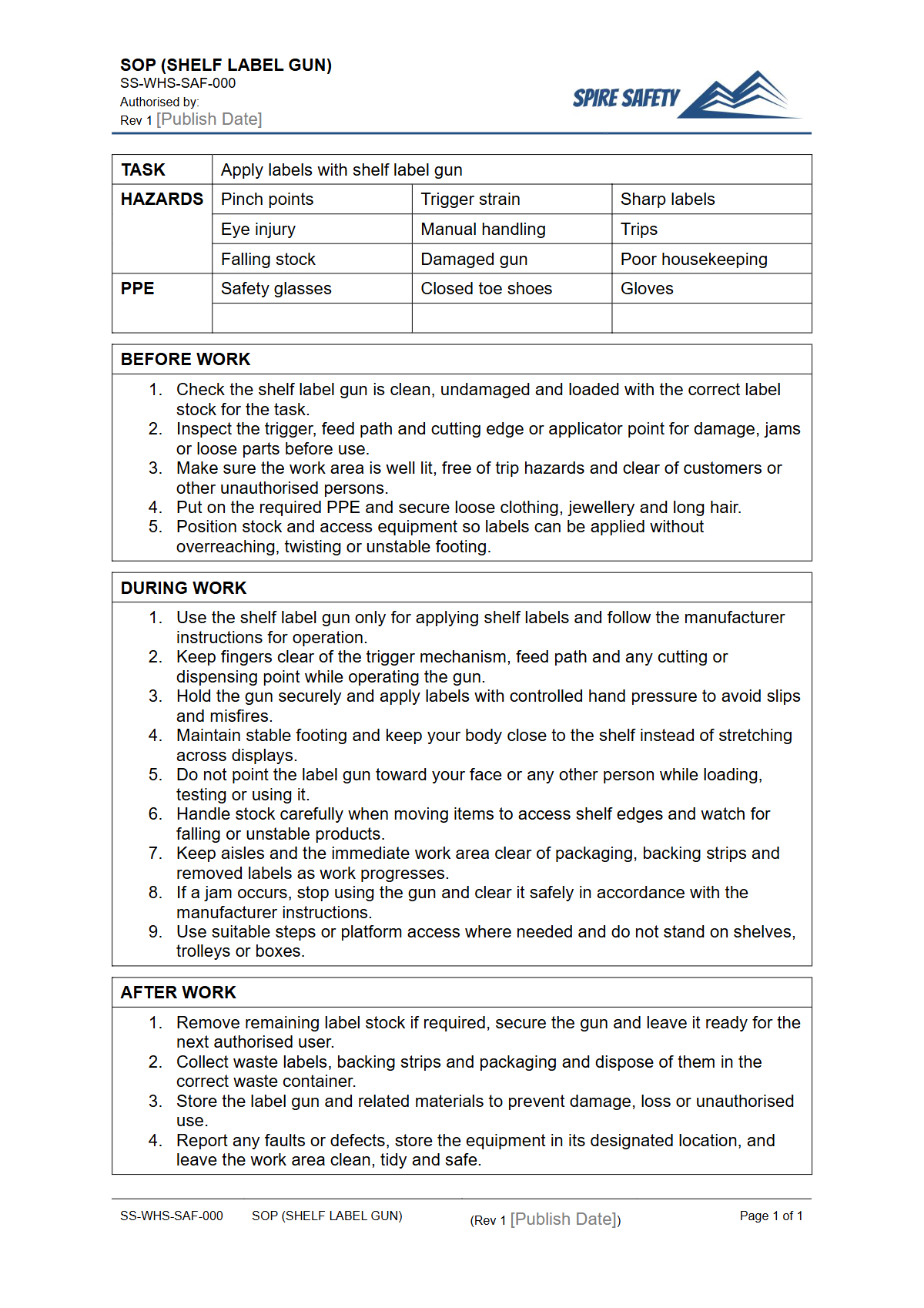
Download our free Safe Operating Procedure for shelf label guns. This template helps outline safe work practices for retail and warehouse environments.
Free Safe Operating Procedure (Shelf Label Gun) Template
DOCX • 126 KB + PDF
Updated Oct 2026
No signup required
Purpose of the Free Safe Operating Procedure (Shelf Label Gun) Template
A Safe Operating Procedure, or SOP, is a fundamental document that provides clear, step-by-step instructions on how to perform a work task safely. Our Free Safe Operating Procedure (Shelf Label Gun) Template offers a structured starting point for organisations in retail, warehousing, and logistics.
It helps formalise the process for using handheld labelling devices, ensuring every worker performs the task with the same level of safety and efficiency. While a label gun may seem like simple equipment, formalising its use helps control risks associated with repetitive tasks, manual handling, and minor mechanical hazards.
Implementing documented procedures is a key part of an effective safety management system. Using a standardised SOP ensures that all employees, from new hires to experienced staff, are aware of the correct operational steps, potential hazards, and the control measures in place to protect them.
This not only helps meet your duty of care under WHS legislation but also promotes a consistent approach to workplace safety and operational quality. Proper procedures can reduce the likelihood of musculoskeletal disorders and other common injuries in fast-paced environments.
Video walkthrough
How to use the Free Safe Operating Procedure (Shelf Label Gun) Template
This resource is available for immediate download in both DOCX and PDF formats. The DOCX file is fully editable, allowing you to adapt it to your specific operational needs.
To use the template effectively, you should review each section and populate it with information relevant to your workplace, including specific brand and model details of the label guns in use, your site's emergency procedures, and designated personnel.
Important: This document is a template and must be customised to suit your business. We recommend you conduct a site-specific risk assessment and consult with your workers before finalising the procedure.
Their direct experience is invaluable for creating a practical and effective SOP. Integrating customised documents like this one is a core component of building robust WHS management systems that genuinely reflect your organisation's activities.
When to use a Shelf Label Gun SOP
A Safe Operating Procedure for a shelf label gun should be used as a primary training and reference tool. It is most effective when integrated into your daily operations in several key scenarios:
- Employee Induction: Provide the SOP to all new employees who will be required to use a label gun as part of their initial WHS and task-specific training.
- Refresher Training: Use the document for periodic refresher training sessions to reinforce safe work habits and address any complacency that may have developed over time.
- Introduction of New Equipment: Whenever a new model of label gun is introduced, the SOP should be reviewed and updated to reflect any changes in its operation, loading mechanism, or ergonomic design.
- Post-Incident Review: If an incident or near-miss involving a label gun occurs, the SOP should be a central part of the investigation to determine if the procedure was adequate and followed correctly.
Who should use it
This SOP is intended for a broad range of personnel within a retail or warehouse setting. The primary users are the workers who operate the equipment daily, but others in the organisation have a role in its implementation and oversight:
- Retail Assistants and Storepersons: The end-users who perform labelling tasks on the shop floor or in the stockroom.
- Team Leaders and Supervisors: Responsible for ensuring their team members are trained on and adhere to the SOP.
- WHS Representatives and Committees: Involved in the review and consultation process to ensure the procedure is practical and effectively controls risks.
- Managers: Accountable for providing the resources for safe work and ensuring that safe systems of work, like SOPs, are properly implemented across the business. Proper documentation for common tasks is often examined during a WHS compliance audit.
Key Hazards and Control Measures
Even simple equipment presents risks that must be managed. The SOP should detail these specific to your environment, but common examples include:
- Repetitive Strain Injuries (RSIs): Resulting from prolonged use. Controls include encouraging regular breaks, rotating tasks, providing ergonomically designed label guns, and training on neutral wrist posture.
- Pinch Points: Fingers can get caught in the label roll holder or feed mechanism during loading. Controls involve following the manufacturer's loading instructions, de-energising if applicable, and maintaining focus during the task.
- Manual Handling: Lifting and carrying boxes of label rolls. Controls include breaking down large boxes into smaller, lighter loads and providing training on safe lifting techniques. Similar principles apply to managing other equipment, as detailed in our Safe Operating Procedure for a deep fryer.
- Slips, Trips, and Falls: Workers may be focused on the shelves and not on their path. Controls include good housekeeping to keep aisles clear and promoting situational awareness. This is especially important in environments with more complex machinery, such as those covered in our Conveyer System SOP template.
For a complete overview of procedural templates and other safety documents, you can browse our full free WHS resources library, which includes tools for various equipment types, including our popular FREE Circular Saw SOP Template.
Common mistakes
Common mistakes to avoid
- Using a generic template without customising it for the specific label gun model and workplace.
- Failing to adequately train workers on the SOP, assuming they will read and understand it on their own.
- Not involving the staff who use the label guns every day in the drafting and review process.
- Forgetting to schedule regular reviews, allowing the procedure to become outdated and irrelevant.
Legal references
Legal considerations
The following legal requirements may be relevant to this type of work.
- Work Health and Safety Act (Harmonised) — Provides the primary duties for protecting workers and other people from work health and safety risks.
- Work Health and Safety Regulations (Harmonised) — Sets out requirements supporting the management of workplace hazards and risks.
The following codes may be relevant to this type of work.
- Managing WHS Risks Code of Practice — Provides practical guidance on identifying hazards, assessing risks and applying effective controls.
- Work Health and Safety Consultation, Cooperation and Coordination Code of Practice — Provides practical guidance on consulting workers and coordinating with other duty holders.
- Managing the Work Environment and Facilities Code of Practice — Provides practical guidance on safe work environments, workplace facilities and related controls.
Did you know
Ergonomic Evolution
Modern label guns are often designed with advanced ergonomics to reduce wrist strain and fatigue, a direct response to the prevalence of musculoskeletal disorders (MSDs) in the retail and logistics industries.
The PCBU's Duty
Under Australian WHS law, a Person Conducting a Business or Undertaking (PCBU) has a duty of care to manage risks for all work activities, no matter how simple they seem. This includes providing adequate instruction and training for using tools like a label gun.
FAQ
Frequently asked questions
01Is a Safe Operating Procedure legally required for a shelf label gun?
02How often should we review our shelf label gun SOP?
03Can this template be used for any brand of shelf label gun?
04What is the difference between an SOP and a SWMS?
Share this resource
Free Safe Operating Procedure (Shelf Label Gun) Template
Browse Categories
How To Use It
- 1Download and open in Word or PDF.
- 2Replace the placeholders with your business details.
- 3Get it reviewed by a WHS specialist before rollout.
Need it customised?
Our WHS consultants can adapt this template to your site, run a gap analysis, or audit what you already have in place.
Book a Free Consultation WHS consulting servicesor call 1300 156 382
Related templates
- Free Safe Operating Procedure (Ship Cabin Cleaning) Template
- Free Safe Operating Procedure (Ship Galley Cleaning) Template
- Free Safe Operating Procedure (Ship Waste Handling) Template
- Free Safe Operating Procedure (Shock Absorber Change) Template
- Free Safe Operating Procedure (Shoe Press) Template
- Free Safe Operating Procedure (Shopping Basket Clean) Template