
Free Safe Operating Procedure (Ship Galley Cleaning) Template
Manage kitchen hazards aboard maritime vessels with our structured Safe Operating Procedure for ship galley cleaning. Download your free template today.
Free Safe Operating Procedure (Ship Galley Cleaning) Template
DOCX • 126 KB + PDF
Updated Oct 2026
No signup required
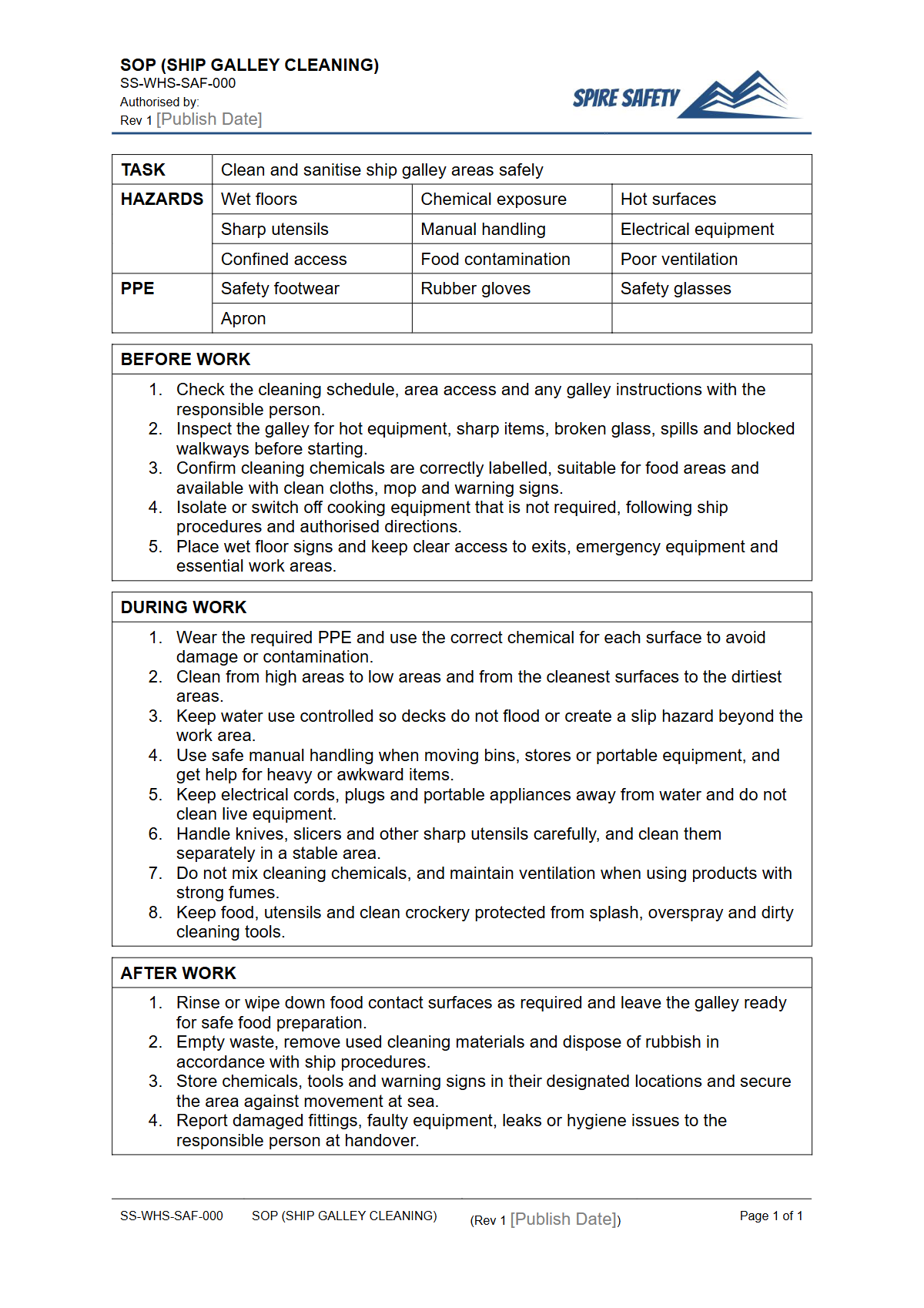
Purpose of the Free Safe Operating Procedure (Ship Galley Cleaning) Template
Maintaining a high standard of cleanliness in a ship's galley is critical for preventing foodborne illness, managing fire risks, and ensuring the overall health and safety of the crew. This Free Safe Operating Procedure (Ship Galley Cleaning) Template provides a comprehensive starting point for maritime operators to document the required tasks, hazards, and controls.
It is designed to be adapted to any vessel, helping to formalise procedures for everything from daily wipe-downs to deep cleaning of specific kitchen equipment. By implementing a structured SOP, you establish a clear, repeatable process that reduces the risk of injury from slips, chemical exposure, and ergonomic strains.
Video walkthrough
How to Use the Free Safe Operating Procedure (Ship Galley Cleaning) Template
This downloadable DOCX and PDF file offers a framework aligned with Australian WHS best practices. To make it effective for your vessel, you must add specific details relevant to your operations.
This includes listing the exact cleaning chemicals used (and referencing their Safety Data Sheets), detailing the layout of your galley, specifying the types of cooking equipment, and outlining your emergency procedures. This document should be developed in consultation with galley staff to ensure it is practical and reflects real-world tasks. Properly integrated, an SOP becomes a key component of broader WHS management systems.
Customisation is Essential
Please note: This is a template and not a complete Safe Operating Procedure. You must customise this document to reflect the specific equipment, chemicals, layout, and work practices of your vessel.
We recommend consulting with your galley crew during the customisation process to ensure the SOP is practical and effective.
When to Use This Safe Operating Procedure
A Ship Galley Cleaning SOP should be a living document used for daily operations and formal processes. It is essential for inducting and training new galley crew, ensuring they understand the required standards and safety protocols from day one.
Use it as a checklist for routine daily, weekly, and deep cleaning tasks to maintain consistency. It should also be referenced during incident investigations involving galley hygiene or safety, and be reviewed and updated regularly as part of your vessel's safety management schedule.
For complex environments, seeking WHS consulting can help identify all necessary triggers for SOP use.
Who Should Use This SOP
This Safe Operating Procedure is intended for several key roles on board a vessel:
- Galley Staff (Cooks, Stewards): To guide their day-to-day cleaning activities, ensuring all tasks are completed safely and to the required standard.
- Chief Cook / Catering Manager: To manage, train, and supervise galley staff, and to verify that cleaning procedures are being followed correctly.
- Master / Ship Officers: As part of their overall responsibility for the health, safety, and welfare of the crew under WHS legislation.
- Vessel Operators / PCBUs: To demonstrate they have a system in place for managing hygiene and safety risks in the galley, which is a critical part of their duty of care.
The SOP also serves as crucial evidence during internal or external inspections, forming part of the vessel's safety documentation that may be reviewed during WHS compliance auditing.
Associated Hazards in Galley Environments
While this SOP focuses on cleaning, the galley is a high-risk area with numerous potential hazards that must be managed concurrently. These include:
- Slips, trips, and falls: From wet or greasy floors.
- Chemical hazards: From improper use, mixing, or storage of cleaning agents.
- Ergonomic injuries: From manual handling, awkward postures, and repetitive tasks.
- Burns and scalds: From hot surfaces, steam, and cooking oils. Procedures for specific equipment can be detailed in separate documents, such as our free deep fryer SOP template.
- Cuts and amputations: From knives, meat slicers, and other sharp equipment.
- Fire: From grease build-up in extraction hoods and ducts.
A thorough risk assessment should be conducted to identify all potential hazards specific to your galley. You can find more templates to manage other workplace risks in our free WHS resources library.
Common mistakes
Common mistakes to avoid
- Using the template without customising it for the vessel's specific layout and equipment.
- Failing to train all relevant crew members and agency staff on the finalised SOP.
- Not providing the correct Personal Protective Equipment (PPE) specified in the procedure.
- Storing cleaning chemicals incorrectly or in unlabelled containers, creating new hazards.
Legal references
Legal considerations
The following legal requirements may be relevant to this type of work.
- Work Health and Safety Act (Harmonised) — Provides the primary duties for protecting workers and other people from work health and safety risks.
- Work Health and Safety Regulations (Harmonised) — Sets out requirements supporting the management of workplace hazards and risks.
The following codes may be relevant to this type of work.
- Managing WHS Risks Code of Practice — Provides practical guidance on identifying hazards, assessing risks and applying effective controls.
- Work Health and Safety Consultation, Cooperation and Coordination Code of Practice — Provides practical guidance on consulting workers and coordinating with other duty holders.
- Managing the Work Environment and Facilities Code of Practice — Provides practical guidance on safe work environments, workplace facilities and related controls.
Did you know
Slips, Trips, and Falls
Slips, trips, and falls are one of the leading causes of injuries in the workplace, with wet and greasy floors in galley environments posing a significant risk to maritime crew.
Maritime Labour Convention
The Maritime Labour Convention (MLC, 2006) sets out seafarers' rights to decent working conditions, including specific requirements for accommodation, recreational facilities, food, and catering, which directly impacts galley standards.
FAQ
Frequently asked questions
01What is the difference between an SOP and a Safe Work Method Statement (SWMS)?
02Do I still need an SOP for cleaning if my crew is very experienced?
03How often should a ship galley cleaning SOP be reviewed?
04Can I use this template for a land-based commercial kitchen?
Share this resource
Free Safe Operating Procedure (Ship Galley Cleaning) Template
Browse Categories
How To Use It
- 1Download and open in Word or PDF.
- 2Replace the placeholders with your business details.
- 3Get it reviewed by a WHS specialist before rollout.
Need it customised?
Our WHS consultants can adapt this template to your site, run a gap analysis, or audit what you already have in place.
Book a Free Consultation WHS consulting servicesor call 1300 156 382
Related templates
- Free Safe Operating Procedure (Ship Waste Handling) Template
- Free Safe Operating Procedure (Shock Absorber Change) Template
- Free Safe Operating Procedure (Shoe Press) Template
- Free Safe Operating Procedure (Shopping Basket Clean) Template
- Free Safe Operating Procedure (Shopping Trolley Return) Template
- Free Safe Operating Procedure (Shower Area Descaling) Template