
Free Safe Operating Procedure (Shopping Trolley Return) Template
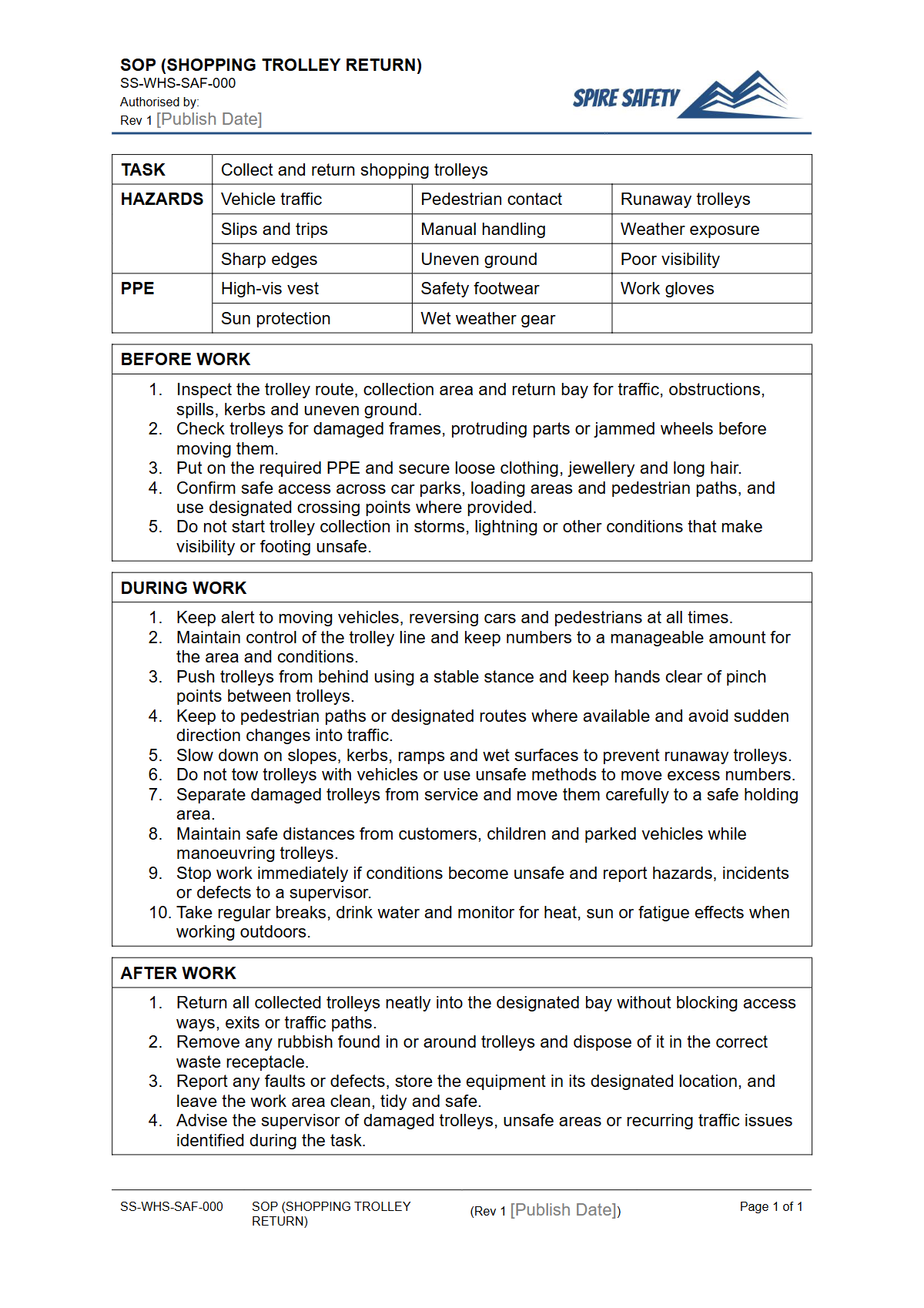
Download our free Safe Operating Procedure for shopping trolley return. This template helps you document safe work practices for trolley collection and management.
Free Safe Operating Procedure (Shopping Trolley Return) Template
DOCX • 126 KB + PDF
Updated Oct 2026
No signup required
Purpose of the Free Safe Operating Procedure (Shopping Trolley Return) Template
Managing the collection and return of shopping trolleys is a common but surprisingly hazardous task in retail environments. This free Safe Operating Procedure (Shopping Trolley Return) template provides a structured framework for documenting the safest way to perform this job.
It helps a Person Conducting a Business or Undertaking (PCBU) meet their primary duty of care by managing risks associated with manual handling, traffic management, and public interaction. A well-defined SOP ensures every worker follows the same approved, safe method, reducing the likelihood of incidents and injuries.
Using this template helps formalise your process, creating a reliable training tool for new employees and a benchmark for performance reviews. It prompts you to consider specific hazards in your environment, such as car park gradients, traffic flow, weather conditions, and the physical demands of pushing long lines of trolleys.
Integrating task-specific SOPs like this one is a fundamental component of effective WHS management systems, demonstrating a proactive approach to workplace safety.
Video walkthrough
How to use the Free Safe Operating Procedure (Shopping Trolley Return) Template
This document is available as a fully editable DOCX file, allowing for complete customisation, and a print-ready PDF for immediate use after filling it out. Start by downloading the template and reviewing its sections.
You will need to carefully adapt the content to reflect the unique conditions of your workplace, including the specific equipment used, the layout of your car park, and your company's emergency procedures.
IMPORTANT: This is a template only. We are not familiar with your specific worksite, equipment, or personnel.
You MUST customise this document to align with your own risk assessments and operational realities. We strongly recommend you consult with the workers who actually perform the task, as their direct experience is invaluable for creating a practical and effective procedure.
If you require expert assistance in developing or reviewing your safety documentation, consider engaging professional WHS consulting services.
Customisation is Key
Pay close attention to sections covering Personal Protective Equipment (PPE), pre-start checks (if using a trolley collection mule), and the step-by-step process for collection. Your procedure should detail the maximum number of trolleys to be moved at one time, approved routes through the car park, and methods for securing trolleys in designated bays.
Detailing procedures for different equipment is crucial, just as you would create a specific Safe Operating Procedure for a Deep Fryer in a food service area.
When to use it
A Safe Operating Procedure for shopping trolley return should be a core part of your safety system. It should be used during the induction and training of any new employee tasked with trolley collection.
It also serves as an essential tool for conducting refresher training to prevent procedural drift and complacency among experienced staff. Following any incident, near miss, or change in work conditions (such as a new car park layout or the introduction of a trolley pusher machine), this SOP must be reviewed and updated to ensure it remains relevant and effective.
Regularly scheduled reviews, typically annually, should also be part of your process. This proactive approach helps maintain a high standard of safety and operational efficiency. For more templates and checklists to support your safety management activities, explore our complete free WHS resources library.
Who should use it
This template is designed for use by a range of personnel within a retail organisation. Store Managers and Department Heads are responsible for ensuring safe systems of work are in place and should oversee the implementation of the SOP.
WHS Officers or Safety Representatives will find it a valuable tool for conducting risk assessments and developing safety documentation. Team Leaders and Supervisors must use the finalised SOP to train and supervise staff effectively.
Finally, the trolley collection workers themselves are the primary end-users, relying on the SOP for clear, step-by-step guidance on how to perform their duties safely. For complex sites with multiple types of equipment, you may need a suite of documents, such as a FREE Conveyer System SOP for back-of-house logistics.
Common mistakes
Common mistakes to avoid
- Failing to customise the template for the specific car park layout and traffic flow.
- Not providing adequate, practical training to staff on the documented procedure.
- Neglecting to include steps for managing adverse weather or low-light conditions.
- Forgetting to schedule and conduct regular reviews, rendering the SOP outdated.
Legal references
Legal considerations
The following legal requirements may be relevant to this type of work.
- Work Health and Safety Act (Harmonised) — Provides the primary duties for protecting workers and other people from work health and safety risks.
- Work Health and Safety Regulations (Harmonised) — Sets out requirements supporting the management of workplace hazards and risks.
The following codes may be relevant to this type of work.
- Managing WHS Risks Code of Practice — Provides practical guidance on identifying hazards, assessing risks and applying effective controls.
- Work Health and Safety Consultation, Cooperation and Coordination Code of Practice — Provides practical guidance on consulting workers and coordinating with other duty holders.
- Managing the Work Environment and Facilities Code of Practice — Provides practical guidance on safe work environments, workplace facilities and related controls.
Did you know
Musculoskeletal Risk
Hazardous manual tasks, including pushing and pulling shopping trolleys, are a leading cause of serious workers' compensation claims in Australia. A well-designed SOP is a key control measure to mitigate this risk.
Trolley Economics
Beyond safety, abandoned shopping trolleys represent a significant cost to retailers and local councils, who may spend thousands of dollars annually on retrieval services and responding to public complaints.
FAQ
Frequently asked questions
01What are the main hazards involved in shopping trolley collection?
02Is an SOP legally required for returning shopping trolleys in Australia?
03How often should our Shopping Trolley Return SOP be reviewed?
04Can this template be used for electric trolley collection machines (mules)?
Share this resource
Free Safe Operating Procedure (Shopping Trolley Return) Template
Browse Categories
How To Use It
- 1Download and open in Word or PDF.
- 2Replace the placeholders with your business details.
- 3Get it reviewed by a WHS specialist before rollout.
Need it customised?
Our WHS consultants can adapt this template to your site, run a gap analysis, or audit what you already have in place.
Book a Free Consultation WHS consulting servicesor call 1300 156 382
Related templates
- Free Safe Operating Procedure (Shower Area Descaling) Template
- Free Safe Operating Procedure (Shower Commode Cleaning) Template
- Free Safe Operating Procedure (Shower Screen Cleaning) Template
- Free Safe Operating Procedure (Shower Trolley Check) Template
- Free Safe Operating Procedure (Shower Trolley Cleaning) Template
- Free Safe Operating Procedure (Shrink Wrapper) Template