
Free Safe Operating Procedure (Shower Area Descaling) Template
Detail the risks and controls for cleaning and descaling shower areas with our comprehensive template.
Free Safe Operating Procedure (Shower Area Descaling) Template
DOCX • 126 KB + PDF
Updated Oct 2026
No signup required
Purpose of the Free Safe Operating Procedure (Shower Area Descaling) Template
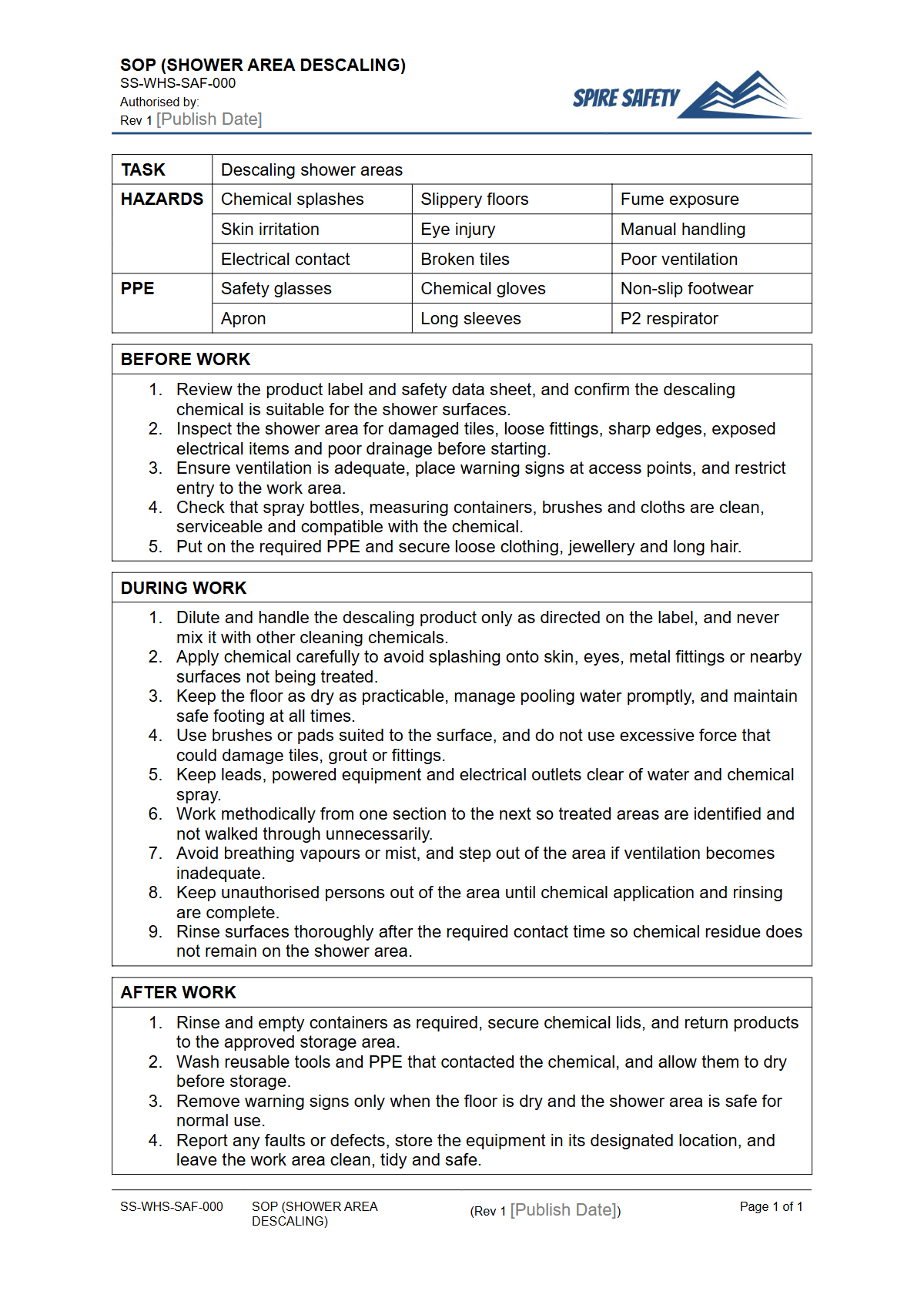
This Free Safe Operating Procedure (Shower Area Descaling) Template provides a structured framework for businesses to document a safe system of work for cleaning and removing limescale, soap scum, and mineral deposits from shower facilities. The primary purpose is to help Persons Conducting a Business or Undertaking (PCBUs) manage significant health and safety risks associated with the task.
These risks commonly include exposure to hazardous chemicals, slips and falls on wet surfaces, ergonomic injuries from manual handling, and potential eye or skin damage.
By implementing a clear Safe Operating Procedure (SOP), organisations can ensure workers are aware of the hazards, understand the required control measures, and follow a consistent, safe method for every cleaning cycle. This document serves as a critical training tool and a reference point for supervisors and workers, reinforcing the importance of safety protocols like using correct Personal Protective Equipment (PPE), ensuring proper ventilation, and following emergency procedures.
It is a foundational component of a proactive safety culture and is essential for demonstrating due diligence in managing workplace hazards.
Video walkthrough
How to use the Free Safe Operating Procedure (Shower Area Descaling) Template
Our Free Safe Operating Procedure (Shower Area Descaling) Template is provided in an editable DOCX format for easy customisation. After downloading, you must adapt the document to reflect the specific circumstances of your workplace.
This involves reviewing each section and adding site-specific details, such as the exact names of the descaling chemicals used, the location of Safety Data Sheets (SDS), workplace-specific emergency contact numbers, and the required types of PPE available on-site. The procedure should align with the manufacturer's instructions for any cleaning agents and equipment.
Important: This is a template only. The content is a starting point and does not constitute a complete, ready-to-use document.
We have no way of knowing your specific workplace hazards, chemicals, or equipment. You are responsible for customising this template to ensure it is relevant and comprehensive for your business operations. Once tailored, the SOP should be used to train all relevant workers, with records of this training maintained.
Regular reviews and updates are necessary to keep the procedure current, especially if new chemicals or processes are introduced. Integrating this procedure into your broader WHS management system ensures it functions as part of a cohesive safety strategy.
When to use this Safe Operating Procedure
A Safe Operating Procedure for descaling showers should be used consistently before and during the execution of the task. It is not a document to be filed away; it is an active tool for risk management.
Specifically, it should be consulted during worker inductions for new cleaning staff or contractors, used as the basis for pre-start toolbox talks before commencing cleaning shifts, and referenced whenever a worker is unsure about a step in the process. It should also be reviewed and potentially updated following any near miss or incident, or when new descaling products are introduced into the workplace. For tasks with similar chemical hazards, such as cleaning kitchen equipment, you might also find value in our Safe Operating Procedure for deep fryer cleaning.
Who should use this Safe Operating Procedure
This SOP is intended for a range of personnel within an organisation. Workers and Cleaning Staff are the primary users who must follow the step-by-step instructions to perform their duties safely.
Supervisors and Facility Managers are responsible for implementing the SOP, ensuring workers are trained on its contents, and monitoring compliance. Health and Safety Representatives (HSRs) and WHS committees should be involved in the consultation process during the development and review of the SOP.
Finally, PCBUs and Senior Management hold the ultimate responsibility for ensuring a safe system of work is in place, making this template a key tool for meeting their legislative obligations. If you need assistance developing or reviewing your procedures, our team of WHS consulting professionals can provide expert guidance.
Regular verification ensures that these procedures are not just documented but are also effective in practice. The outcomes of such verification can be a key input for WHS compliance audits, helping to identify gaps and opportunities for improvement across the organisation. For more templates and safety documents, browse our complete free WHS resources library.
Common mistakes
Common mistakes to avoid
- Using incorrect dilution ratios for concentrated chemicals, leading to ineffective cleaning or increased chemical hazards.
- Failing to ensure adequate mechanical or natural ventilation in enclosed shower areas, allowing fumes to build up.
- Neglecting to use 'wet floor' signage, which creates a serious and unexpected slip hazard for other workers or patrons.
- Using hot water to dilute or rinse some acid-based descalers, which can increase the release of hazardous vapours.
Legal references
Legal considerations
The following legal requirements may be relevant to this type of work.
- Work Health and Safety Act (Harmonised) — Provides the primary duties for protecting workers and other people from work health and safety risks.
- Work Health and Safety Regulations (Harmonised) — Sets out requirements supporting the management of workplace hazards and risks.
The following codes may be relevant to this type of work.
- Managing WHS Risks Code of Practice — Provides practical guidance on identifying hazards, assessing risks and applying effective controls.
- Work Health and Safety Consultation, Cooperation and Coordination Code of Practice — Provides practical guidance on consulting workers and coordinating with other duty holders.
- Managing the Work Environment and Facilities Code of Practice — Provides practical guidance on safe work environments, workplace facilities and related controls.
Did you know
The Hazard of Mixing Chemicals
Never mix different cleaning chemicals, particularly those containing bleach and ammonia. The combination can create highly toxic chloramine gas, which can cause severe respiratory damage, chest pain, and nausea.
Slips, Trips, and Falls
According to Safe Work Australia, slips, trips, and falls are a leading cause of serious workplace injuries. Wet and soapy floors created during cleaning tasks are a significant and preventable hazard.
FAQ
Frequently asked questions
01What chemicals are used for descaling showers and what are the risks?
02Is a Safe Operating Procedure legally required for cleaning tasks in Australia?
03What personal protective equipment (PPE) is needed for shower descaling?
04How often should shower descaling procedures be reviewed?
Share this resource
Free Safe Operating Procedure (Shower Area Descaling) Template
Browse Categories
How To Use It
- 1Download and open in Word or PDF.
- 2Replace the placeholders with your business details.
- 3Get it reviewed by a WHS specialist before rollout.
Need it customised?
Our WHS consultants can adapt this template to your site, run a gap analysis, or audit what you already have in place.
Book a Free Consultation WHS consulting servicesor call 1300 156 382
Related templates
- Free Safe Operating Procedure (Shower Commode Cleaning) Template
- Free Safe Operating Procedure (Shower Screen Cleaning) Template
- Free Safe Operating Procedure (Shower Trolley Check) Template
- Free Safe Operating Procedure (Shower Trolley Cleaning) Template
- Free Safe Operating Procedure (Shrink Wrapper) Template
- Free Safe Operating Procedure (Shrub Hand Pruning) Template