
Free Safe Operating Procedure (Shower Screen Cleaning) Template
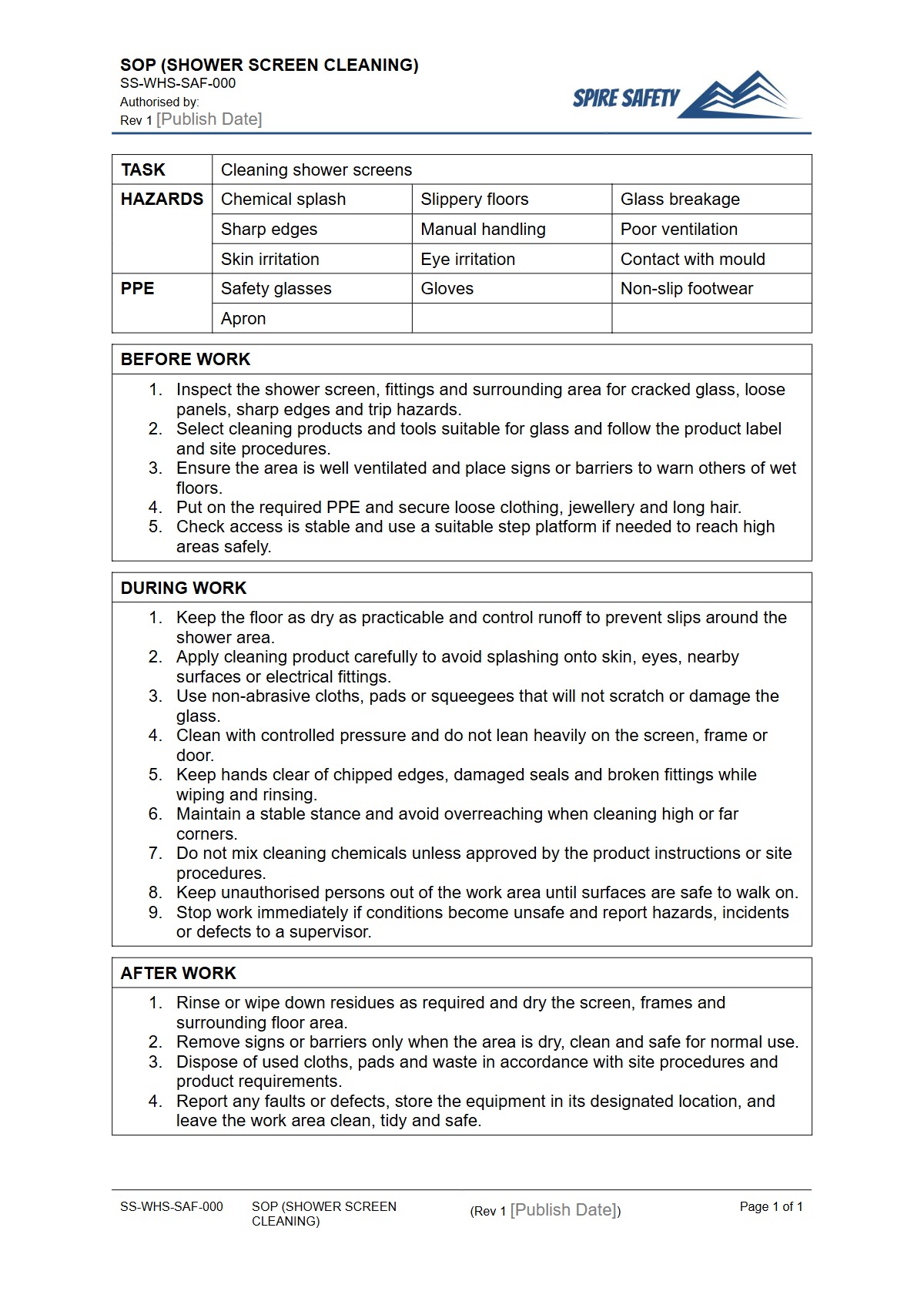
Download our free Safe Operating Procedure for shower screen cleaning. This customisable template helps you document safe work methods and meet your WHS duties.
Free Safe Operating Procedure (Shower Screen Cleaning) Template
DOCX • 126 KB + PDF
Updated Oct 2026
No signup required
Purpose of the Free Safe Operating Procedure (Shower Screen Cleaning) Template
The primary purpose of this Free Safe Operating Procedure (Shower Screen Cleaning) Template is to help you establish and document a safe system of work. A well-drafted SOP is a fundamental tool for managing risks associated with routine cleaning tasks.
It clearly communicates expectations to workers, ensures consistency in how tasks are performed, and serves as a vital record for training and inductions. By systematically addressing hazards like hazardous chemical use, manual handling, and potential slips, this SOP helps a Person Conducting a Business or Undertaking (PCBU) meet their primary duty of care under WHS legislation. Documented procedures like these are foundational components of effective WHS management systems.
Video walkthrough
How to use the Free Safe Operating Procedure (Shower Screen Cleaning) Template
This template is available as a DOCX file for easy customisation and a PDF for immediate printing. To use it effectively, download the DOCX version and adapt it to the specific context of your workplace.
This involves conducting a site-specific risk assessment to identify all relevant hazards. You must add details about the exact chemicals used (referencing their Safety Data Sheets), the specific layout of the work area, and your organisation's emergency procedures.
Please note: this is a template, not a finished document. We strongly recommend you customise it with input from the workers who perform the task.
For complex operations or if you are unsure about your obligations, engaging professional WHS consulting can provide clarity and expert guidance.
When to use this Safe Operating Procedure
An SOP for shower screen cleaning should be used consistently whenever the task is performed. It is particularly important during worker induction and training, providing a clear benchmark for safe and correct performance.
It also serves as a critical reference tool for supervisors and workers on a day-to-day basis. The SOP should be made readily accessible in the work area, either as a hard copy or digitally.
Furthermore, the procedure should be reviewed regularly—typically annually, or whenever there is a change in equipment, chemicals, processes, or after an incident occurs. Regular reviews, often part of a scheduled WHS compliance auditing program, ensure the SOP remains current and effective.
Who should use this document
This Safe Operating Procedure is designed for use by any worker tasked with cleaning shower screens in a commercial or professional setting. This includes hotel housekeepers, commercial cleaners, maintenance staff, and employees in serviced apartments or residential care facilities.
Managers and supervisors should also use this document to train staff, monitor work practices, and investigate any incidents. The development and review of the SOP should be a collaborative effort, involving both management and the workers who will be following the procedure.
Documenting procedures for all common tasks, from cleaning to food preparation, is best practice. For example, a hospitality venue might also use a Free Safe Operating Procedure for a Deep Fryer to manage kitchen risks.
Beyond specific cleaning or appliance tasks, SOPs are essential for any equipment that presents a risk to health and safety. The principles of identifying hazards, outlining control measures, and detailing step-by-step instructions apply universally.
For instance, workshops or maintenance facilities would require similar documentation for their machinery, such as a Free Air Compressor SOP, to manage risks from pressurised systems and noise.
By implementing this structured SOP, you take a proactive step towards a safer workplace. It helps standardise procedures, reduce the likelihood of injuries, and demonstrates a commitment to health and safety. For more templates covering a wide range of tasks and equipment, browse our complete free WHS resources library.
Common mistakes
Common mistakes to avoid
- Failing to read the Safety Data Sheet (SDS) for the cleaning chemicals being used.
- Neglecting to ensure adequate ventilation, leading to inhalation of fumes.
- Using a generic template without customising it for site-specific hazards and equipment.
- Forgetting to consult with the workers who actually perform the cleaning task when drafting the SOP.
Legal references
Legal considerations
The following legal requirements may be relevant to this type of work.
- Work Health and Safety Act (Harmonised) — Provides the primary duties for protecting workers and other people from work health and safety risks.
- Work Health and Safety Regulations (Harmonised) — Sets out requirements supporting the management of workplace hazards and risks.
The following codes may be relevant to this type of work.
- Managing WHS Risks Code of Practice — Provides practical guidance on identifying hazards, assessing risks and applying effective controls.
- Work Health and Safety Consultation, Cooperation and Coordination Code of Practice — Provides practical guidance on consulting workers and coordinating with other duty holders.
- Managing the Work Environment and Facilities Code of Practice — Provides practical guidance on safe work environments, workplace facilities and related controls.
Did you know
The Hierarchy of Control
A Safe Operating Procedure is an administrative control, which is the fourth level in the hierarchy of control measures. It's most effective when used alongside higher-level controls like using safer, non-toxic cleaning agents (substitution).
Slips and Trips
Slips, trips, and falls are a leading cause of workplace injury in Australia. Implementing procedures for managing wet floors during and after cleaning is a critical risk control measure.
FAQ
Frequently asked questions
01What hazards are involved in cleaning shower screens?
02Is a Safe Operating Procedure legally required for cleaning tasks?
03What PPE is typically needed for shower screen cleaning?
04How often should an SOP for cleaning be reviewed?
Share this resource
Free Safe Operating Procedure (Shower Screen Cleaning) Template
Browse Categories
How To Use It
- 1Download and open in Word or PDF.
- 2Replace the placeholders with your business details.
- 3Get it reviewed by a WHS specialist before rollout.
Need it customised?
Our WHS consultants can adapt this template to your site, run a gap analysis, or audit what you already have in place.
Book a Free Consultation WHS consulting servicesor call 1300 156 382
Related templates
- Free Safe Operating Procedure (Shower Trolley Check) Template
- Free Safe Operating Procedure (Shower Trolley Cleaning) Template
- Free Safe Operating Procedure (Shrink Wrapper) Template
- Free Safe Operating Procedure (Shrub Hand Pruning) Template
- Free Safe Operating Procedure (Shrub Planting) Template
- Free Safe Operating Procedure (Side Rail Adjustment) Template