
Free Safe Operating Procedure (Shrub Planting) Template
Establish clear safety guidelines for landscaping and horticultural tasks with our free template. Download your Safe Operating Procedure for shrub planting.
Free Safe Operating Procedure (Shrub Planting) Template
DOCX • 126 KB + PDF
Updated Oct 2026
No signup required
Purpose of the Free Safe Operating Procedure (Shrub Planting) Template
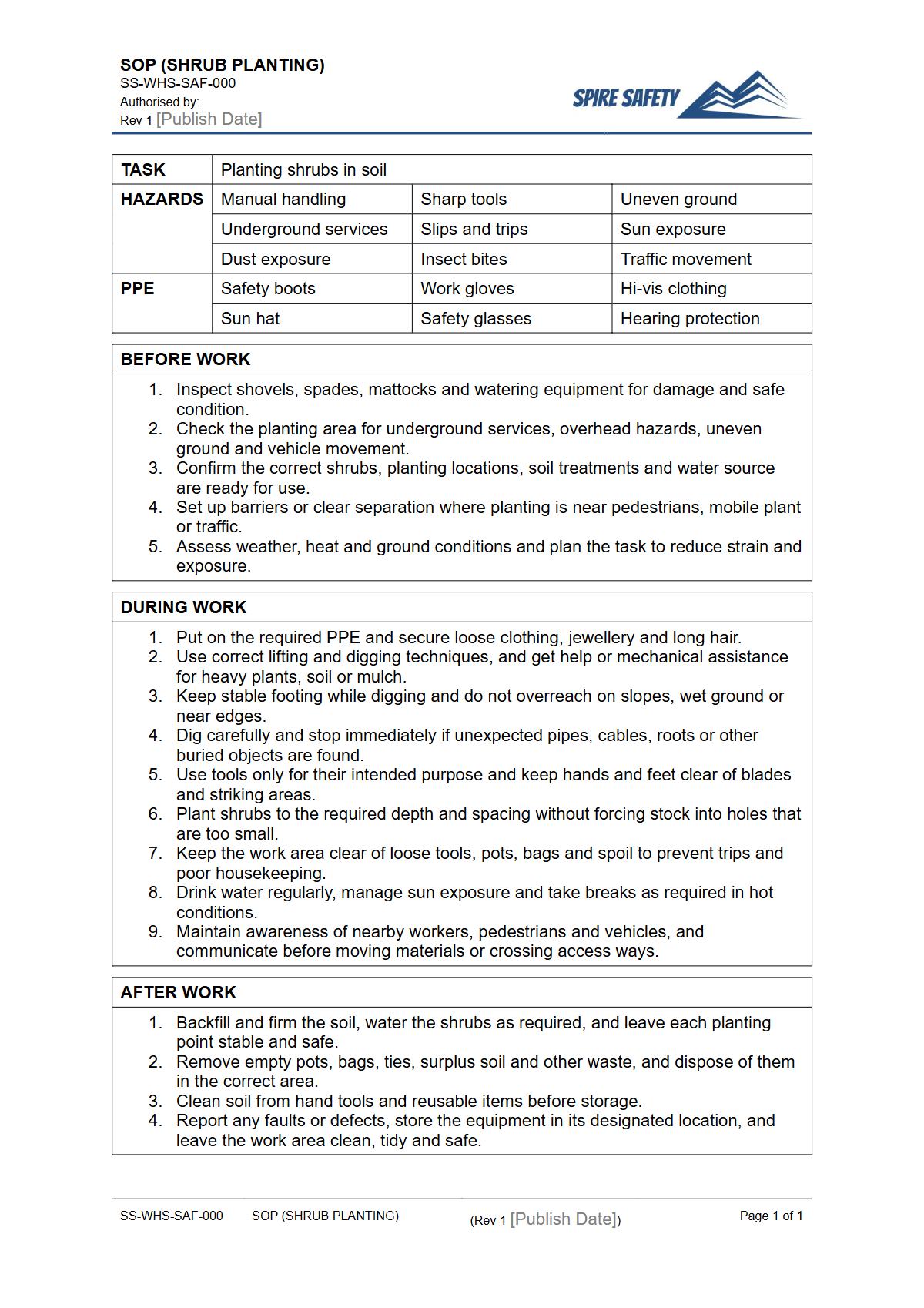
The primary purpose of this Safe Operating Procedure for shrub planting is to provide a clear, step-by-step guide for performing the task safely. It helps organisations formalise procedures to reduce the risk of injury and ensure consistency across all workers.
An SOP is a fundamental component of effective WHS management systems, acting as a practical tool for risk management.
This document covers key safety areas including:
- Pre-operational checks (e.g., assessing the site, checking tools).
- Required Personal Protective Equipment (PPE) such as gloves, safety footwear, and eye protection.
- The sequence of operations from preparing the soil to planting and backfilling.
- Potential hazards like manual handling strains, cuts from tools, soil contaminants, and pest encounters.
- Emergency procedures and clean-up requirements.
For related tasks involving soil preparation, you might also require procedures for specific machinery. For instance, our FREE Spreader SOP (Safe Operating Procedure) Template can guide the safe application of fertilisers or soil conditioners.
Video walkthrough
How to use the Free Safe Operating Procedure (Shrub Planting) Template
This template is provided in both DOCX and PDF formats for your convenience. The DOCX file is fully editable, allowing for comprehensive customisation to reflect the specific conditions and equipment at your worksite.
Customisation is Essential
Please note: This document is a template, not a finished product. You must adapt it to your unique workplace.
We are not familiar with your specific site, tools, soil conditions, or worker competencies. It is your responsibility to review, edit, and add site-specific information to ensure the final SOP is accurate and effective for your operations.
Implementation Steps:
- Download: Choose the DOCX version for easy editing.
- Customise: Add your company name and logo. Review every section and update the content to match your specific tools (e.g., particular shovels, augers), soil types, local flora/fauna hazards, and established procedures.
- Consult: Involve workers who perform the task in the review process. Their practical experience is invaluable for identifying risks and effective controls.
- Approve: Have a supervisor or WHS manager formally approve the finalised document.
- Train: Ensure all relevant workers are trained on the contents of the new SOP. Similar training would be required when introducing equipment covered by our FREE Planter SOP (Safe Operating Procedure) Template.
When to use this Safe Operating Procedure
A Safe Operating Procedure for shrub planting should be used as a primary reference document in several scenarios. It is an essential tool for inducting new employees or training existing workers on the correct, safe method for the task.
Supervisors can use it to conduct pre-start meetings or toolbox talks, reinforcing key safety points before work begins.
The SOP also serves as a benchmark for performance and safety observations. During routine site inspections or formal safety audits, the procedure provides a clear standard against which actual work practices can be measured.
For businesses undergoing a WHS compliance auditing process, having a comprehensive library of customised SOPs demonstrates a proactive approach to risk management. In the unfortunate event of an incident or near-miss, the SOP is a critical document for the investigation, helping to identify whether procedures were followed and if they need revision.
Who should use this document
This SOP template is designed for use by a range of personnel within organisations that perform landscaping, horticulture, grounds maintenance, or agricultural work. This includes:
- WHS Managers and Safety Officers: To develop and implement formalised safety procedures as part of the overall safety management system.
- Supervisors and Team Leaders: To train their teams, conduct pre-task risk assessments, and supervise work to ensure it aligns with documented procedures.
- Workers: As a reference guide to understand the approved steps, required PPE, and hazards associated with shrub planting.
- Business Owners (PCBUs): To fulfil their duty of care by providing a safe system of work.
If your work involves more extensive ground preparation, such as creating channels for irrigation or root barriers, you may also need procedures for more powerful equipment. Consider reviewing our FREE Trencher SOP (Safe Operating Procedure) Template to manage the specific risks associated with that machinery. You can find more templates like this in our free WHS resources library.
Common mistakes
Common mistakes to avoid
- Using the template without customising it for site-specific conditions and tools.
- Failing to clearly list all required Personal Protective Equipment (PPE).
- Not involving workers who perform the task in the drafting and review process.
- Forgetting to train workers on the finalised SOP and document the training.
Legal references
Legal considerations
The following legal requirements may be relevant to this type of work.
- Work Health and Safety Act (Harmonised) — Provides the primary duties for protecting workers and other people from work health and safety risks.
- Work Health and Safety Regulations (Harmonised) — Sets out requirements supporting the management of workplace hazards and risks.
The following codes may be relevant to this type of work.
- Managing WHS Risks Code of Practice — Provides practical guidance on identifying hazards, assessing risks and applying effective controls.
- Work Health and Safety Consultation, Cooperation and Coordination Code of Practice — Provides practical guidance on consulting workers and coordinating with other duty holders.
- Managing the Work Environment and Facilities Code of Practice — Provides practical guidance on safe work environments, workplace facilities and related controls.
Did you know
Manual Handling Risk
Musculoskeletal disorders from tasks like digging and lifting heavy plants are a leading cause of workplace injury claims in the Australian agriculture and horticulture sectors.
Soil Borne Illness
Soil can contain harmful bacteria like Legionella longbeachae and Clostridium tetani (tetanus). Wearing appropriate PPE like gloves is a critical control to prevent infection.
FAQ
Frequently asked questions
01What hazards are involved in shrub planting?
02Is a Safe Operating Procedure legally required for planting shrubs in Australia?
03How often should an SOP for shrub planting be reviewed?
04What is the difference between an SOP and a SWMS?
Share this resource
Free Safe Operating Procedure (Shrub Planting) Template
Browse Categories
How To Use It
- 1Download and open in Word or PDF.
- 2Replace the placeholders with your business details.
- 3Get it reviewed by a WHS specialist before rollout.
Need it customised?
Our WHS consultants can adapt this template to your site, run a gap analysis, or audit what you already have in place.
Book a Free Consultation WHS consulting servicesor call 1300 156 382
Related templates
- Free Safe Operating Procedure (Side Rail Adjustment) Template
- Free Safe Operating Procedure (Signage Cleaning) Template
- Free Safe Operating Procedure (Silage Cover Removal) Template
- Free Safe Operating Procedure (Silicone Application) Template
- Free Safe Operating Procedure (Silo Aeration Fan) Template
- Free Safe Operating Procedure (Silo Level Probe) Template