
Free Safe Operating Procedure (Silage Cover Removal) Template
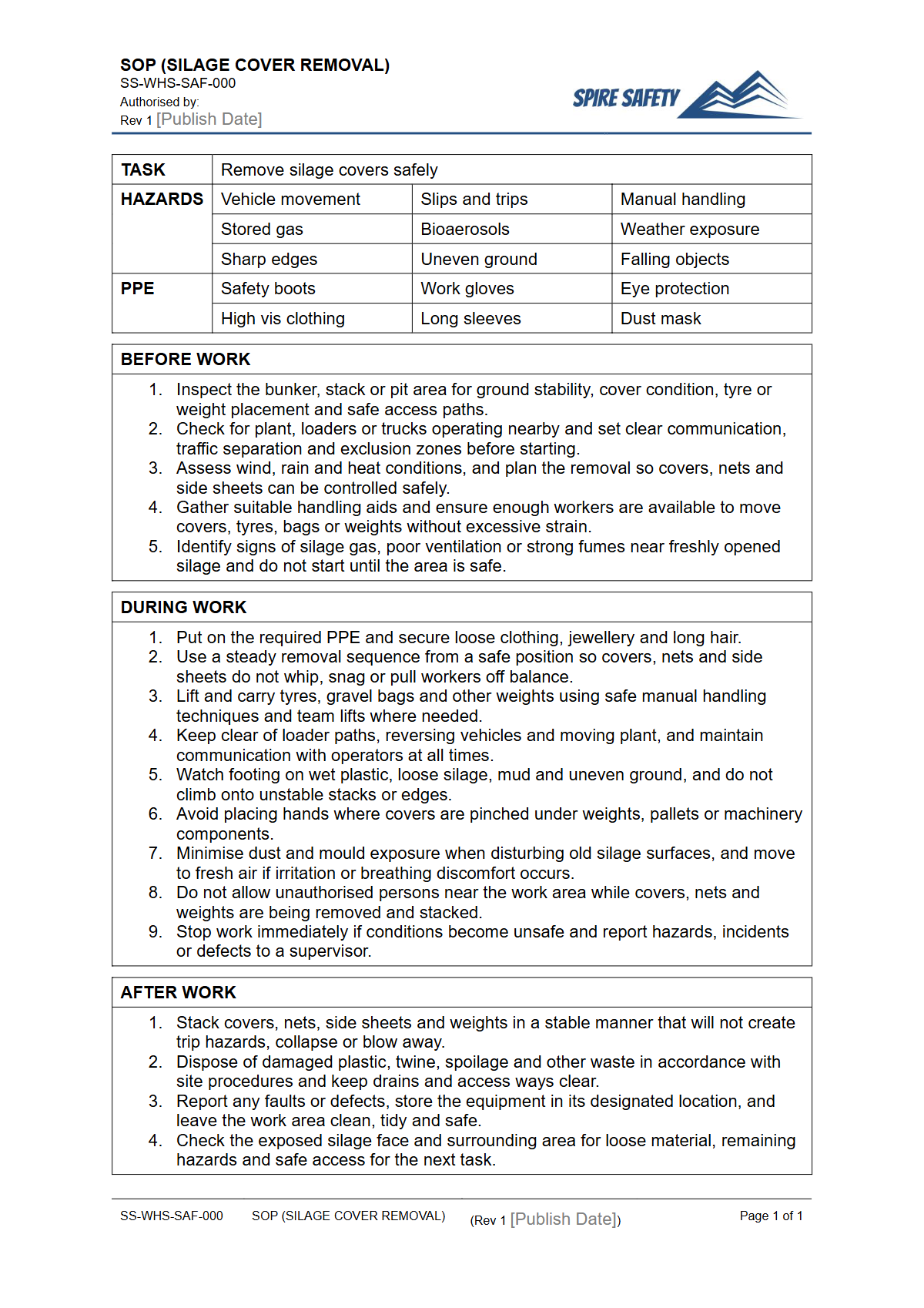
Download our free Safe Operating Procedure (Silage Cover Removal) Template to formalise safety protocols for this high-risk agricultural task. Get your DOCX.
Free Safe Operating Procedure (Silage Cover Removal) Template
DOCX • 126 KB + PDF
Updated Oct 2026
No signup required
Purpose of the Free Safe Operating Procedure (Silage Cover Removal) Template
Removing the protective cover from a silage pit or bunker is a task with significant, often underestimated, risks. This free Safe Operating Procedure (Silage Cover Removal) Template provides a structured framework for documenting the required safety measures.
It helps agricultural businesses formalise a step-by-step process that addresses hazards such as falls from height, muscular stress from manual handling, and exposure to toxic gases. By implementing a clear SOP, you can standardise safe work practices, improve worker training, and demonstrate a proactive approach to risk management. Formalising these procedures is a critical step; if you require assistance in conducting the initial risk assessments that inform these documents, consider engaging with a service for expert WHS consulting.
Video walkthrough
How to use the Free Safe Operating Procedure (Silage Cover Removal) Template
This resource is available as a fully editable DOCX file for easy customisation, as well as a print-ready PDF. It is designed to be adapted to the specific conditions of your farm or agricultural operation.
IMPORTANT: This is a template only. We have developed it as a starting point, but you must customise it with your site-specific details, machinery, personnel, and control measures to ensure it is relevant and effective for your operations.
Generic procedures are insufficient for managing specific workplace hazards.
To use the template effectively, review each section and populate it with information relevant to your site. This includes identifying the specific equipment used, listing required personal protective equipment (PPE), outlining communication protocols, and detailing emergency response actions.
A well-customised SOP is a vital component of a robust WHS management system, helping to ensure safety and operational consistency.
Key Sections to Customise:
- Site and Task Details: Specify the location, date, and personnel involved.
- Risk Assessment Summary: Briefly outline the key hazards identified for the task (e.g., falls, asphyxiation, entanglement) and the primary controls in place.
- Personal Protective Equipment (PPE): List all mandatory PPE, such as high-visibility clothing, non-slip safety boots, gloves, and potentially harnesses or gas monitors.
- Step-by-Step Procedure: Detail the entire process from pre-start checks to clean-up. Be specific about the sequence of removing weights (like tyres), folding or rolling the plastic, and securing the exposed silage face.
- Emergency Procedures: Document the immediate actions to be taken in case of a fall, gas exposure, or other incidents, including emergency contacts and the location of first aid equipment.
When to use a Safe Operating Procedure
An SOP for silage cover removal should be used consistently before any such task is undertaken. It serves as a practical checklist and reminder for experienced workers and an essential training guide for new staff.
The document should be a key part of a pre-start or toolbox talk, allowing the team to review hazards and confirm the work plan. It is also a critical reference document following any incident or near-miss, providing a baseline against which current practices can be reviewed and improved.
Many farms use machinery like telehandlers for these tasks, and maintaining a specific Telehandler SOP template is equally important for safe operation.
Who should use it
This procedure is designed for use by all personnel involved in agricultural operations where silage is stored and managed. This includes:
- PCBUs (Persons Conducting a Business or Undertaking): Farm owners and managers use it to meet their duty of care to provide a safe system of work.
- Supervisors: Team leaders and farm managers use it to direct and monitor work, ensuring it is performed according to the agreed safety standards.
- Workers and Operators: The individuals physically performing the task use the SOP as a guide to work safely and consistently.
- WHS Advisors: Safety professionals use this template as a foundation for building site-specific documentation tailored to the farm's unique risks.
Integrating specific SOPs for all major farm equipment is a best practice for comprehensive safety management. For example, maintaining a clear spreader SOP ensures that risks associated with that machinery are also formally controlled.
Standardising procedures across different tasks creates a culture of safety and predictability. While this document covers silage cover removal, you can find many other useful documents in our free WHS resources library to build out your safety system.
Common mistakes
Common mistakes to avoid
- Working alone, leaving no one to raise the alarm or assist in an emergency.
- Failing to monitor the atmosphere for toxic gases before and during entry into a bunker or near the silage face.
- Using unstable or inappropriate equipment to access the top of the silage stack.
- Not having a documented emergency and rescue plan in place and understood by all workers.
Legal references
Legal considerations
The following legal requirements may be relevant to this type of work.
- Work Health and Safety Act (Harmonised) — Provides the primary duties for protecting workers and other people from work health and safety risks.
- Work Health and Safety Regulations (Harmonised) — Sets out requirements supporting the management of workplace hazards and risks.
The following codes may be relevant to this type of work.
- Managing WHS Risks Code of Practice — Provides practical guidance on identifying hazards, assessing risks and applying effective controls.
- Work Health and Safety Consultation, Cooperation and Coordination Code of Practice — Provides practical guidance on consulting workers and coordinating with other duty holders.
- Managing the Work Environment and Facilities Code of Practice — Provides practical guidance on safe work environments, workplace facilities and related controls.
Did you know
Invisible Danger
Silage can produce nitrogen dioxide and carbon dioxide, both of which are colourless, heavier than air, and can be fatal. Nitrogen dioxide has a bleach-like smell, but high concentrations can deaden the sense of smell, making it an unreliable warning sign.
Falls are a Major Risk
In Australia, falls from height are a leading cause of death and serious injury in the agriculture industry. Working on top of uncovered or partially covered silage stacks presents a significant and often underestimated fall risk.
FAQ
Frequently asked questions
01What are the main hazards when removing silage covers?
02Why is a specific SOP needed for silage cover removal?
03Can I use this template for building a silage stack too?
04How often should our SOP for silage cover removal be reviewed?
Share this resource
Free Safe Operating Procedure (Silage Cover Removal) Template
Browse Categories
How To Use It
- 1Download and open in Word or PDF.
- 2Replace the placeholders with your business details.
- 3Get it reviewed by a WHS specialist before rollout.
Need it customised?
Our WHS consultants can adapt this template to your site, run a gap analysis, or audit what you already have in place.
Book a Free Consultation WHS consulting servicesor call 1300 156 382
Related templates
- Free Safe Operating Procedure (Silicone Application) Template
- Free Safe Operating Procedure (Silo Aeration Fan) Template
- Free Safe Operating Procedure (Silo Level Probe) Template
- Free Safe Operating Procedure (Silo Unloading) Template
- Free Safe Operating Procedure (Site Litter Collection) Template
- Free Safe Operating Procedure (Skidder) Template