
Free Safe Operating Procedure (Silo Unloading) Template
Clearly outline the safety steps for unloading silos at your agricultural or industrial site. Download our customisable template to get started today.
Free Safe Operating Procedure (Silo Unloading) Template
DOCX • 126 KB + PDF
Updated Oct 2026
No signup required
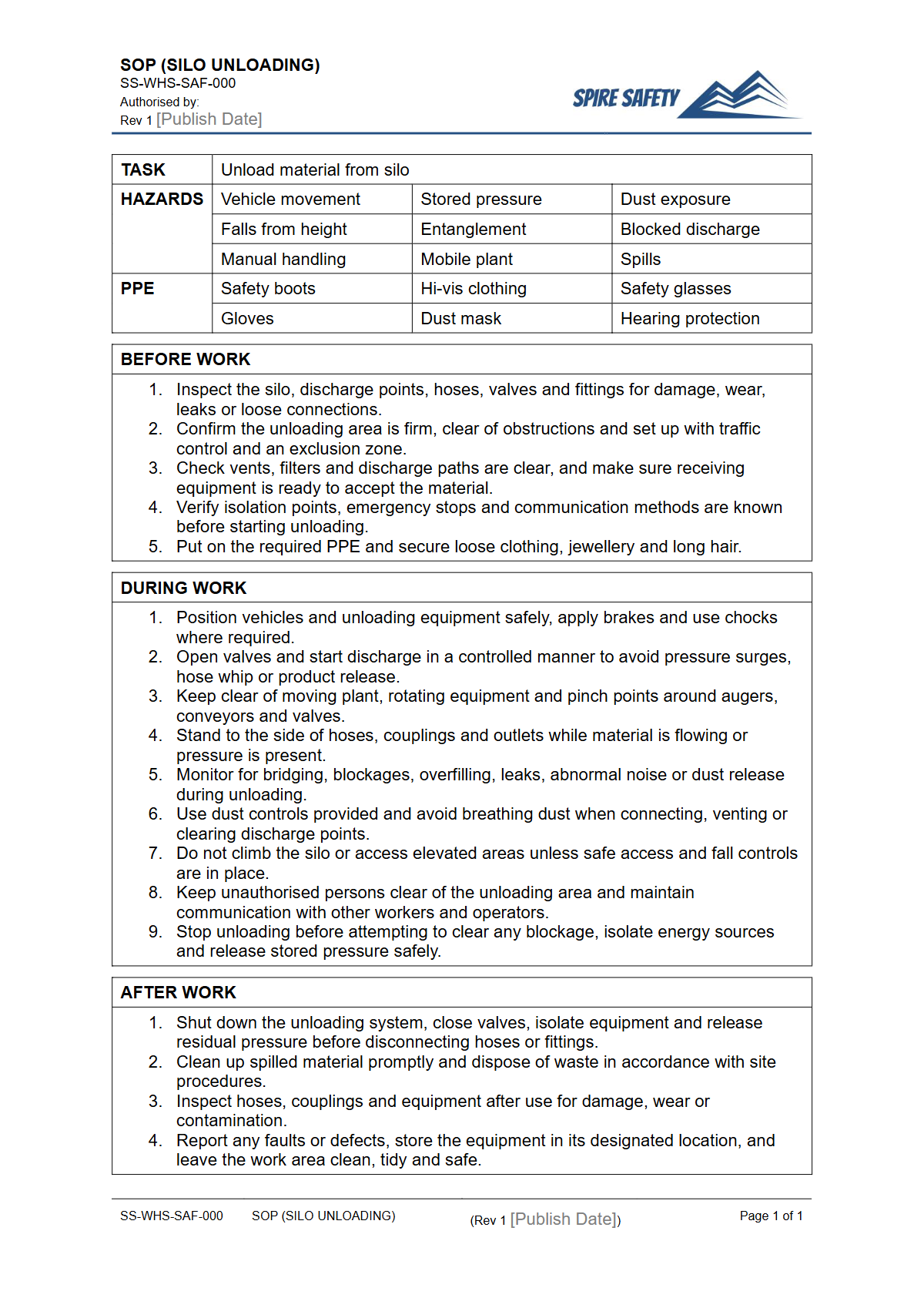
Purpose of the Free Safe Operating Procedure (Silo Unloading) Template
This Free Safe Operating Procedure (Silo Unloading) Template provides a structured starting point for documenting the required safety steps for unloading bulk materials from a silo. Operating and working around silos presents significant risks, including engulfment, hazardous atmospheres, falls from height, and entanglement with machinery like augers and conveyors.
Using a detailed Safe Operating Procedure (SOP) is a critical administrative control to ensure workers understand these hazards and follow a consistent, safe method of work for every task.
A well-developed SOP forms a fundamental part of your overall safety framework. It serves as a key document for worker training, competency assessments, and pre-start meetings.
Integrating this procedure into your broader safety program helps demonstrate a commitment to providing a safe system of work, which is a core requirement of Australian WHS legislation. Proper documentation is a cornerstone of effective WHS management systems, helping to standardise safe work practices across your entire organisation.
Video walkthrough
How to use the Free Safe Operating Procedure (Silo Unloading) Template
To get started, simply download the template in your preferred format (DOCX for easy editing or PDF for reference). The document is a comprehensive guide, but it is not a complete, ready-to-use procedure.
You must adapt it to the specific context of your workplace.
Key customisation steps include:
- Identifying the specific type of silo (e.g., tower, bunker, bag) and the material being stored (e.g., grain, cement, feed).
- Listing the exact plant and equipment used in the unloading process, such as augers, blowers, or belts.
- Incorporating site-specific emergency procedures, including rescue plans for engulfment.
- Detailing the required Personal Protective Equipment (PPE), such as respiratory protection for dust, safety harnesses for working at height, and appropriate gloves and footwear.
Note: We provide this template as a guide. It is essential that you customise it with your own site-specific information and consult with the equipment manufacturer’s instructions, relevant Australian Standards, and Codes of Practice to ensure it is suitable for your workplace.
The unloading process often involves other machinery; for related procedures, you might find our FREE Conveyer System SOP a useful reference.
When to use this Safe Operating Procedure
A Safe Operating Procedure for silo unloading should be actively used and referenced before and during all unloading tasks. It is not a document to be filed away and forgotten.
It should be used as a primary tool for training new operators and for conducting refresher training for experienced personnel. Supervisors should use the SOP as a checklist for observing work practices and verifying that the correct safety controls are in place.
In agricultural settings where various types of machinery are used, having clear SOPs for each is vital. Standardising procedures for tasks like silo unloading helps prevent incidents and streamline operations, much like using a FREE Grain Drill SOP ensures consistent and safe planting.
The principles of step-by-step hazard control are transferable across many farm activities.
This SOP should also be reviewed and referenced during incident investigations. If an accident or a near-miss occurs, the procedure can be analysed to determine if it was followed correctly and whether it needs to be updated to prevent a recurrence.
Similar structured procedures are also crucial when handling different kinds of bulk materials, and our FREE Spreader SOP offers another example for a related agricultural task.
Who should use it
This template is designed for use by a range of personnel within an organisation:
- WHS Managers and Safety Officers: To develop, implement, and integrate the SOP into the organisation's overall WHS management system.
- Supervisors and Team Leaders: To train workers, enforce the procedure, and conduct pre-start briefings and safety observations.
- Plant Operators and Workers: As a clear, step-by-step guide to follow for safely performing silo unloading tasks.
- Training Coordinators: To form the basis of a training and competency assessment program for silo operations.
The effectiveness of any SOP relies on its correct implementation and regular review. This can be verified through workplace inspections and formal audits.
These activities help confirm that the documented procedures match the reality of work being performed on the ground and that they remain effective at controlling risks. Engaging professionals for WHS compliance auditing can provide an independent assessment of your safety systems, including the practical application of your SOPs. For more downloadable templates and safety guides, you can explore our full free WHS resources library.
Common mistakes
Common mistakes to avoid
- Entering a silo to clear a blockage without following full confined space entry procedures, including isolation and atmospheric testing.
- Failing to recognise and manage the risks of 'bridging' or 'rat-holing', where material hangs up and can collapse unexpectedly.
- Using unsafe methods to dislodge blockages, such as poking from below or standing on unstable material.
- Neglecting to use appropriate Personal Protective Equipment (PPE), particularly P2-rated respiratory protection to prevent inhaling harmful dust.
Legal references
Legal considerations
The following legal requirements may be relevant to this type of work.
- Work Health and Safety Act (Harmonised) — Provides the primary duties for protecting workers and other people from work health and safety risks.
- Work Health and Safety Regulations (Harmonised) — Sets out requirements supporting the management of workplace hazards and risks.
The following codes may be relevant to this type of work.
- Managing WHS Risks Code of Practice — Provides practical guidance on identifying hazards, assessing risks and applying effective controls.
- Work Health and Safety Consultation, Cooperation and Coordination Code of Practice — Provides practical guidance on consulting workers and coordinating with other duty holders.
- Managing the Work Environment and Facilities Code of Practice — Provides practical guidance on safe work environments, workplace facilities and related controls.
Did you know
Quicksand Effect
Flowing grain in a silo behaves like quicksand. A worker can become trapped in as little as 4-5 seconds and can be completely submerged in less than 30 seconds.
Dust Explosions
Fine dust from materials like grain, flour, or sugar is highly combustible. When suspended in the air in a confined space like a silo and exposed to an ignition source, it can cause a powerful and devastating explosion.
FAQ
Frequently asked questions
01What is the biggest risk when unloading a silo?
02How often should a Silo Unloading SOP be reviewed?
03Can this template be used for any type of silo?
04Is a Safe Operating Procedure a legal requirement for silo unloading?
Share this resource
Free Safe Operating Procedure (Silo Unloading) Template
Browse Categories
How To Use It
- 1Download and open in Word or PDF.
- 2Replace the placeholders with your business details.
- 3Get it reviewed by a WHS specialist before rollout.
Need it customised?
Our WHS consultants can adapt this template to your site, run a gap analysis, or audit what you already have in place.
Book a Free Consultation WHS consulting servicesor call 1300 156 382
Related templates
- Free Safe Operating Procedure (Site Litter Collection) Template
- Free Safe Operating Procedure (Skidder) Template
- Free Safe Operating Procedure (Skip Bin Changeover) Template
- Free Safe Operating Procedure (Skip Bin Inspection) Template
- Free Safe Operating Procedure (Skip Bin Loading) Template
- Free Safe Operating Procedure (Skip Bin Placement) Template