
Free Safe Operating Procedure (Skip Bin Changeover) Template
Download our Free Safe Operating Procedure (Skip Bin Changeover) Template to manage high-risk tasks.
Free Safe Operating Procedure (Skip Bin Changeover) Template
DOCX • 126 KB + PDF
Updated Oct 2026
No signup required
Purpose of the Free Safe Operating Procedure (Skip Bin Changeover) Template
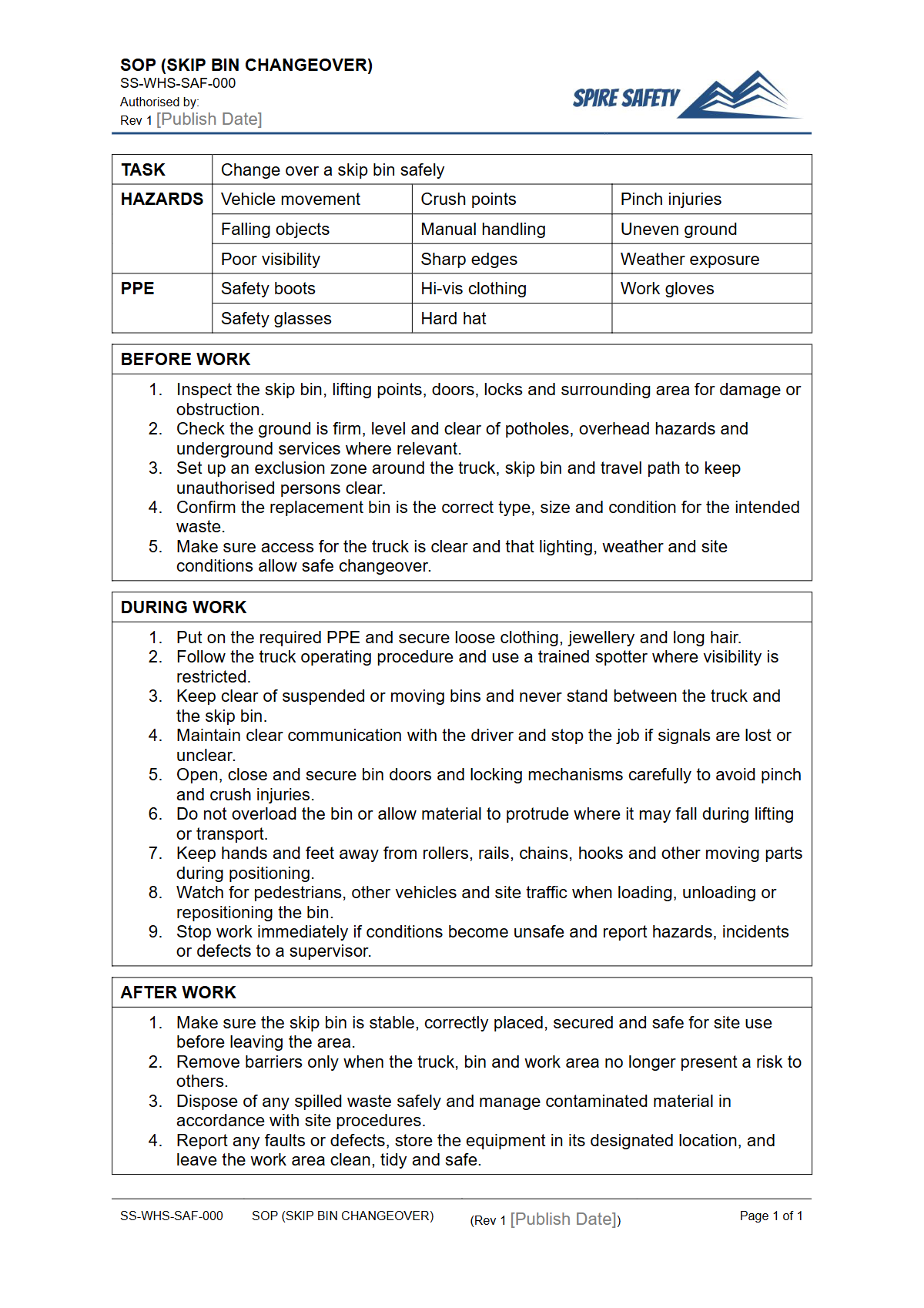
This Free Safe Operating Procedure (Skip Bin Changeover) Template provides a structured starting point for businesses to formalise the process of exchanging full skip bins for empty ones. The task, while routine, involves significant risks from mobile plant, suspended loads, and manual handling.
A documented SOP is a critical tool for managing these risks effectively. It helps organisations identify hazards, implement control measures, and provide clear, step-by-step instructions to workers, ensuring the task is performed safely and consistently every time.
Using this SOP demonstrates a commitment to workplace health and safety by standardising procedures for tasks involving heavy machinery and potentially unstable loads. It serves as a key component of your safety management system, acting as a training guide for new employees and a reference for experienced operators.
A well-developed SOP helps you meet your duty of care under Australian WHS legislation by ensuring a safe system of work is in place for high-risk activities. For related tasks involving heavy equipment, our FREE Telehandler SOP Template can provide further guidance on plant operation.
Video walkthrough
How to use the Free Safe Operating Procedure (Skip Bin Changeover) Template
This Safe Operating Procedure template is provided in both an editable DOCX format and a print-ready PDF. To begin, download the file and open it.
The document is structured with key sections including required PPE, pre-operational checks, a sequential guide for the changeover process, and post-operational clean-up. You must systematically work through each section and adapt the content to reflect the realities of your workplace.
IMPORTANT: This document is a template and must be customised to your specific operational context. We have provided a framework based on common industry practice, but you are responsible for adding details relevant to your site layout, the type of lifting machinery used (e.g., crane truck, forklift), bin specifications, and existing traffic management plans.
Integrating this SOP is a key part of developing a complete WHS management system that is practical and effective for your team.
When to use it
A Safe Operating Procedure for skip bin changeovers should be used as the primary reference document for the task. It should be readily accessible to all personnel involved, including truck drivers, forklift operators, and site supervisors.
This SOP should be consulted during worker training and induction for the task. It is also a vital tool to use during pre-start meetings or toolbox talks to review hazards and reinforce safe work methods before the job begins.
Furthermore, the SOP should be a live document, reviewed and updated following any incident or near miss, when new equipment is introduced, or as part of scheduled WHS compliance audits. Regularly reviewing the procedure ensures it remains relevant and continues to effectively control risks associated with the task. This proactive approach helps maintain a culture of safety and continuous improvement within your organisation.
Who should use it
This SOP is intended for a range of personnel within an organisation. WHS managers and site supervisors should use it to establish and enforce a standardised, safe method for skip bin handling.
It provides them with a clear benchmark for observing work practices and conducting competency assessments. Workers who perform the changeover are the primary end-users; the SOP gives them clear, unambiguous instructions to follow, reducing the likelihood of errors that could lead to injury.
Persons Conducting a Business or Undertaking (PCBUs) can use the finalised document to demonstrate due diligence in providing a safe system of work. It is also a valuable resource for safety committees and worker representatives during consultation on WHS matters.
For broader safety system advice, consider our general WHS consulting services to ensure your procedures are robust. You can explore other useful documents in our free WHS resources library to support your operations.
Common mistakes
Common mistakes to avoid
- Using a generic SOP without customising it for the specific site, vehicle, and bin type.
- Failing to establish and enforce clear exclusion zones for pedestrians and other vehicles.
- Neglecting to train workers on the finalised SOP and verify their understanding before they perform the task.
- Not regularly inspecting lifting equipment (e.g., chains, slings, hooks) for wear and tear.
Legal references
Legal considerations
The following legal requirements may be relevant to this type of work.
- Work Health and Safety Act (Harmonised) — Provides the primary duties for protecting workers and other people from work health and safety risks.
- Work Health and Safety Regulations (Harmonised) — Sets out requirements supporting the management of workplace hazards and risks.
The following codes may be relevant to this type of work.
- Managing WHS Risks Code of Practice — Provides practical guidance on identifying hazards, assessing risks and applying effective controls.
- Work Health and Safety Consultation, Cooperation and Coordination Code of Practice — Provides practical guidance on consulting workers and coordinating with other duty holders.
- Managing the Work Environment and Facilities Code of Practice — Provides practical guidance on safe work environments, workplace facilities and related controls.
Did you know
Suspended Load Dangers
A standard 6 cubic metre skip bin filled with soil or concrete can weigh over 7 tonnes. This significant weight makes it a critical suspended load, requiring stringent exclusion zones and certified lifting gear.
Traffic Management
Incidents involving vehicles and pedestrians are a major risk during skip bin operations. A simple but effective traffic management plan can drastically reduce the likelihood of a collision.
FAQ
Frequently asked questions
01What are the main hazards in a skip bin changeover?
02Is an SOP a legal requirement for changing skip bins in Australia?
03Who is responsible for developing the SOP for a skip bin changeover?
04How often should a skip bin SOP be reviewed?
Share this resource
Free Safe Operating Procedure (Skip Bin Changeover) Template
Browse Categories
How To Use It
- 1Download and open in Word or PDF.
- 2Replace the placeholders with your business details.
- 3Get it reviewed by a WHS specialist before rollout.
Need it customised?
Our WHS consultants can adapt this template to your site, run a gap analysis, or audit what you already have in place.
Book a Free Consultation WHS consulting servicesor call 1300 156 382
Related templates
- Free Safe Operating Procedure (Skip Bin Inspection) Template
- Free Safe Operating Procedure (Skip Bin Loading) Template
- Free Safe Operating Procedure (Skip Bin Placement) Template
- Free Safe Operating Procedure (Skip Bin Removal) Template
- Free Safe Operating Procedure (Skirting Board Clean) Template
- Free Safe Operating Procedure (Slasher Mower) Template