
Free Safe Operating Procedure (Skip Bin Removal) Template
Download our free Safe Operating Procedure (Skip Bin Removal) Template.
Free Safe Operating Procedure (Skip Bin Removal) Template
DOCX • 126 KB + PDF
Updated Oct 2026
No signup required
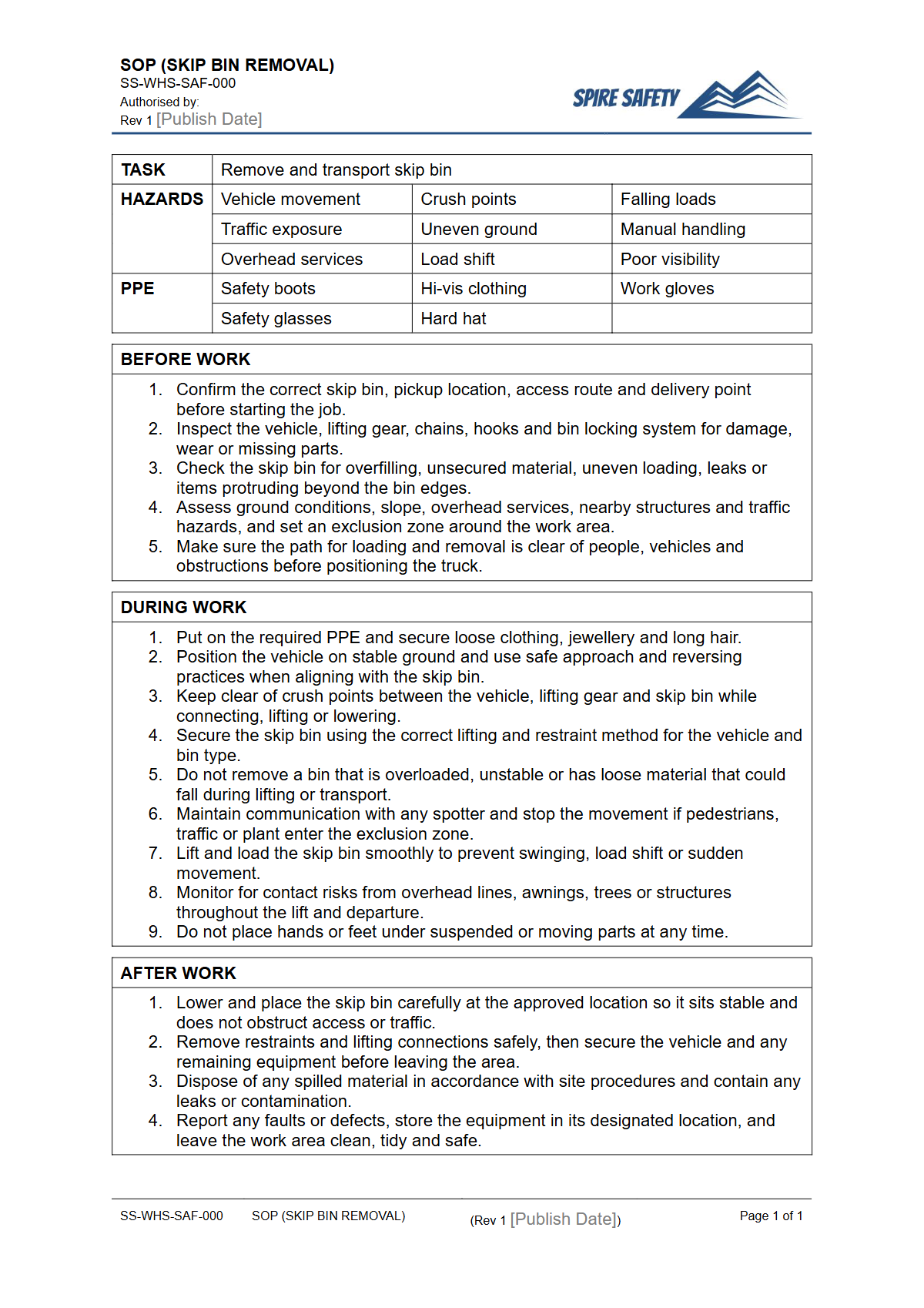
Purpose of the Free Safe Operating Procedure (Skip Bin Removal) Template
Effectively managing workplace safety requires clear, documented processes for high-risk tasks. This free Safe Operating Procedure (Skip Bin Removal) Template provides a structured starting point for your organisation to formalise its safety protocols.
Removing skip bins, a common task in construction, waste management, and industrial sites, involves significant hazards. These include manual handling risks, interaction with heavy vehicles, and potential for falling objects.
Using a detailed SOP helps ensure that every person involved understands the required steps to control these risks and perform the job safely.
The purpose of this document is to outline a step-by-step sequence for the task, identify potential hazards at each stage, and specify the control measures required to eliminate or minimise them. A well-developed SOP is a fundamental part of a robust safety framework, acting as a key training tool and a reference for workers and supervisors.
It demonstrates a commitment to fulfilling WHS duties by proactively managing foreseeable risks. Integrating this type of procedure is a crucial step in building comprehensive WHS management systems that protect workers and ensure operational consistency.
Video walkthrough
How to use the Free Safe Operating Procedure (Skip Bin Removal) Template
This template is provided in both DOCX and PDF formats for your convenience. The DOCX file is fully editable, allowing for complete customisation to align with your specific operational context.
To use it, simply download the file and open it in a word processor like Microsoft Word or Google Docs. You can then add your company logo, site-specific details, emergency contact information, and any unique procedures relevant to your workplace.
This process of adaptation is not just recommended; it is essential for the document to be effective.
IMPORTANT: This is a template only. It must be customised to reflect the specific equipment (e.g., truck type, lifting mechanism), environment, and risks at your workplace.
We recommend a consultation process with workers and supervisors who perform the task to ensure the SOP is practical, accurate, and effective. After customisation, the SOP should be used as a primary document for training, inductions, and ongoing competency verification.
For guidance on implementing SOPs and other safety documentation, consider seeking professional WHS consulting to ensure your systems are robust.
When to use it
A Safe Operating Procedure for skip bin removal should be used consistently as part of your daily work planning and execution. It is most effective when integrated into several key business processes.
Use it during the induction and training of new employees to ensure they understand the approved method before ever undertaking the task. It should also serve as the basis for pre-start meetings or toolbox talks, reinforcing safety standards and discussing any site-specific conditions that may affect the job on a given day.
The document should be readily accessible to all relevant personnel, either as a hard copy in the vehicle or digitally on a mobile device.
Furthermore, the SOP is a critical reference when conducting risk assessments or investigating an incident. It provides the established baseline for how the work should be performed, helping to identify any deviations that may have contributed to a safety breach.
Many similar high-risk tasks involving heavy vehicles also benefit from documented procedures, such as our Body Truck SOP. Regular review and reference to the SOP help maintain a culture of safety-consciousness within the organisation.
On busy sites where multiple types of plant and equipment operate, coordinating activities is vital. The controls outlined in your skip bin removal SOP must align with the procedures for other machinery.
For example, the operation of a telehandler in the vicinity must be accounted for in your traffic management and exclusion zone plans. You can standardise procedures for other common equipment using resources like our free Telehandler SOP template to ensure consistency across all site operations.
Who should use it
This Safe Operating Procedure is intended for a range of personnel within an organisation. The primary users are the workers and plant operators who physically carry out the task of removing skip bins.
For them, it is a direct guide to performing their job safely and correctly. Supervisors and team leaders must also use the SOP to train their teams, monitor work practices, and enforce the specified safety controls.
They are responsible for ensuring the procedures are understood and followed on the ground.
WHS managers and safety officers will use the SOP as a key piece of documentation within the overall safety management system. They are typically responsible for drafting, reviewing, and updating the procedure in consultation with the workforce.
The document serves as evidence of a safe system of work during safety audits. Ultimately, the Person Conducting a Business or Undertaking (PCBU) is responsible for ensuring such systems are in place, making this SOP a critical tool for demonstrating compliance with WHS duties.
Regular WHS compliance audits can help verify that these documented procedures are being implemented effectively across the business.
Documenting procedures for all high-risk equipment is a key part of WHS management. For instance, if your site also involves earthmoving activities, having a Dozer SOP template ensures that operators of that machinery also have clear, documented guidance.
You can find many more similar documents in our free WHS resources library to help build out your safety documentation.
Common mistakes
Common mistakes to avoid
- Using a generic SOP without site-specific customisation.
- Failing to establish clear exclusion zones for pedestrians during lifting operations.
- Neglecting to check the bin's contents for prohibited or hazardous materials before transport.
- Assuming the driver is solely responsible for safety, ignoring the duties of others on site.
Legal references
Legal considerations
The following legal requirements may be relevant to this type of work.
- Work Health and Safety Act (Harmonised) — Provides the primary duties for protecting workers and other people from work health and safety risks.
- Work Health and Safety Regulations (Harmonised) — Sets out requirements supporting the management of workplace hazards and risks.
The following codes may be relevant to this type of work.
- Managing WHS Risks Code of Practice — Provides practical guidance on identifying hazards, assessing risks and applying effective controls.
- Work Health and Safety Consultation, Cooperation and Coordination Code of Practice — Provides practical guidance on consulting workers and coordinating with other duty holders.
- Managing the Work Environment and Facilities Code of Practice — Provides practical guidance on safe work environments, workplace facilities and related controls.
Did you know
Vehicle Incidents
A significant portion of workplace fatalities in the transport and waste management sectors involve moving vehicles. Effective traffic management plans are a critical component of any skip bin removal procedure.
Manual Handling Risk
Musculoskeletal disorders from hazardous manual tasks are a leading cause of serious workers' compensation claims in Australia. Properly assessing and controlling lifting risks is essential.
FAQ
Frequently asked questions
01What are the main hazards in skip bin removal?
02Is a Safe Operating Procedure a legal requirement for skip bin removal in Australia?
03How often should a Skip Bin Removal SOP be reviewed?
04Can I use this template for different types of skip bins?
Share this resource
Free Safe Operating Procedure (Skip Bin Removal) Template
Browse Categories
How To Use It
- 1Download and open in Word or PDF.
- 2Replace the placeholders with your business details.
- 3Get it reviewed by a WHS specialist before rollout.
Need it customised?
Our WHS consultants can adapt this template to your site, run a gap analysis, or audit what you already have in place.
Book a Free Consultation WHS consulting servicesor call 1300 156 382
Related templates
- Free Safe Operating Procedure (Skirting Board Clean) Template
- Free Safe Operating Procedure (Slasher Mower) Template
- Free Safe Operating Procedure (Sling Label Inspection) Template
- Free Safe Operating Procedure (Sling Selection Check) Template
- Free Safe Operating Procedure (Slitting Line) Template
- Free Safe Operating Procedure (Slotting Machine) Template