
Free Safe Operating Procedure (Slitting Line) Template
Control slitting line hazards with our structured Safe Operating Procedure template. Download the free DOCX and PDF to start documenting your process.
Free Safe Operating Procedure (Slitting Line) Template
DOCX • 126 KB + PDF
Updated Oct 2026
No signup required
Purpose of the Free Safe Operating Procedure (Slitting Line) Template
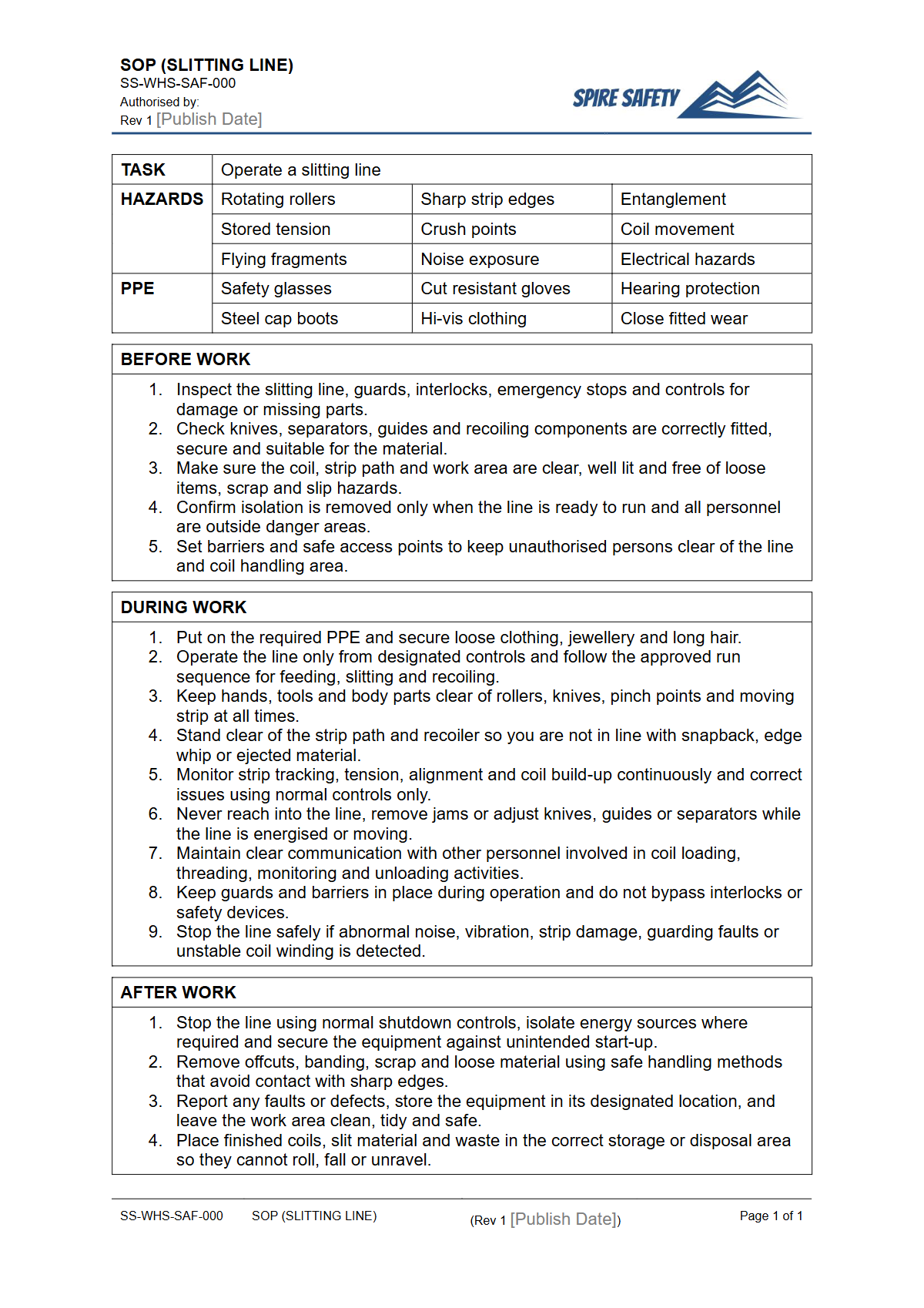
This free Safe Operating Procedure (Slitting Line) Template provides a structured starting point for organisations to document the step-by-step requirements for operating metal coil slitting machinery safely. Slitting lines present significant risks, including severe cuts from sharp metal edges, entanglement in rotating parts, and crushing injuries from heavy coils and moving components.
Implementing a detailed SOP is a critical control measure for managing these high-risk activities.
A well-developed SOP helps standardise operator behaviour, ensures all safety controls are communicated, and provides a clear reference for training and supervision. By outlining pre-start checks, operational steps, and shutdown procedures, it forms a vital part of your overall safety framework, helping to fulfil your duty of care under Australian WHS legislation. Documented procedures like this are a cornerstone of robust WHS management systems.
Video walkthrough
How to use the Free Safe Operating Procedure (Slitting Line) Template
This resource is available for immediate download in both DOCX and PDF formats. The DOCX file is fully editable, allowing you to tailor the content directly to your workplace’s specific machinery, tasks, and risk profile.
The template is structured to guide you through documenting key safety information clearly and logically.
Important: It is crucial to understand that this is a template, not a finished document. We strongly advise that you customise every section to reflect the specific slitting line models, materials handled, and unique processes in your workplace.
Consultation with experienced operators and supervisors during this customisation process is essential for creating an effective and practical SOP. For procedures on related machinery, you may find our FREE Conveyer System SOP a useful reference.
Key Customisation Areas
- Plant and Equipment Details: Specify the make, model, and unique identifiers of your slitting line(s).
- Pre-Operational Checks: Detail the specific checks required for your machine, such as verifying guard positions, E-stop functionality, and hydraulic/pneumatic system integrity.
- Step-by-Step Instructions: Modify the operational steps to match your exact workflow, including coil loading, threading, setting knives, running the line, and unloading finished coils.
- Emergency Procedures: Document site-specific emergency shutdown, lockout/tagout (LOTO), and first aid responses.
- Required PPE: List the mandatory personal protective equipment, ensuring it meets relevant Australian Standards (e.g., specific cut-resistance level for gloves, type of eye protection). Similar principles for selecting task-specific equipment apply to other high-risk tools, as outlined in our FREE Circular Saw SOP.
When to use it
A slitting line SOP should be the primary reference document for anyone interacting with the machinery. Its application includes new worker inductions and task-specific training, ensuring a consistent and safe introduction to the process.
It should be readily available at the worksite for operators to reference during their duties and for supervisors to use as a tool for monitoring safe work practices.
The document also serves as a critical baseline for conducting periodic risk assessments and reviewing safety protocols. It should be formally reviewed and updated after any incident, when modifications are made to the machinery or process, or on a scheduled basis as part of your safety management system's continuous improvement cycle. Ensure it is integrated with procedures for auxiliary equipment, such as those detailed in our Free Air Compressor SOP.
Who should use it
This SOP is intended for a range of personnel within an organisation:
- Slitting Line Operators: As the primary users, they must follow the outlined procedures for every task to ensure their own safety and that of their colleagues.
- Supervisors and Team Leaders: They are responsible for enforcing the SOP, providing training, and ensuring operators are competent in its application.
- WHS Managers and Personnel: They use the SOP to develop training programs, conduct risk assessments, and integrate the procedure into the broader WHS management system. It can also be a valuable document during internal WHS compliance auditing activities.
- Maintenance Crew: While they will have their own specific maintenance procedures, they need to be familiar with the operational SOP, particularly the lockout/tagout sections, before commencing any work.
Spire Safety provides a wide range of templates and guidance documents. To see what else is available, you can browse our complete free WHS resources library.
Common mistakes
Common mistakes to avoid
- Failing to adequately guard all rotating parts, in-running nip points, and cutting blades.
- Using generic PPE instead of task-specific items like high-level cut-resistant gloves.
- Neglecting to include detailed, machine-specific lockout/tagout (LOTO) procedures for cleaning and maintenance.
- Writing the SOP in isolation without consulting the experienced operators who perform the work daily.
Legal references
Legal considerations
The following legal requirements may be relevant to this type of work.
- Work Health and Safety Act (Harmonised) — Provides the primary duties for protecting workers and other people from work health and safety risks.
- Work Health and Safety Regulations (Harmonised) — Sets out requirements supporting the management of workplace hazards and risks.
The following codes may be relevant to this type of work.
- Managing WHS Risks Code of Practice — Provides practical guidance on identifying hazards, assessing risks and applying effective controls.
- Work Health and Safety Consultation, Cooperation and Coordination Code of Practice — Provides practical guidance on consulting workers and coordinating with other duty holders.
- Managing the Work Environment and Facilities Code of Practice — Provides practical guidance on safe work environments, workplace facilities and related controls.
Did you know
Nip Point Dangers
The forces at a nip point on machinery like a slitting line can be immense, capable of drawing in loose clothing, hair, or limbs in a fraction of a second, often before a person has time to react.
Cut Resistance Levels
Cut-resistant gloves are rated according to standards like AS/NZS 2161.3:2020. Selecting the appropriate level is critical and depends on the specific risk of handling sharp-edged metal coils.
FAQ
Frequently asked questions
01What are the main hazards of a slitting line?
02Is a Safe Operating Procedure a legal requirement in Australia?
03How often should a slitting line SOP be reviewed?
04Who is responsible for writing a Safe Operating Procedure?
Share this resource
Free Safe Operating Procedure (Slitting Line) Template
Browse Categories
How To Use It
- 1Download and open in Word or PDF.
- 2Replace the placeholders with your business details.
- 3Get it reviewed by a WHS specialist before rollout.
Need it customised?
Our WHS consultants can adapt this template to your site, run a gap analysis, or audit what you already have in place.
Book a Free Consultation WHS consulting servicesor call 1300 156 382
Related templates
- Free Safe Operating Procedure (Slotting Machine) Template
- Free Safe Operating Procedure (Slump Testing) Template
- Free Safe Operating Procedure (Slurry Pump) Template
- Free Safe Operating Procedure (Slush Machine) Template
- Free Safe Operating Procedure (Smoke Damper Test) Template
- Free Safe Operating Procedure (Smoke Detector Test) Template