
Free Safe Operating Procedure (Slush Machine) Template
Develop a clear process for operating commercial slush machines with our free template. Download your Safe Operating Procedure (Slush Machine) Template now.
Free Safe Operating Procedure (Slush Machine) Template
DOCX • 126 KB + PDF
Updated Oct 2026
No signup required
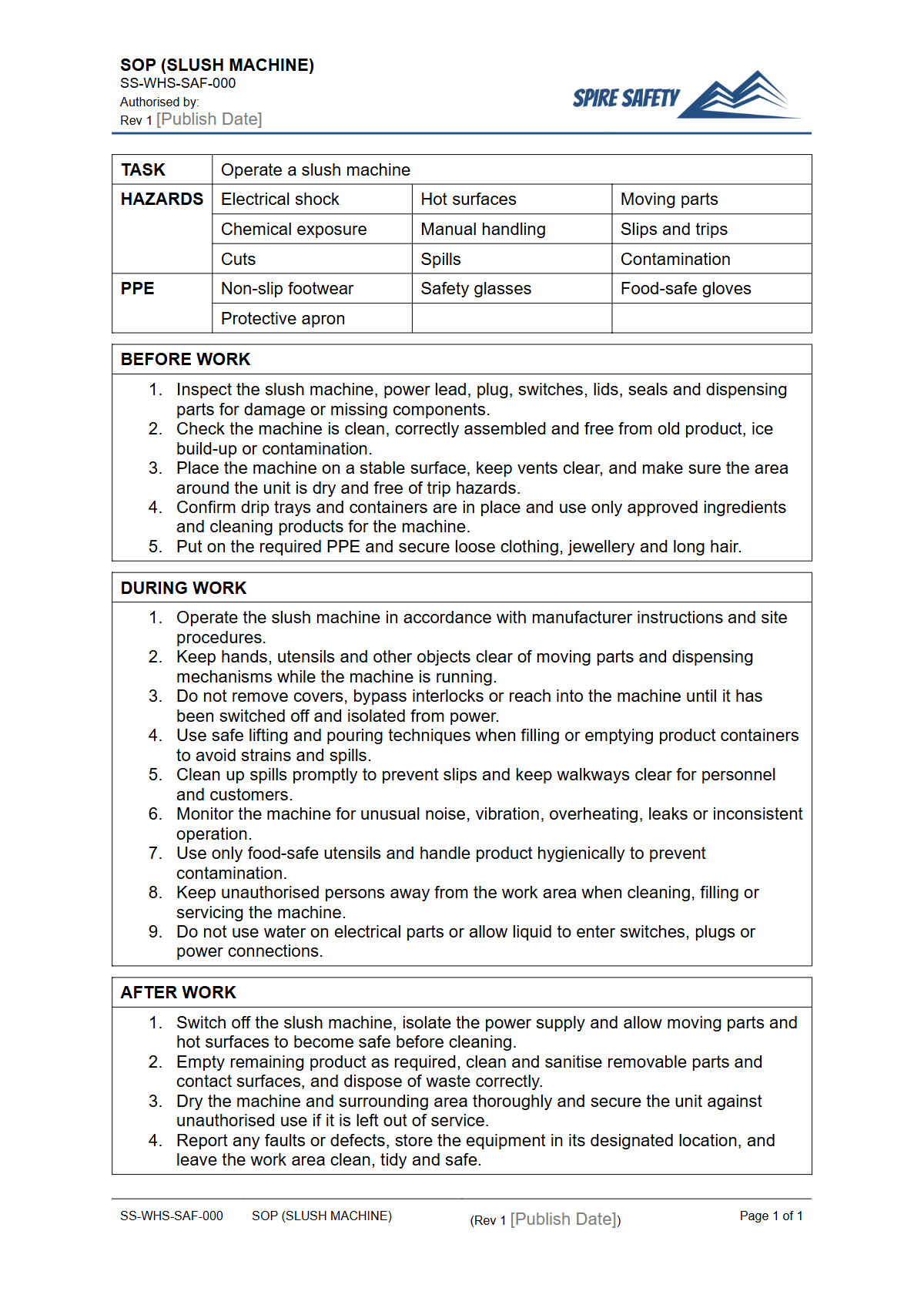
Purpose of the Free Safe Operating Procedure (Slush Machine) Template
This Free Safe Operating Procedure (Slush Machine) Template provides a structured framework for documenting the safe use of commercial slush, granita, or frozen beverage machines. It is designed to help your organisation identify potential hazards and establish clear, step-by-step controls to minimise risks to workers and customers.
Using a formalised SOP promotes consistent, safe work practices, assists in training new staff, and demonstrates a commitment to workplace health and safety. The template is a valuable starting point for businesses in hospitality, retail, and food service sectors aiming to manage risks associated with food preparation equipment.
Implementing documented procedures is a fundamental part of a robust safety framework. For businesses looking to formalise their entire safety approach, integrating SOPs into broader WHS management systems can create a cohesive and effective safety culture that covers all operational risks.
Key Hazards Addressed
While operating a slush machine may seem straightforward, several hazards must be managed:
- Electrical Hazards: Risk of electric shock from faulty wiring, improper grounding, or contact with water during operation or cleaning.
- Slips, Trips, and Falls: Spills of syrup, water, or the finished product can create slippery surfaces, increasing the risk of falls.
- Hygiene and Food Safety: Incorrect cleaning procedures or infrequent sanitation can lead to bacterial growth (e.g., mould, listeria), posing a health risk to consumers.
- Manual Handling: Lifting heavy syrup containers, moving the machine for cleaning, or awkward postures during maintenance can lead to musculoskeletal injuries.
- Mechanical Hazards: Although rare with modern designs, contact with moving parts like mixing augers during maintenance or improper assembly can cause injuries.
Video walkthrough
How to use the Free Safe Operating Procedure (Slush Machine) Template
This template is provided in both DOCX and PDF formats for your convenience. To effectively implement this Safe Operating Procedure for a Slush Machine, begin by downloading the file and opening it with compatible software like Microsoft Word or Google Docs.
Systematically work through each section, customising the content to reflect the specific make and model of the machines used in your workplace, your unique operational environment, and any site-specific risks. Engage with the workers who actually operate and clean the machines to ensure the procedure is practical and accurately reflects their tasks.
Important: This document is a template only. It must be customised to suit the specific equipment, chemicals, and processes used in your workplace.
We make no guarantee that this document is suitable for your specific circumstances. A generic procedure is not a substitute for a site-specific risk assessment and consultation with your team.
Reviewing and updating SOPs is a continuous process. As part of your safety management, you might also consider documenting procedures for other common equipment, such as an Air Compressor SOP, to ensure all plant is managed under a consistent safety protocol.
When to use this SOP
A Safe Operating Procedure for a slush machine should be used as a primary reference document during several key activities. It is essential for inducting and training new employees, ensuring they learn the correct, safe method from the outset.
It should also be readily available in the work area for operators to consult whenever they are unsure about a step, particularly for tasks performed infrequently, like deep cleaning or troubleshooting. The SOP is also a critical tool for supervisors conducting competency assessments and for safety officers during routine inspections or after an incident has occurred.
Periodic reviews of your safety documents are crucial to their effectiveness. An independent review process, such as a formal WHS compliance audit, can help identify gaps in your procedures and ensure they remain aligned with current legislation and best practices.
Who should use a Slush Machine SOP
This SOP is intended for a range of personnel within an organisation. Primarily, it is for the direct operators of the equipment—the café staff, kitchen hands, or service attendants responsible for the day-to-day filling, operation, and dispensing of the product.
Supervisors and managers should also use the document to oversee operations, enforce safety standards, and conduct training. Additionally, maintenance and cleaning staff must refer to the SOP to ensure they follow safe isolation and sanitation procedures, protecting both themselves and the consumers.
Documenting procedures for all machinery helps build a comprehensive safety library. For organisations with more complex production lines, a resource like our FREE Conveyer System SOP Template can provide a useful reference for managing interconnected equipment safely.
Similarly, if your operations involve other types of processing equipment, adapting a template like the FREE Injection Molding Machine SOP might offer insights into managing process-specific hazards.
By ensuring all relevant personnel are familiar with and adhere to the SOP, you create multiple layers of safety. For more templates and safety resources, you can browse our complete free WHS resources library for documents covering a wide range of tasks and equipment.
Common mistakes
Common mistakes to avoid
- Neglecting daily and weekly cleaning schedules, leading to mould and bacteria.
- Using incorrect syrup-to-water ratios, which can cause the machine to freeze up or fail.
- Performing maintenance or clearing a jam without first disconnecting the machine from power.
- Placing the machine in an area with poor ventilation, causing the compressor to overheat.
Legal references
Legal considerations
The following legal requirements may be relevant to this type of work.
- Work Health and Safety Act (Harmonised) — Provides the primary duties for protecting workers and other people from work health and safety risks.
- Work Health and Safety Regulations (Harmonised) — Sets out requirements supporting the management of workplace hazards and risks.
The following codes may be relevant to this type of work.
- Managing WHS Risks Code of Practice — Provides practical guidance on identifying hazards, assessing risks and applying effective controls.
- Work Health and Safety Consultation, Cooperation and Coordination Code of Practice — Provides practical guidance on consulting workers and coordinating with other duty holders.
- Managing the Work Environment and Facilities Code of Practice — Provides practical guidance on safe work environments, workplace facilities and related controls.
Did you know
Hidden Health Hazard
Improperly cleaned slush machines can become breeding grounds for bacteria like Listeria. Some studies have found that the high sugar content does not prevent bacterial growth, making strict adherence to sanitation schedules critical for food safety.
FAQ
Frequently asked questions
01What is included in a Safe Operating Procedure for a slush machine?
02How often should a slush machine SOP be reviewed?
03Is specific training required to operate a slush machine safely?
04Who is responsible for writing a Safe Operating Procedure?
Share this resource
Free Safe Operating Procedure (Slush Machine) Template
Browse Categories
How To Use It
- 1Download and open in Word or PDF.
- 2Replace the placeholders with your business details.
- 3Get it reviewed by a WHS specialist before rollout.
Need it customised?
Our WHS consultants can adapt this template to your site, run a gap analysis, or audit what you already have in place.
Book a Free Consultation WHS consulting servicesor call 1300 156 382
Related templates
- Free Safe Operating Procedure (Smoke Damper Test) Template
- Free Safe Operating Procedure (Smoke Detector Test) Template
- Free Safe Operating Procedure (Smoke Machine) Template
- Free Safe Operating Procedure (Smoke Stain Removal) Template
- Free Safe Operating Procedure (Snorkel Equipment) Template
- Free Safe Operating Procedure (Soccer Goal Inspection) Template