
Free Safe Operating Procedure (Smoke Damper Test) Template
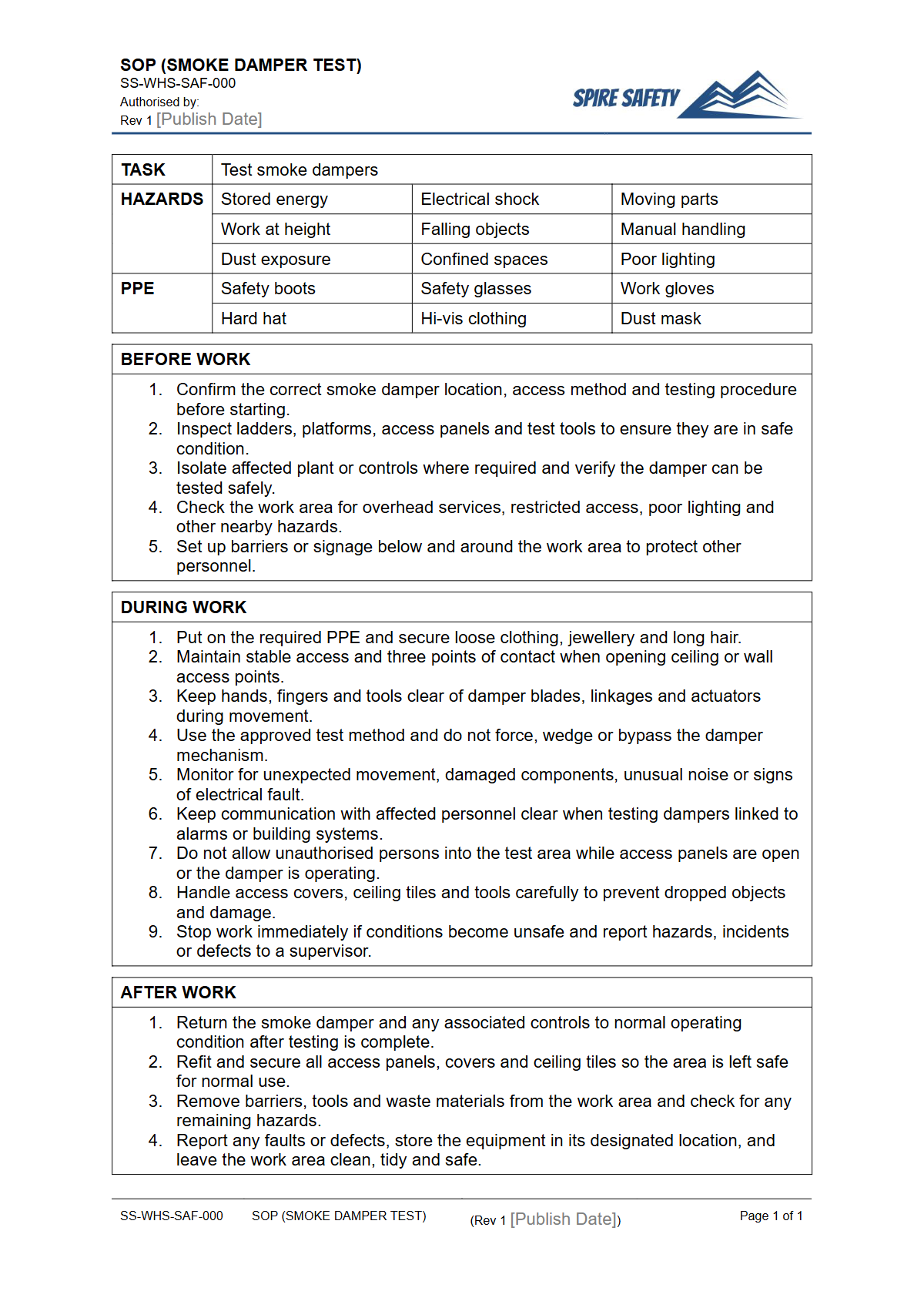
Download our free Safe Operating Procedure (Smoke Damper Test) template. It provides a clear, structured format for documenting safety steps.
Free Safe Operating Procedure (Smoke Damper Test) Template
DOCX • 126 KB + PDF
Updated Oct 2026
No signup required
Purpose of the Free Safe Operating Procedure (Smoke Damper Test) Template
A smoke damper is a critical component of a building’s fire safety system, designed to prevent the spread of smoke through ductwork. Regular testing is not just good practice; it’s a fundamental safety requirement.
This Free Safe Operating Procedure (Smoke Damper Test) Template provides a structured framework for documenting the step-by-step process for inspecting and testing these devices. Using a formal SOP helps ensure that tests are performed consistently and thoroughly every time, regardless of who is performing the task.
It provides a clear record of work, assists in training new personnel, and demonstrates due diligence in maintaining a safe environment.
Documenting your procedures is a cornerstone of any effective safety framework. A well-written SOP forms part of your overall WHS management systems, integrating operational tasks with your broader safety objectives.
It turns safety from an abstract concept into a practical, repeatable action. This template helps you formalise one of the most critical maintenance tasks in building fire safety, ensuring all safety checks, isolation steps, and functional tests are carried out in the correct sequence.
Video walkthrough
How to Use the Free Safe Operating Procedure (Smoke Damper Test) Template
This resource is provided in both DOCX and PDF formats for your convenience. The DOCX file is fully editable, allowing you to tailor the procedure to your specific needs.
To use the template effectively, download the file and open it in a compatible word processor. Review each section, including the pre-start checks, operational steps, and post-task clean-up, and modify the content to align with the specific types of smoke dampers installed in your facility, the tools required, and the unique hazards of your environment.
It's crucial to remember that this is a template, not a finished document. We have designed it to be customised.
You must adapt it to reflect the specific smoke damper systems, access methods, and risks present in your workplace. This includes adding site-specific details like the location of fire indicator panels, isolation points, and emergency contacts.
A generic procedure is not sufficient; a risk assessment should inform the final document.
When to Use This Safe Operating Procedure
This SOP should be used every time a smoke damper test is conducted. It provides a consistent methodology for scheduled routine maintenance as mandated by Australian Standard AS 1851, which outlines frequencies for testing fire protection systems.
Beyond routine checks, it is also essential to use this procedure following any significant modification or repair to the HVAC system, after a fire alarm activation, or as part of commissioning a new building or tenancy. Regular, documented testing is often a prerequisite for annual fire safety statements and can be a key point of verification during WHS compliance auditing.
Who Should Use This Safe Operating Procedure
This SOP is designed for use by competent persons tasked with maintaining building safety systems. This includes qualified HVAC technicians, facilities maintenance personnel, fire safety contractors, and electricians with the appropriate training and expertise.
Facility Managers and Building Managers should use this template to establish and enforce the standard of work required. Persons Conducting a Business or Undertaking (PCBUs) can use it to ensure they are meeting their legal obligation to provide and maintain a safe system of work.
The procedure should be readily available to anyone involved in the testing process, serving as both a guide and a training tool.
Organisations manage a wide range of equipment, each with its own risks and operating requirements. Documenting procedures for all key tasks is essential, from complex fire systems to more common equipment.
For example, maintaining clear documentation is just as important for facilities equipment, as demonstrated in this Free Safe Operating Procedure (Floor Scrubber Operation) Template. You can find more examples for various plant and equipment in our free WHS resources library to help build out your safety documentation.
Common mistakes
Common mistakes to avoid
- Failing to test dampers at the required frequency specified in AS 1851.
- Neglecting to properly document test results, including pass/fail status and any corrective actions taken.
- Using personnel who are not competent or adequately trained for the specific task and equipment.
- Overlooking access issues where dampers have become obstructed by new construction, wiring, or stored materials.
Legal references
Legal considerations
The following legal requirements may be relevant to this type of work.
- Work Health and Safety Act (Harmonised) — Provides the primary duties for protecting workers and other people from work health and safety risks.
- Work Health and Safety Regulations (Harmonised) — Sets out requirements supporting the management of workplace hazards and risks.
The following codes may be relevant to this type of work.
- Managing WHS Risks Code of Practice — Provides practical guidance on identifying hazards, assessing risks and applying effective controls.
- Work Health and Safety Consultation, Cooperation and Coordination Code of Practice — Provides practical guidance on consulting workers and coordinating with other duty holders.
- Managing the Work Environment and Facilities Code of Practice — Provides practical guidance on safe work environments, workplace facilities and related controls.
Did you know
Australian Standard
AS 1851 is the primary standard governing the routine service of fire protection systems and equipment, including smoke dampers, in Australia.
Fire vs. Smoke Dampers
While fire dampers close to stop the spread of flames, smoke dampers are specifically designed to stop the movement of smoke and toxic gases, which are the leading cause of injury and death in a fire.
FAQ
Frequently asked questions
01What is a smoke damper?
02How often should smoke dampers be tested in Australia?
03Who is qualified to test smoke dampers?
04Does this SOP template cover both manual and motorised dampers?
Share this resource
Free Safe Operating Procedure (Smoke Damper Test) Template
Browse Categories
How To Use It
- 1Download and open in Word or PDF.
- 2Replace the placeholders with your business details.
- 3Get it reviewed by a WHS specialist before rollout.
Need it customised?
Our WHS consultants can adapt this template to your site, run a gap analysis, or audit what you already have in place.
Book a Free Consultation WHS consulting servicesor call 1300 156 382
Related templates
- Free Safe Operating Procedure (Smoke Detector Test) Template
- Free Safe Operating Procedure (Smoke Machine) Template
- Free Safe Operating Procedure (Smoke Stain Removal) Template
- Free Safe Operating Procedure (Snorkel Equipment) Template
- Free Safe Operating Procedure (Soccer Goal Inspection) Template
- Free Safe Operating Procedure (Soda Dispenser Cleaning) Template