
Free Safe Operating Procedure (Soda Dispenser Cleaning) Template
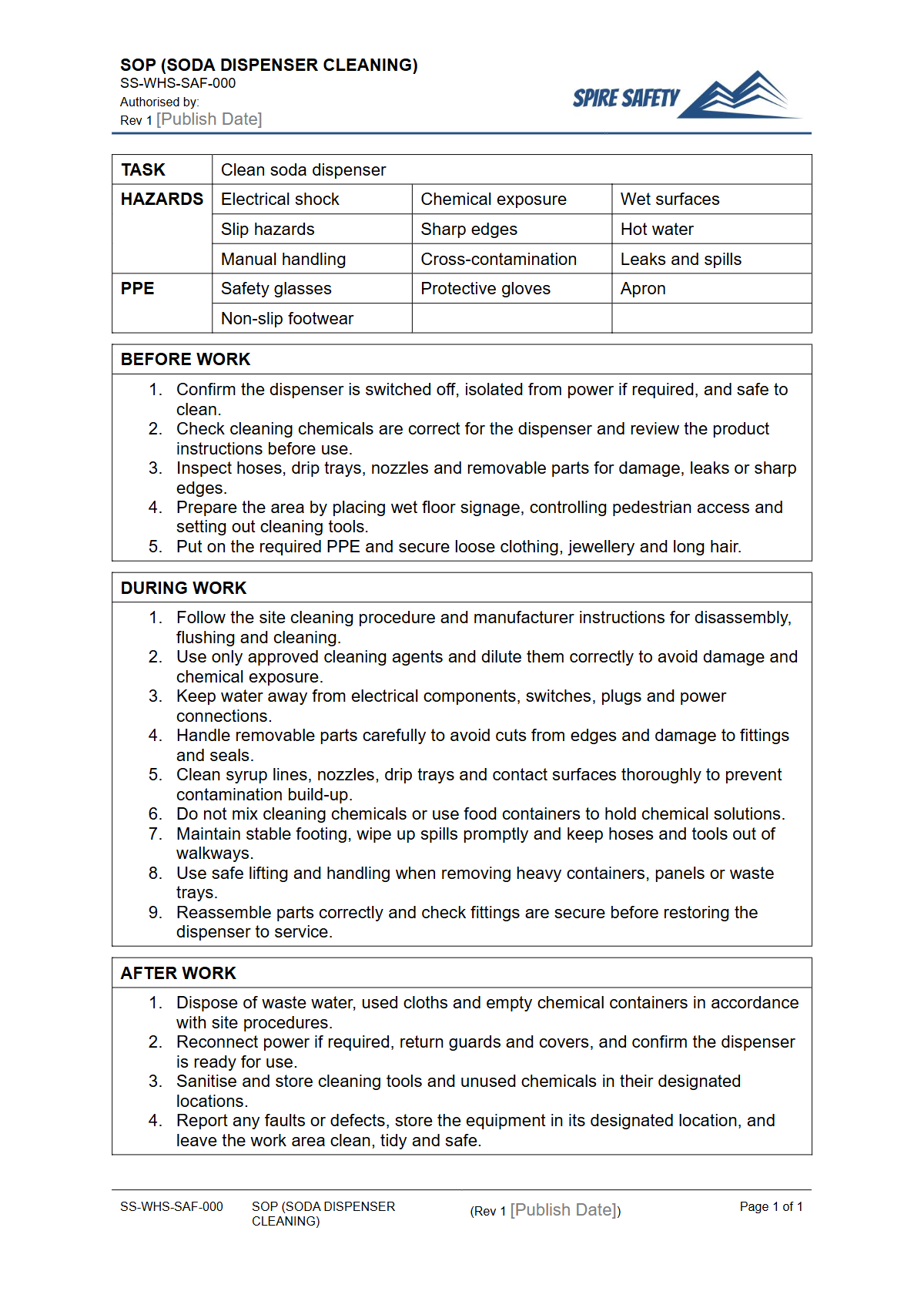
Ensure consistent and safe cleaning of your soda dispensers with our detailed Safe Operating Procedure template. Download your free, customisable DOCX and PDF.
Free Safe Operating Procedure (Soda Dispenser Cleaning) Template
DOCX • 126 KB + PDF
Updated Oct 2026
No signup required
Purpose of the Free Safe Operating Procedure (Soda Dispenser Cleaning) Template
A Safe Operating Procedure (SOP) is a critical document for ensuring tasks are performed safely and consistently. This is especially true for routine activities like equipment cleaning in the hospitality and food service industries.
Spire Safety's Free Safe Operating Procedure (Soda Dispenser Cleaning) Template provides a structured document to help your organisation outline the step-by-step process for this common task. It helps manage risks such as chemical exposure, slips and falls, and electrical hazards, forming a key part of your overall safety management system.
Proper documentation supports worker training and demonstrates due diligence.
The primary purpose of this template is to provide a clear, repeatable framework that standardises your cleaning process. By documenting each step, you reduce the likelihood of errors and ensure that safety and hygiene standards are met every time.
This is similar to how other specific procedures, like a detailed Safe Operating Procedure for deep fryer operation, help manage risks in a kitchen environment. A well-defined SOP for soda dispenser cleaning not only protects your staff but also ensures beverage quality and customer safety by preventing contamination.
Video walkthrough
How to use the Free Safe Operating Procedure (Soda Dispenser Cleaning) Template
This document is provided as a starting point. It is essential that you customise it to reflect the specific equipment, chemicals, and environment of your workplace.
Download the DOCX file and adapt it to fit your unique operational context.
Your customisation should include:
- Specific Equipment: List the make and model of the soda dispensers in use.
- Chemicals: Name the specific cleaning and sanitising agents, and reference their Safety Data Sheets (SDS).
- Personal Protective Equipment (PPE): Detail the exact PPE required, such as specific types of gloves or safety glasses.
- Emergency Procedures: Outline steps to take in case of a chemical spill, electrical fault, or other incident.
- Site-Specific Details: Add any other relevant information unique to your location or workflow.
Important: This template is a guide and not a substitute for a site-specific risk assessment. We have developed it as a foundation, but you are responsible for ensuring the final document is comprehensive and accurately reflects the hazards and control measures for your business.
When to use it
A Safe Operating Procedure for soda dispenser cleaning should be a core part of your daily and weekly routines. It is not a document to be filed away and forgotten.
It should be actively used in several scenarios, including as part of a scheduled cleaning program alongside other tasks detailed in documents like a free SOP for Floor Scrubber Operation to maintain overall site cleanliness.
Key usage points include:
- Worker Training: Use the SOP as the primary training document for new employees or those newly assigned to the task.
- Refresher Training: Conduct periodic refresher training to ensure long-term staff haven't developed unsafe habits.
- Procedural Reference: Keep the SOP easily accessible near the work area so workers can refer to it as needed.
- After an Incident: Review and update the SOP following any incident or near-miss to incorporate learnings and prevent recurrence.
- Process Changes: Revise the SOP whenever new equipment, chemicals, or cleaning protocols are introduced.
Who should use it
The SOP is designed for several key roles within an organisation. Each group interacts with the document differently to contribute to a safer workplace.
- Workers: Employees assigned to clean the soda dispensers must follow the step-by-step instructions to ensure their own safety and the safety of others. They are the primary users.
- Supervisors and Managers: Team leaders and managers use the SOP to train staff, monitor performance, and verify that procedures are being followed correctly. It provides a clear benchmark for expected behaviour and work standards.
- WHS Personnel: Health and safety officers or managers use the SOP as an artefact within the broader WHS management system. They assist in its development, review its effectiveness, and integrate it into the overall safety framework.
Ultimately, a successful SOP requires buy-in from everyone. Developing the procedure in consultation with the workers who perform the task is a crucial step.
This collaborative approach ensures the SOP is practical, accurate, and more likely to be adopted. For complex environments, seeking external WHS consulting advice can help validate your processes and ensure they align with best practice.
This document is just one of many templates available in our free WHS resources library, designed to help Australian businesses improve their safety systems.
Common mistakes
Common mistakes to avoid
- Using incorrect dilution ratios for cleaning chemicals, reducing effectiveness or creating a new hazard.
- Failing to disconnect the machine from power before cleaning internal components, creating an electrical risk.
- Neglecting to thoroughly rinse cleaning solutions, leaving chemical residue that can contaminate beverages.
- Not documenting training, leaving no record that workers understand and are competent in the safe procedure.
Legal references
Legal considerations
The following legal requirements may be relevant to this type of work.
- Work Health and Safety Act (Harmonised) — Provides the primary duties for protecting workers and other people from work health and safety risks.
- Work Health and Safety Regulations (Harmonised) — Sets out requirements supporting the management of workplace hazards and risks.
The following codes may be relevant to this type of work.
- Managing WHS Risks Code of Practice — Provides practical guidance on identifying hazards, assessing risks and applying effective controls.
- Work Health and Safety Consultation, Cooperation and Coordination Code of Practice — Provides practical guidance on consulting workers and coordinating with other duty holders.
- Managing the Work Environment and Facilities Code of Practice — Provides practical guidance on safe work environments, workplace facilities and related controls.
Did you know
Biofilm Risk
Soda dispenser nozzles are a prime breeding ground for biofilm—a slimy matrix of bacteria. Regular, thorough cleaning as per a documented SOP is crucial to prevent contamination and protect customer health.
Syrup Spills
Spilled soda syrup creates a significant slip hazard that can be hard to see on many floor surfaces. Procedures should include immediate clean-up protocols for any spills to prevent falls.
FAQ
Frequently asked questions
01What are the main hazards when cleaning a soda dispenser?
02How often should a soda dispenser cleaning SOP be reviewed?
03Is this soda dispenser SOP template enough for WHS compliance?
04What personal protective equipment (PPE) is needed for cleaning a soda dispenser?
Share this resource
Free Safe Operating Procedure (Soda Dispenser Cleaning) Template
Browse Categories
How To Use It
- 1Download and open in Word or PDF.
- 2Replace the placeholders with your business details.
- 3Get it reviewed by a WHS specialist before rollout.
Need it customised?
Our WHS consultants can adapt this template to your site, run a gap analysis, or audit what you already have in place.
Book a Free Consultation WHS consulting servicesor call 1300 156 382
Related templates
- Free Safe Operating Procedure (Soft Drink Dispenser) Template
- Free Safe Operating Procedure (Soft Serve Machine) Template
- Free Safe Operating Procedure (Soil Amendment Mixing) Template
- Free Safe Operating Procedure (Soil Compaction Test) Template
- Free Safe Operating Procedure (Soil Sampling) Template
- Free Safe Operating Procedure (Soiled Linen Trolley) Template