
Free Safe Operating Procedure (Soil Compaction Test) Template
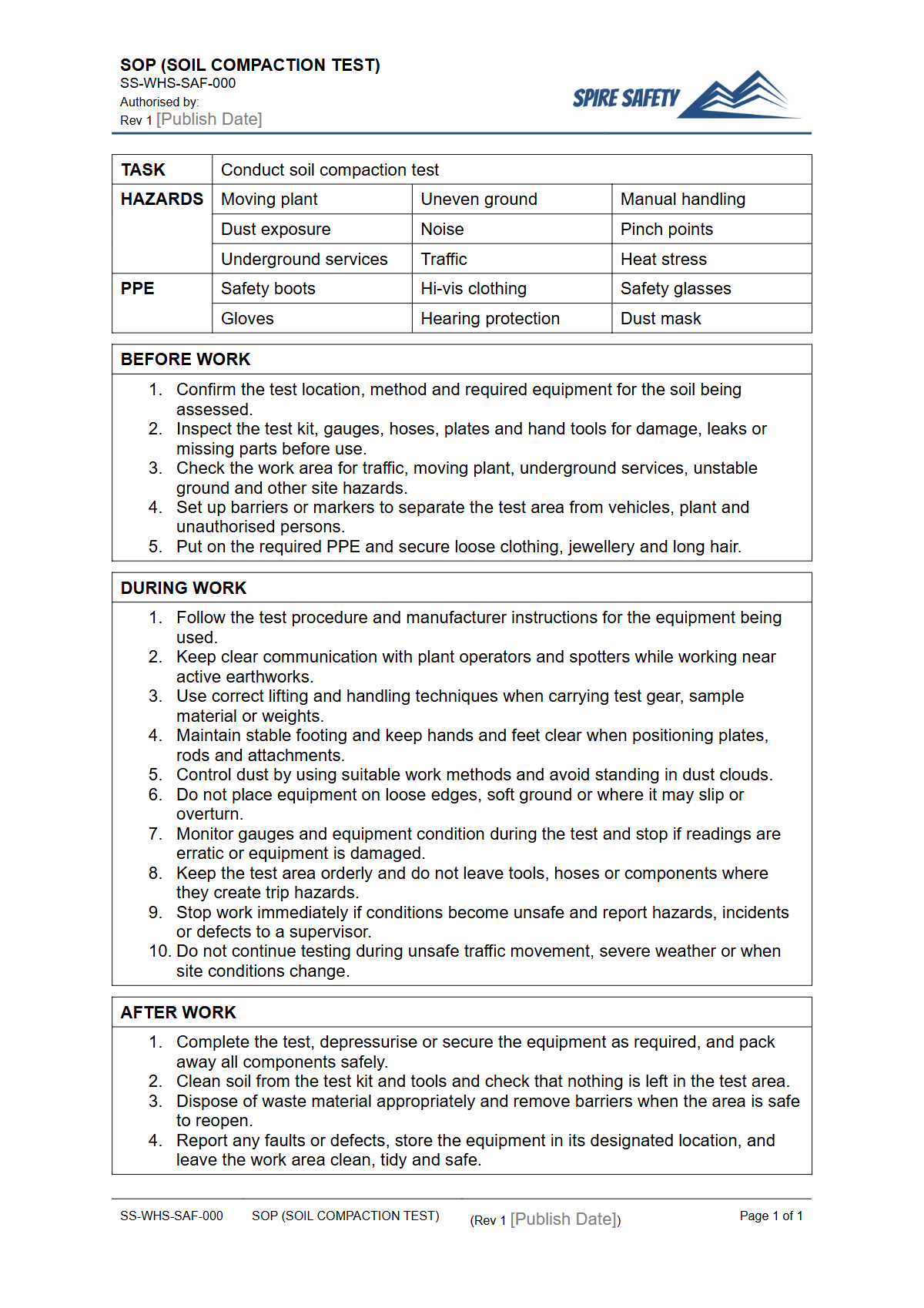
Download our free Safe Operating Procedure (Soil Compaction Test) template to formalise safety steps for geotechnical testing. Get your customisable DOCX now.
Free Safe Operating Procedure (Soil Compaction Test) Template
DOCX • 126 KB + PDF
Updated Oct 2026
No signup required
Purpose of the Free Safe Operating Procedure (Soil Compaction Test) Template
Conducting soil compaction tests is a critical task in construction and civil engineering projects, ensuring ground stability and foundation integrity. However, the process involves specific hazards, including manual handling, exposure to dust, noise from equipment, and potential radiation exposure from nuclear densometers.
This free Safe Operating Procedure (Soil Compaction Test) template provides a structured starting point for documenting the required safety controls for this activity. It helps your organisation standardise procedures, train workers effectively, and demonstrate due diligence in risk management.
A well-defined SOP is a cornerstone of a functional safety framework. By clearly outlining steps for pre-operational checks, safe operation, and post-task clean-up, you create a repeatable and auditable process.
Integrating this document into your broader safety program supports the development of robust WHS management systems, ensuring that safety protocols are consistently applied across all projects and teams.
Video walkthrough
How to use the Free Safe Operating Procedure (Soil Compaction Test) Template
This resource is provided as a downloadable DOCX file that you can easily edit and adapt. A PDF version is also included for straightforward distribution once you have finalised the procedure.
It is crucial to tailor the content to the specific context of your workplace, considering the exact type of compaction testing equipment used (e.g., nuclear densometer, sand cone), the site conditions, and your existing safety protocols.
To implement this SOP effectively, you should consult with the geotechnical technicians and site supervisors who will be performing the work. Their direct input is invaluable for identifying practical hazards and effective control measures.
A site-specific risk assessment should be completed to inform the final document. The process of managing ground-related risks is also detailed in our FREE Trencher SOP Template, which addresses similar excavation hazards.
Please be aware: this is a template we have developed to guide you. It must be customised to suit the specific equipment, substances, and circumstances of your workplace.
When to use it
A Safe Operating Procedure for soil compaction testing should be used whenever this task is performed. It is an essential document for a range of project stages and quality assurance activities, including:
- Pre-construction site investigation: To assess soil properties for foundation and structural design.
- During earthworks and construction: As a quality control measure to verify that compaction meets engineering specifications for backfill, road bases, and building pads.
- Infrastructure projects: For critical checks on dams, embankments, retaining walls, and pipelines where soil stability is paramount.
- Post-remediation verification: To confirm that reinstated ground meets the required density and stability standards.
Having a documented SOP ensures that these critical tests are performed safely and consistently, providing reliable data that can be crucial during WHS compliance auditing and project handovers.
Who should use it
This Safe Operating Procedure is designed for use by various personnel involved in construction and civil works. Key users include:
- Geotechnical Technicians and Field Engineers: The primary operators who perform the tests on-site.
- Site Supervisors and Foremen: To oversee the work, ensure procedures are followed, and manage associated risks within their teams. - Project Managers: To ensure that project activities comply with both engineering specifications and WHS requirements.
- WHS Advisors and Officers: To integrate the procedure into the site's overall safety management plan and use it for inductions and training.
On larger sites, this procedure complements other plant-related documents, such as the FREE Scraper SOP Template used for bulk earthmoving operations. Consistency across all operational safety documents is key to building a strong safety culture.
If your team requires assistance in adapting this template or developing a suite of SOPs for high-risk construction tasks, engaging professional WHS consulting services can provide expert guidance and ensure your documentation is robust and practical.
On a modern worksite, numerous pieces of plant and equipment operate simultaneously. This SOP for soil compaction testing should be integrated with procedures for other machinery, like the one found in our FREE Telehandler SOP Template, to manage overlapping work areas and shared risks.
This document is just one of many available in our comprehensive free WHS resources library, which offers a wide range of templates to help you manage workplace safety effectively.
Common mistakes
Common mistakes to avoid
- Failing to check for underground services (e.g., pipes, cables) before driving test probes into the ground.
- Using uncalibrated or poorly maintained testing equipment, leading to inaccurate results and rework.
- Neglecting to wear appropriate PPE, particularly respiratory protection for dust and hearing protection for noise.
- Inadequate record-keeping of test locations, conditions, and results, compromising quality assurance.
Legal references
Legal considerations
The following legal requirements may be relevant to this type of work.
- Work Health and Safety Act (Harmonised) — Provides the primary duties for protecting workers and other people from work health and safety risks.
- Work Health and Safety Regulations (Harmonised) — Sets out requirements supporting the management of workplace hazards and risks.
The following codes may be relevant to this type of work.
- Managing WHS Risks Code of Practice — Provides practical guidance on identifying hazards, assessing risks and applying effective controls.
- Work Health and Safety Consultation, Cooperation and Coordination Code of Practice — Provides practical guidance on consulting workers and coordinating with other duty holders.
- Managing the Work Environment and Facilities Code of Practice — Provides practical guidance on safe work environments, workplace facilities and related controls.
Did you know
The Proctor Test
The standard soil compaction test, known as the Proctor test, was developed by Ralph R. Proctor in 1933. It revolutionised civil engineering by providing a reliable method to determine the optimal moisture content at which soil can achieve its maximum density.
FAQ
Frequently asked questions
01What are the main hazards in soil compaction testing?
02How often should a Safe Operating Procedure for soil compaction be reviewed?
03Does this SOP template cover nuclear densometer safety?
04Why is documenting soil compaction testing important for WHS?
Share this resource
Free Safe Operating Procedure (Soil Compaction Test) Template
Browse Categories
How To Use It
- 1Download and open in Word or PDF.
- 2Replace the placeholders with your business details.
- 3Get it reviewed by a WHS specialist before rollout.
Need it customised?
Our WHS consultants can adapt this template to your site, run a gap analysis, or audit what you already have in place.
Book a Free Consultation WHS consulting servicesor call 1300 156 382
Related templates
- Free Safe Operating Procedure (Soil Sampling) Template
- Free Safe Operating Procedure (Soiled Linen Trolley) Template
- Free Safe Operating Procedure (Solar Inverter Service) Template
- Free Safe Operating Procedure (Solar Panel Cleaning) Template
- Free Safe Operating Procedure (Solar Panel Install) Template
- Free Safe Operating Procedure (Solar Panel Removal) Template