
Free Safe Operating Procedure (Solar Panel Removal) Template
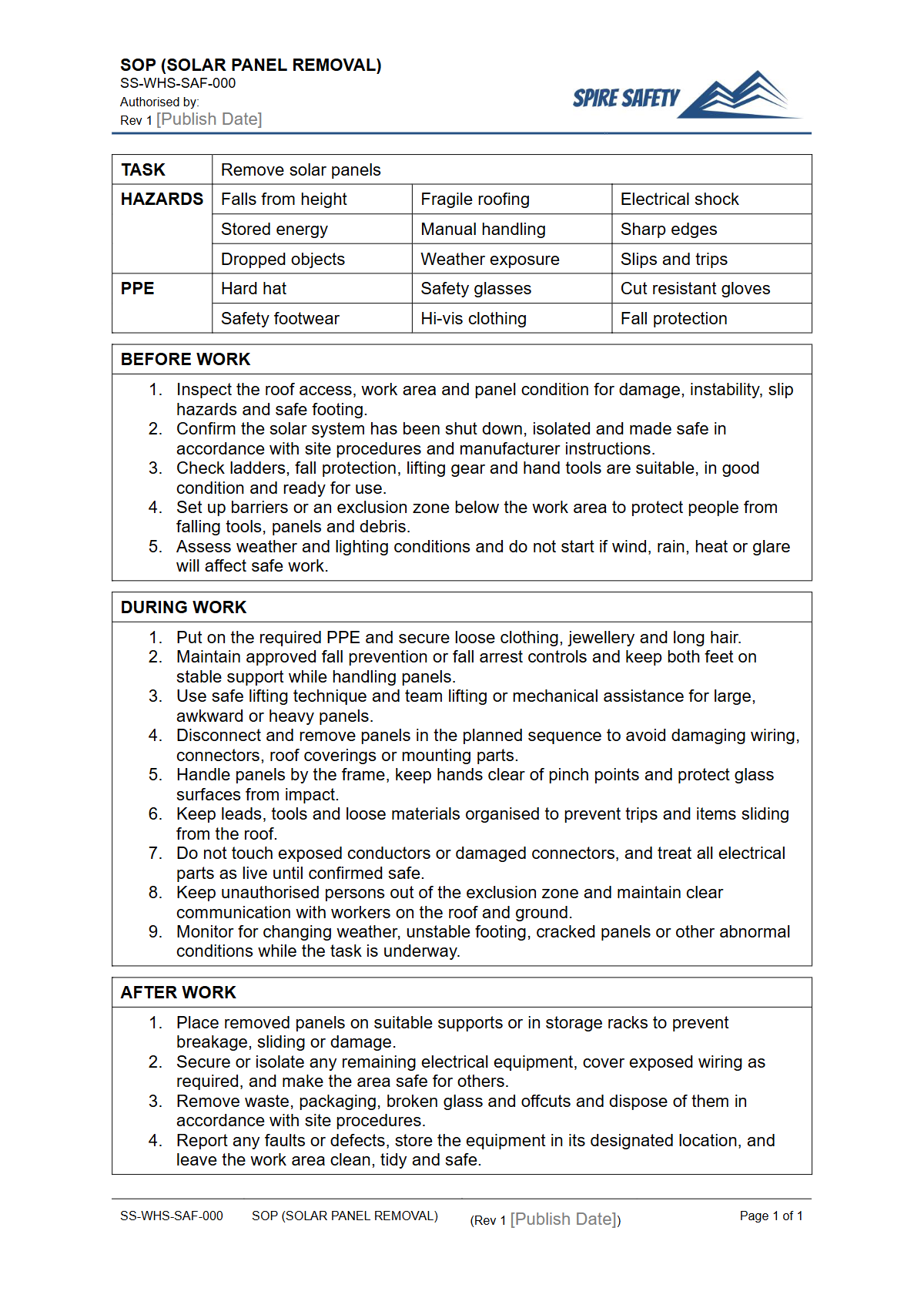
Download our free Safe Operating Procedure (Solar Panel Removal) Template. This customisable DOCX and PDF helps manage electrical and fall risks.
Free Safe Operating Procedure (Solar Panel Removal) Template
DOCX • 126 KB + PDF
Updated Oct 2026
No signup required
Purpose of the Free Safe Operating Procedure (Solar Panel Removal) Template
This free Safe Operating Procedure (Solar Panel Removal) template provides a structured framework for documenting the process of safely removing photovoltaic (PV) solar panels. Solar panel removal is a high-risk task involving significant hazards, including falls from height, electric shock from live components, and musculoskeletal injuries from manual handling.
Using a formalised SOP helps your organisation systematically identify these risks and outline the control measures required to ensure worker safety. It provides a clear, step-by-step guide that standardises the task and communicates safety expectations to everyone involved.
A documented SOP is a fundamental part of an effective safety management system. It serves as evidence of your commitment to providing a safe work environment and can be used for training, inductions, and incident investigations.
Integrating specific procedures like this one into your broader safety framework is crucial for maintaining compliance and proactively managing workplace risks. A well-implemented SOP supports the development of comprehensive WHS management systems, ensuring that safety is consistently addressed at every level of your operation.
Video walkthrough
How to use the Free Safe Operating Procedure (Solar Panel Removal) Template
Our Safe Operating Procedure (Solar Panel Removal) template is provided in both DOCX and PDF formats. Download the DOCX version to edit and adapt it for your specific workplace.
Before implementing this procedure, you must conduct a thorough risk assessment for the solar panel removal task, considering the specific site, the type of solar array, the equipment being used, and the competency of the workers involved. The findings of your risk assessment should be used to populate and customise the relevant sections of this SOP.
It's crucial to remember that this is a template, not a finished document. We have provided a structured starting point aligned with Australian WHS practice, but you must customise it with your specific equipment models, site conditions, emergency procedures, and worker responsibilities to make it effective.
This SOP may need to be used in conjunction with procedures for other machinery on site, such as our FREE Telehandler SOP Template if one is used for lifting panels or equipment.
If you are uncertain about how to conduct the necessary risk assessment or tailor the procedure to your unique operational context, it is wise to seek professional guidance. Our experienced consultants can assist with all aspects of workplace safety, from documentation to implementation.
You can learn more about our WHS consulting services for specialised support.
When to use this Safe Operating Procedure
This SOP should be finalised and implemented before any solar panel removal work commences. It is a critical tool for planning and executing the job safely.
It should be used during toolbox talks and pre-start meetings to brief workers on the specific hazards and control measures for the day's task. It also serves as a primary training document for new workers or those unfamiliar with the procedure, ensuring everyone understands the required safety protocols before they begin.
The SOP is not a 'set and forget' document. It should be reviewed regularly, at least annually, or whenever there is a change to the task, equipment, or work environment.
It must also be reviewed after any near miss or incident to identify and incorporate improvements. Regular checks ensure the procedure remains relevant and effective.
The effectiveness of such procedures can be verified through a systematic review process like WHS compliance auditing to confirm that work practices align with documented standards.
On a larger construction or demolition site, multiple high-risk tasks may occur simultaneously. This SOP for solar panel removal should be integrated with other procedures for the site, such as the one outlined in our FREE Circular Saw SOP Template, to ensure a coordinated approach to safety management.
Who should use this Safe Operating Procedure
This Safe Operating Procedure is intended for use by multiple people within an organisation. Persons Conducting a Business or Undertaking (PCBUs), site managers, and supervisors are responsible for ensuring that a safe system of work, such as this SOP, is developed, implemented, and followed.
They must provide the necessary resources, training, and supervision to support the procedure.
Workers and contractors who are tasked with performing solar panel removal are the primary users of the SOP. They must be trained in the procedure and are responsible for following the specified steps and using the required personal protective equipment (PPE).
WHS managers and safety officers will also use this document to facilitate risk assessments, deliver training, and conduct workplace inspections. It provides a benchmark against which actual work practices can be measured.
This template is one of many tools available to help you build a safer workplace, and we encourage you to explore our complete free WHS resources library for more templates and checklists.
Common mistakes
Common mistakes to avoid
- Assuming the system is de-energised after switching off the main breaker, forgetting the DC side remains live.
- Failing to use proper fall prevention and arrest systems when working on roofs.
- Attempting removal without a licensed electrician to perform the electrical disconnections.
- Underestimating the weight and awkwardness of panels, leading to poor manual handling.
Legal references
Legal considerations
The following legal requirements may be relevant to this type of work.
- Work Health and Safety Act (Harmonised) — Provides the primary duties for protecting workers and other people from work health and safety risks.
- Work Health and Safety Regulations (Harmonised) — Sets out requirements supporting the management of workplace hazards and risks.
The following codes may be relevant to this type of work.
- Managing WHS Risks Code of Practice — Provides practical guidance on identifying hazards, assessing risks and applying effective controls.
- Work Health and Safety Consultation, Cooperation and Coordination Code of Practice — Provides practical guidance on consulting workers and coordinating with other duty holders.
- Managing the Work Environment and Facilities Code of Practice — Provides practical guidance on safe work environments, workplace facilities and related controls.
Did you know
Lingering Power
A single solar panel can generate a hazardous level of DC voltage in any daylight, even on an overcast day. A string of panels connected in series can produce several hundred volts, posing a lethal risk if not handled correctly.
Panel Weight
The average residential solar panel weighs between 18 and 22 kilograms. This makes them a significant manual handling risk, especially when working on sloped and unstable roof surfaces.
FAQ
Frequently asked questions
01What are the main hazards of solar panel removal?
02Do I need to be a licensed electrician to remove solar panels?
03What PPE is required for removing solar panels?
04How do you safely decommission a solar power system before removal?
Share this resource
Free Safe Operating Procedure (Solar Panel Removal) Template
Browse Categories
How To Use It
- 1Download and open in Word or PDF.
- 2Replace the placeholders with your business details.
- 3Get it reviewed by a WHS specialist before rollout.
Need it customised?
Our WHS consultants can adapt this template to your site, run a gap analysis, or audit what you already have in place.
Book a Free Consultation WHS consulting servicesor call 1300 156 382
Related templates
- Free Safe Operating Procedure (Solar Roof Access) Template
- Free Safe Operating Procedure (Solar Shade Cleaning) Template
- Free Safe Operating Procedure (Solvent Handling) Template
- Free Safe Operating Procedure (Solvent Recycling Unit) Template
- Free Safe Operating Procedure (SOP) Template
- Free Safe Operating Procedure (Sound Level Meter) Template