
Free Safe Operating Procedure (Sound Level Meter) Template
Download our free Safe Operating Procedure (Sound Level Meter) Template to formalise your workplace noise assessment process. Get your DOCX and PDF now.
Free Safe Operating Procedure (Sound Level Meter) Template
DOCX • 126 KB + PDF
Updated Oct 2026
No signup required
Purpose of the Free Safe Operating Procedure (Sound Level Meter) Template
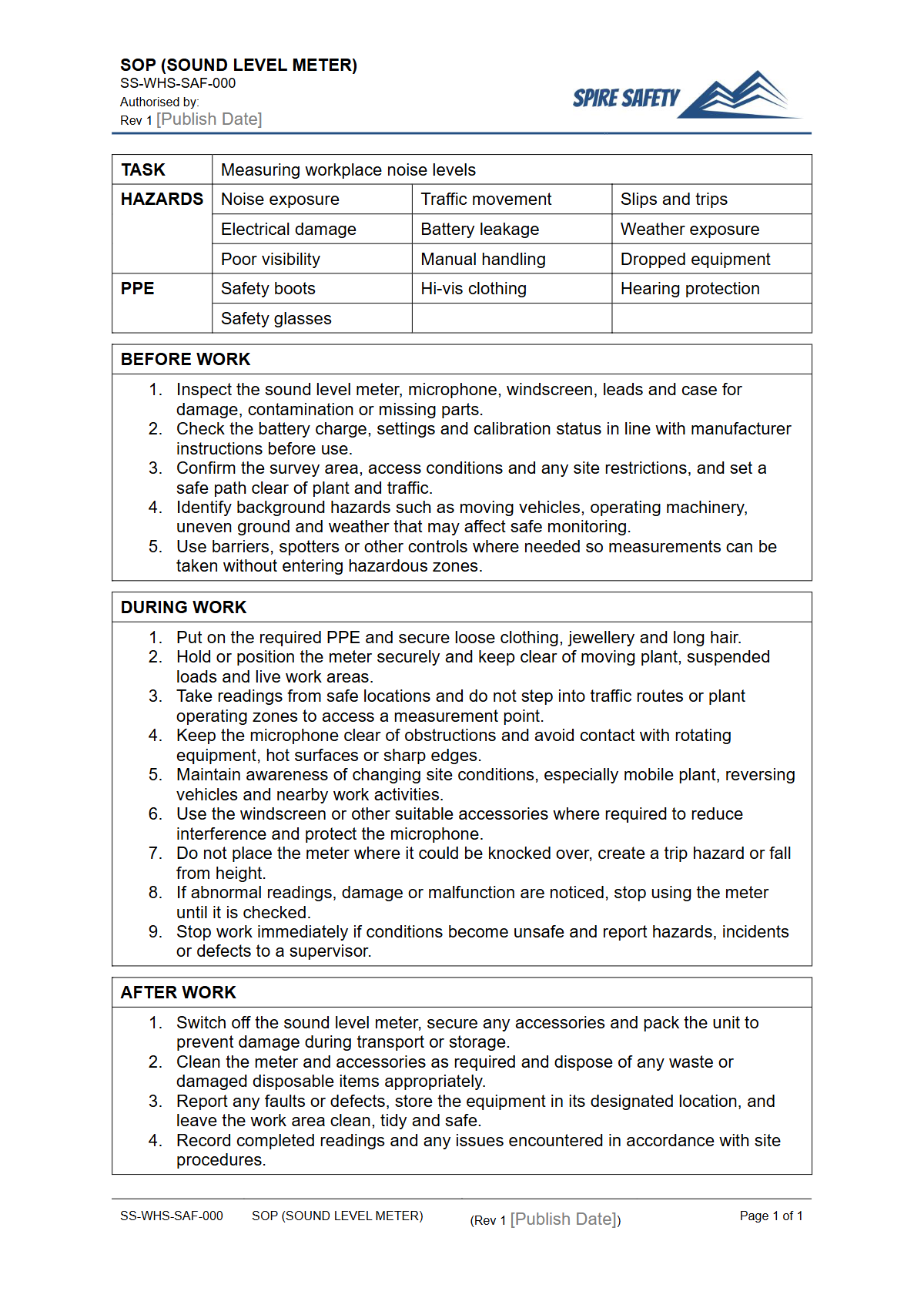
This Safe Operating Procedure (SOP) template provides a structured framework for the correct and safe use of a sound level meter in a workplace setting. Using this free Safe Operating Procedure (Sound Level Meter) Template helps your organisation standardise the process for measuring noise, ensuring measurements are consistent, accurate, and repeatable.
Formalising this process is a critical step in identifying hazardous noise levels, assessing worker exposure, and verifying the effectiveness of noise control measures. This document serves as a key component of your overall noise management program, helping to protect workers from noise-induced hearing loss and supporting compliance with Australian WHS duties.
A documented procedure ensures that anyone tasked with conducting noise measurements follows a clear, step-by-step guide covering pre-use checks, calibration, measurement techniques, and data recording. This systematic approach is vital for gathering reliable data that can inform risk assessments and control strategies.
Without a proper SOP, noise data may be unreliable, potentially leading to incorrect conclusions about workplace safety. By implementing this procedure, you create a clear record of your organisation's commitment to proactively managing workplace noise risks.
Video walkthrough
How to use the Free Safe Operating Procedure (Sound Level Meter) Template
This resource is provided as a customisable template in both DOCX and PDF formats. To use it effectively, download the file and adapt its contents to suit the specific context of your workplace.
This includes adding details about the make and model of your sound level meter, the specific environments where it will be used, and the personnel authorised to operate it. You should also integrate any site-specific safety rules or permit-to-work requirements relevant to the task.
Important: This is a template, not a finished document. We have provided a comprehensive starting point, but it is crucial that you customise this Safe Operating Procedure to reflect your unique operational needs, equipment, and risk profile.
The final document should be reviewed and approved by a competent person within your organisation to ensure it is practical and effective for your workplace. Integrating this SOP into your broader WHS management systems ensures it is properly implemented, reviewed, and maintained.
When to use a Sound Level Meter
A sound level meter should be used as part of a proactive approach to workplace health and safety. The SOP governing its use should be followed whenever noise measurements are required. Key scenarios include:
- Initial Noise Assessment: When trying to determine if noise levels in a specific area or from a particular task exceed the exposure standards.
- After introducing new equipment: To measure the noise output of new plant or machinery, such as that outlined in our free Air Compressor SOP, and assess its impact on the overall workplace noise environment.
- Responding to worker concerns: When employees report that an area is too loud or that they are experiencing ringing in their ears (tinnitus) or temporary hearing loss.
- Routine Monitoring: As part of a regular schedule to ensure noise levels have not increased over time due to equipment wear or changes in processes.
- Verifying Noise Controls: To measure the effectiveness of engineering controls like acoustic enclosures, barriers, or mufflers that have been installed to reduce noise.
These activities are often a core component of a formal workplace safety review. A comprehensive WHS compliance audit can help identify all areas where noise assessments are required by legislation and best practice.
What the Safe Operating Procedure Covers
This SOP template provides a logical flow for conducting a noise measurement task safely and accurately. It is structured to guide the user from preparation through to completion. Key sections include:
- Pre-operational Checks: Outlines visual inspection of the meter, checking battery levels, and ensuring all accessories (like the calibrator and windscreen) are present and functional.
- Calibration Procedure: Details the critical steps for performing a field calibration before and after each measurement session to ensure the meter's accuracy.
- Operating Steps: Provides a sequence for taking measurements, including correct positioning of the meter, setting the appropriate weighting (e.g., A-weighting for average exposure), and capturing data for different noise types (e.g., continuous, intermittent, impact). This is essential when assessing equipment like that covered in the Safe Operating Procedure for a deep fryer, which can contribute to overall kitchen noise.
- Post-operational Care: Describes how to properly clean, store, and maintain the sound level meter to ensure its longevity and continued accuracy.
Standardising these steps across your organisation ensures that data collected by different people at different times is comparable and reliable. You can find more examples of task-specific procedures in our free WHS resources library.
Common mistakes
Common mistakes to avoid
- Forgetting to perform field calibration before and after measurements, invalidating the results.
- Holding the meter too close to the body, causing sound reflections that skew the readings.
- Taking measurements in windy conditions without using the meter's foam windscreen.
- Using an uncertified smartphone app for official noise assessments instead of a compliant meter.
Legal references
Legal considerations
The following legal requirements may be relevant to this type of work.
- Work Health and Safety Act (Harmonised) — Provides the primary duties for protecting workers and other people from work health and safety risks.
- Work Health and Safety Regulations (Harmonised) — Sets out requirements supporting the management of workplace hazards and risks.
The following codes may be relevant to this type of work.
- Managing WHS Risks Code of Practice — Provides practical guidance on identifying hazards, assessing risks and applying effective controls.
- Work Health and Safety Consultation, Cooperation and Coordination Code of Practice — Provides practical guidance on consulting workers and coordinating with other duty holders.
- Managing the Work Environment and Facilities Code of Practice — Provides practical guidance on safe work environments, workplace facilities and related controls.
Did you know
A Preventable Disease
Noise-induced hearing loss is the most common preventable occupational injury in Australia. It is permanent and irreversible, but can be avoided with proper noise management.
FAQ
Frequently asked questions
01What is the action level for noise in Australian workplaces?
02How often should a sound level meter be calibrated?
03Can I use a smartphone app to measure workplace noise?
04What is the difference between dB(A) and dB(C) weighting?
Share this resource
Free Safe Operating Procedure (Sound Level Meter) Template
Browse Categories
How To Use It
- 1Download and open in Word or PDF.
- 2Replace the placeholders with your business details.
- 3Get it reviewed by a WHS specialist before rollout.
Need it customised?
Our WHS consultants can adapt this template to your site, run a gap analysis, or audit what you already have in place.
Book a Free Consultation WHS consulting servicesor call 1300 156 382
Related templates
- Free Safe Operating Procedure (Soup Kettle) Template
- Free Safe Operating Procedure (Spa Equipment Cleaning) Template
- Free Safe Operating Procedure (Spa Pool Cleaning) Template
- Free Safe Operating Procedure (Spa Room Cleaning) Template
- Free Safe Operating Procedure (Specimen Transport) Template
- Free Safe Operating Procedure (Spill Berm Setup) Template