
Free Safe Operating Procedure (Spa Pool Cleaning) Template
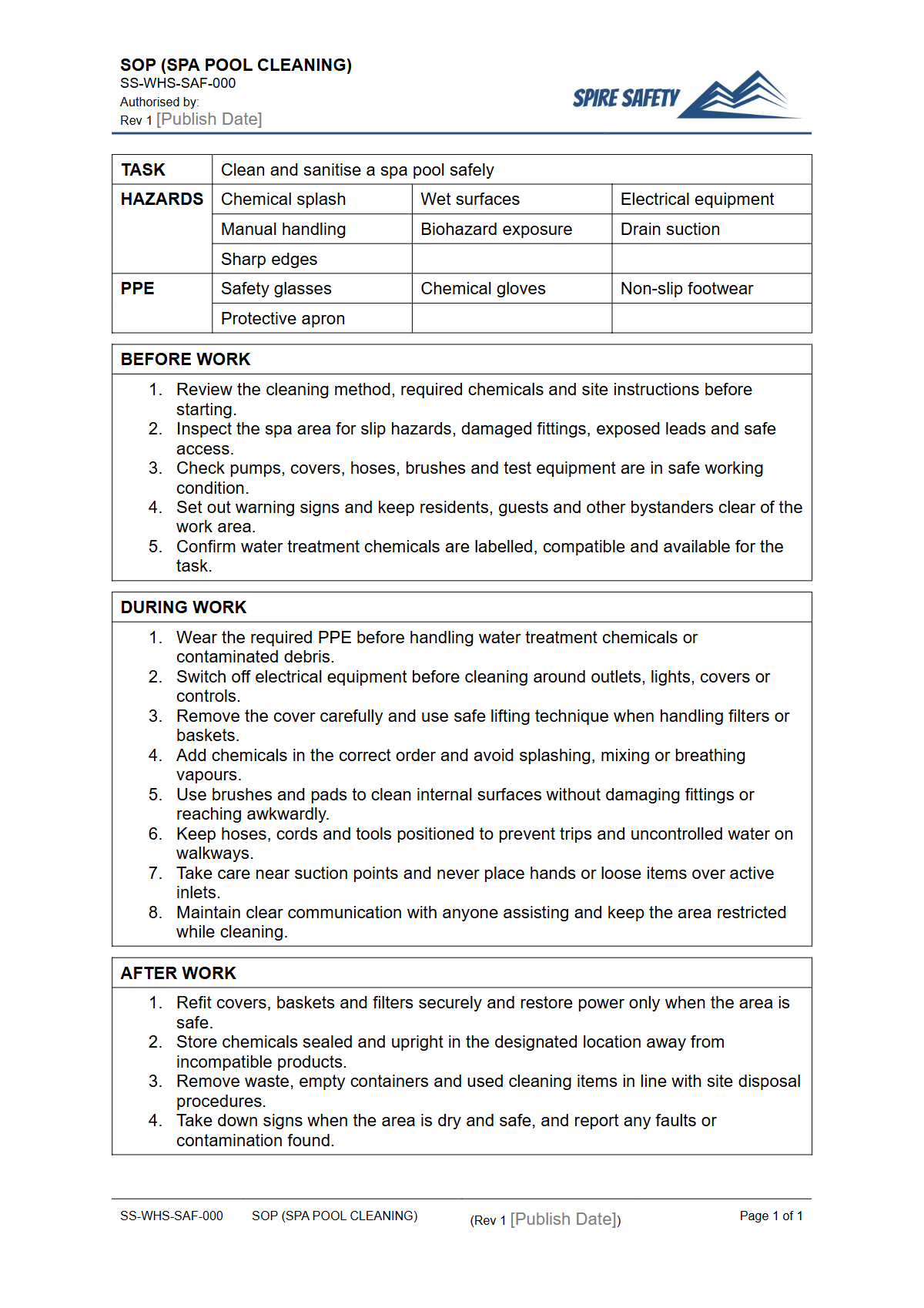
Download our free Safe Operating Procedure (Spa Pool Cleaning) Template to formalise your cleaning processes.
Free Safe Operating Procedure (Spa Pool Cleaning) Template
DOCX • 126 KB + PDF
Updated Oct 2026
No signup required
Purpose of the Free Safe Operating Procedure (Spa Pool Cleaning) Template
The primary purpose of the Free Safe Operating Procedure (Spa Pool Cleaning) Template is to provide a formal, documented method for a high-risk task. By clearly outlining each step, you can effectively manage hazards associated with chemical exposure, electrical equipment, and wet environments. A well-developed Safe Operating Procedure (SOP) helps your organisation to:
- Standardise the Process: Ensure every worker follows the same safe steps, every time, reducing variability and risk.
- Control Hazards: Systematically identify risks such as chemical splashes, toxic gas creation, electric shock, and slips, and implement specific controls to mitigate them.
- Aid in Training: Use the SOP as a practical training tool for new employees and as a refresher for existing staff, ensuring competency in safe work practices.
- Demonstrate Due Diligence: A documented and implemented SOP is a key piece of evidence showing your commitment to providing a safe workplace. It is a foundational document within broader WHS management systems.
Video walkthrough
How to use the Free Safe Operating Procedure (Spa Pool Cleaning) Template
This SOP template is provided in both DOCX and PDF formats for your convenience. To get started, download the file and open it to begin adapting it to your specific operational needs.
The document is designed as a comprehensive starting point, but it requires customisation to be effective in your unique environment.
Please note: This is a template, not a finished document. We have provided a structured starting point, but you must customise it to reflect the specific chemicals, equipment (e.g., pumps, vacuums, heaters), environment, and regulations applicable to your workplace.
Involve the workers who perform the task in the customisation process to ensure the procedure is practical and accurately reflects real-world conditions. For businesses that need to document a wide range of activities, adapting a general Safe Operating Procedure template can be an efficient way to maintain consistency.
If you require expert assistance in tailoring this document or developing your safety systems, our WHS consulting team can provide tailored support.
When to use a Spa Pool Cleaning SOP
A Safe Operating Procedure for spa pool cleaning should be referenced before and during all cleaning activities to reinforce safe habits and ensure no critical steps are missed. It is particularly important to use the SOP for:
- Routine Maintenance: Regular scheduled cleaning, including water testing, chemical balancing, and surface wiping.
- Deep Cleaning: More intensive tasks like draining the spa, scrubbing surfaces, and cleaning filters and jets.
- Commissioning and Decommissioning: Preparing a spa for use at the start of a season or winterising it for a period of disuse.
- Post-Incident Cleaning: Following a contamination event or equipment failure to ensure the spa is returned to a safe state.
Maintenance teams often handle a variety of equipment for site upkeep. Ensuring you have documented procedures for other tools, such as with a Free Air Compressor SOP, helps build a comprehensive library of safe work practices for all tasks.
Who should use this Safe Operating Procedure
This SOP is designed for any person or business responsible for the maintenance and safety of spa pools. Primary users include:
- Facility Managers: For implementing and overseeing safety protocols in hotels, gyms, and residential complexes.
- Maintenance Staff and Pool Technicians: The direct users who perform the cleaning tasks and must follow the procedure.
- Accommodation Providers: Owners of holiday parks, motels, and short-stay rentals with spa facilities.
- WHS Officers and Managers: For integrating the SOP into the broader safety system and using it for risk assessments and training verification.
Safety officers can use the finalised SOP as a benchmark during site inspections. Integrating these checks into a regular schedule of WHS compliance auditing helps verify that safety controls are being implemented effectively on the ground.
Developing robust safety documentation is a continuous process. As you refine your spa cleaning procedures, you may identify needs for other safety tools.
We encourage you to explore our complete free WHS resources library for more templates, checklists, and guides.
Common mistakes
Common mistakes to avoid
- Using the template without customising it for specific site equipment and chemicals.
- Failing to provide or consult the Safety Data Sheet (SDS) for each cleaning agent.
- Not training workers on the final, approved procedure before they undertake the task.
- Neglecting to isolate and lock-out electrical power sources before starting maintenance.
Legal references
Legal considerations
The following legal requirements may be relevant to this type of work.
- Work Health and Safety Act (Harmonised) — Provides the primary duties for protecting workers and other people from work health and safety risks.
- Work Health and Safety Regulations (Harmonised) — Sets out requirements supporting the management of workplace hazards and risks.
The following codes may be relevant to this type of work.
- Managing WHS Risks Code of Practice — Provides practical guidance on identifying hazards, assessing risks and applying effective controls.
- Work Health and Safety Consultation, Cooperation and Coordination Code of Practice — Provides practical guidance on consulting workers and coordinating with other duty holders.
- Managing the Work Environment and Facilities Code of Practice — Provides practical guidance on safe work environments, workplace facilities and related controls.
Did you know
Legionella Risk
Poorly maintained spa pools, with water temperatures between 20°C and 45°C, are prime breeding grounds for Legionella bacteria. Documented cleaning procedures are a critical control measure against Legionnaires' disease.
Toxic Gas Hazard
Mixing common pool chemicals, such as chlorine and acid, can release highly toxic chlorine gas. A clear SOP prevents such mistakes by outlining correct storage, handling, and dosing sequences.
FAQ
Frequently asked questions
01What are the main hazards when cleaning a spa pool?
02Do I need a separate document for each chemical used?
03How often should a Safe Operating Procedure be reviewed?
04Can this template be used for commercial swimming pools?
Share this resource
Free Safe Operating Procedure (Spa Pool Cleaning) Template
Browse Categories
How To Use It
- 1Download and open in Word or PDF.
- 2Replace the placeholders with your business details.
- 3Get it reviewed by a WHS specialist before rollout.
Need it customised?
Our WHS consultants can adapt this template to your site, run a gap analysis, or audit what you already have in place.
Book a Free Consultation WHS consulting servicesor call 1300 156 382
Related templates
- Free Safe Operating Procedure (Spa Room Cleaning) Template
- Free Safe Operating Procedure (Specimen Transport) Template
- Free Safe Operating Procedure (Spill Berm Setup) Template
- Free Safe Operating Procedure (Spill Kit Use) Template
- Free Safe Operating Procedure (Spindle Moulder) Template
- Free Safe Operating Procedure (Spinning Machine) Template