
Free Safe Operating Procedure (Spindle Moulder) Template
Download our free Safe Operating Procedure (Spindle Moulder) Template to manage high-risk woodworking tasks. Customise your DOCX or PDF file today.
Free Safe Operating Procedure (Spindle Moulder) Template
DOCX • 126 KB + PDF
Updated Oct 2026
No signup required
Purpose of the Free Safe Operating Procedure (Spindle Moulder) Template
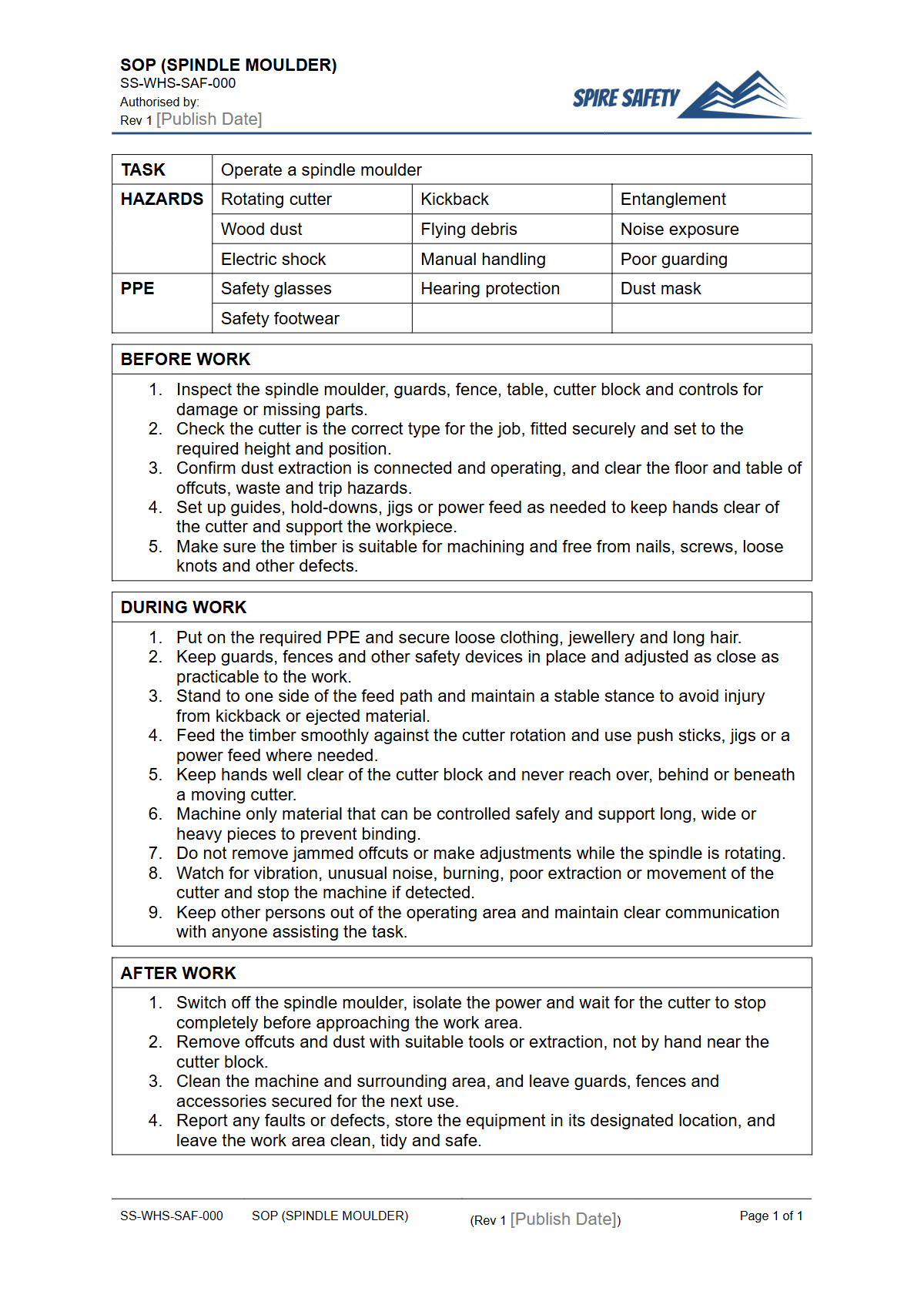
This free Safe Operating Procedure (Spindle Moulder) Template provides a structured framework for documenting the safe use of spindle moulders in your workplace. Operating a spindle moulder involves significant risks, including kickback, entanglement, and noise exposure.
A detailed SOP is a critical administrative control to ensure workers understand the hazards and follow correct procedures to minimise the risk of injury. The purpose of this template is to establish a clear, documented process for operators.
It helps your organisation meet its WHS duties by formalising step-by-step instructions for pre-start checks, operation, and shutdown. The document prompts you to identify specific hazards associated with your machine and outline the control measures required to work safely, such as the use of guards, jigs, and personal protective equipment (PPE).
It provides a more specific framework than a general Safe Operating Procedure (SOP) template by focusing on the unique risks of spindle shaping.
Video walkthrough
How to use the Free Safe Operating Procedure (Spindle Moulder) Template
To effectively use this free Safe Operating Procedure (Spindle Moulder) Template, download the DOCX file and adapt it to your specific workplace environment. Important: This document is a template, not a finished procedure.
You must customise it by adding details about your specific make and model of spindle moulder, the types of materials being processed, and the unique conditions of your workshop. We recommend involving experienced operators and supervisors in the customisation process to ensure the procedure is practical and comprehensive.
Compare it with other machine-specific documents, such as a free Circular Saw SOP, to maintain consistency in your documentation style.
When to use a Safe Operating Procedure
A Safe Operating Procedure for a spindle moulder should be a core part of your safety induction and training for any new worker assigned to use the machine. It serves as a primary training document and a reference for competency assessments.
The SOP should also be readily available at the point of use for quick reference. It is essential to review the SOP following any incident or near-miss, or when changes are made to the equipment or process.
Integrating SOPs like this into your comprehensive WHS management systems demonstrates a proactive approach to risk management.
Who should use this SOP
This SOP template is designed for use by Persons Conducting a Business or Undertaking (PCBUs), workshop managers, and WHS personnel responsible for workplace safety. Supervisors should use the finalised SOP to train and supervise workers, ensuring they adhere to the established procedures.
Operators are the end-users who must understand and follow the SOP to perform their tasks safely. The document also serves as a key piece of evidence during internal WHS compliance auditing, verifying that formal risk controls are in place for high-risk plant.
Implementing Supporting Controls
Effective risk control for a spindle moulder follows the hierarchy of controls. While this SOP is an important administrative control, it must be supported by higher-level measures.
This includes engineering controls like proper machine guarding, effective dust extraction systems, and anti-kickback devices. Ensure your workshop environment is well-lit, free from clutter, and has systems in place to manage related equipment, which might require documents like a free Air Compressor SOP for pneumatic tools or cleaning.
Documentation and Review
Regularly maintaining both the machine and your safety documentation is crucial. Keep a log of all maintenance, inspections, and any modifications to the spindle moulder.
Similarly, document all SOP reviews and updates, and ensure all relevant personnel are trained on the latest version. For more guidance on managing WHS documentation, explore our complete library of free WHS resources to find other useful templates and guides.
Common mistakes
Common mistakes to avoid
- Using the machine without appropriate guards, fences, or pressure pads in place.
- Feeding small or awkwardly shaped pieces by hand instead of using push sticks, jigs, or a power feeder.
- Failing to use an effective dust extraction system, leading to poor visibility and respiratory hazards.
- Wearing loose clothing, gloves, or jewellery that can become entangled in the rotating spindle.
Legal references
Legal considerations
The following legal requirements may be relevant to this type of work.
- Work Health and Safety Act (Harmonised) — Provides the primary duties for protecting workers and other people from work health and safety risks.
- Work Health and Safety Regulations (Harmonised) — Sets out requirements supporting the management of workplace hazards and risks.
The following codes may be relevant to this type of work.
- Managing WHS Risks Code of Practice — Provides practical guidance on identifying hazards, assessing risks and applying effective controls.
- Work Health and Safety Consultation, Cooperation and Coordination Code of Practice — Provides practical guidance on consulting workers and coordinating with other duty holders.
- Managing the Work Environment and Facilities Code of Practice — Provides practical guidance on safe work environments, workplace facilities and related controls.
Did you know
Anti-Kickback Devices
Modern spindle moulders often incorporate pawls or segmented fingers that act as anti-kickback devices. They allow wood to move in only one direction, significantly reducing the risk of a violent ejection.
Direction of Feed
Workpieces must always be fed against the direction of the cutter's rotation. Feeding with the rotation, known as 'climb cutting', is extremely dangerous as it can cause the machine to grab the wood and pull it through uncontrollably.
FAQ
Frequently asked questions
01What is the biggest risk when operating a spindle moulder?
02Is an SOP a legal requirement for a spindle moulder in Australia?
03How often should a spindle moulder SOP be reviewed?
04Can I use this template for other woodworking machinery?
Share this resource
Free Safe Operating Procedure (Spindle Moulder) Template
Browse Categories
How To Use It
- 1Download and open in Word or PDF.
- 2Replace the placeholders with your business details.
- 3Get it reviewed by a WHS specialist before rollout.
Need it customised?
Our WHS consultants can adapt this template to your site, run a gap analysis, or audit what you already have in place.
Book a Free Consultation WHS consulting servicesor call 1300 156 382
Related templates
- Free Safe Operating Procedure (Spinning Machine) Template
- Free Safe Operating Procedure (Sports Field Aeration) Template
- Free Safe Operating Procedure (Sports Field Divoting) Template
- Free Safe Operating Procedure (Sports Field Fertilise) Template
- Free Safe Operating Procedure (Sports Field Line Prep) Template
- Free Safe Operating Procedure (Sports Field Overseed) Template