
Free Safe Operating Procedure (Sports Field Aeration) Template
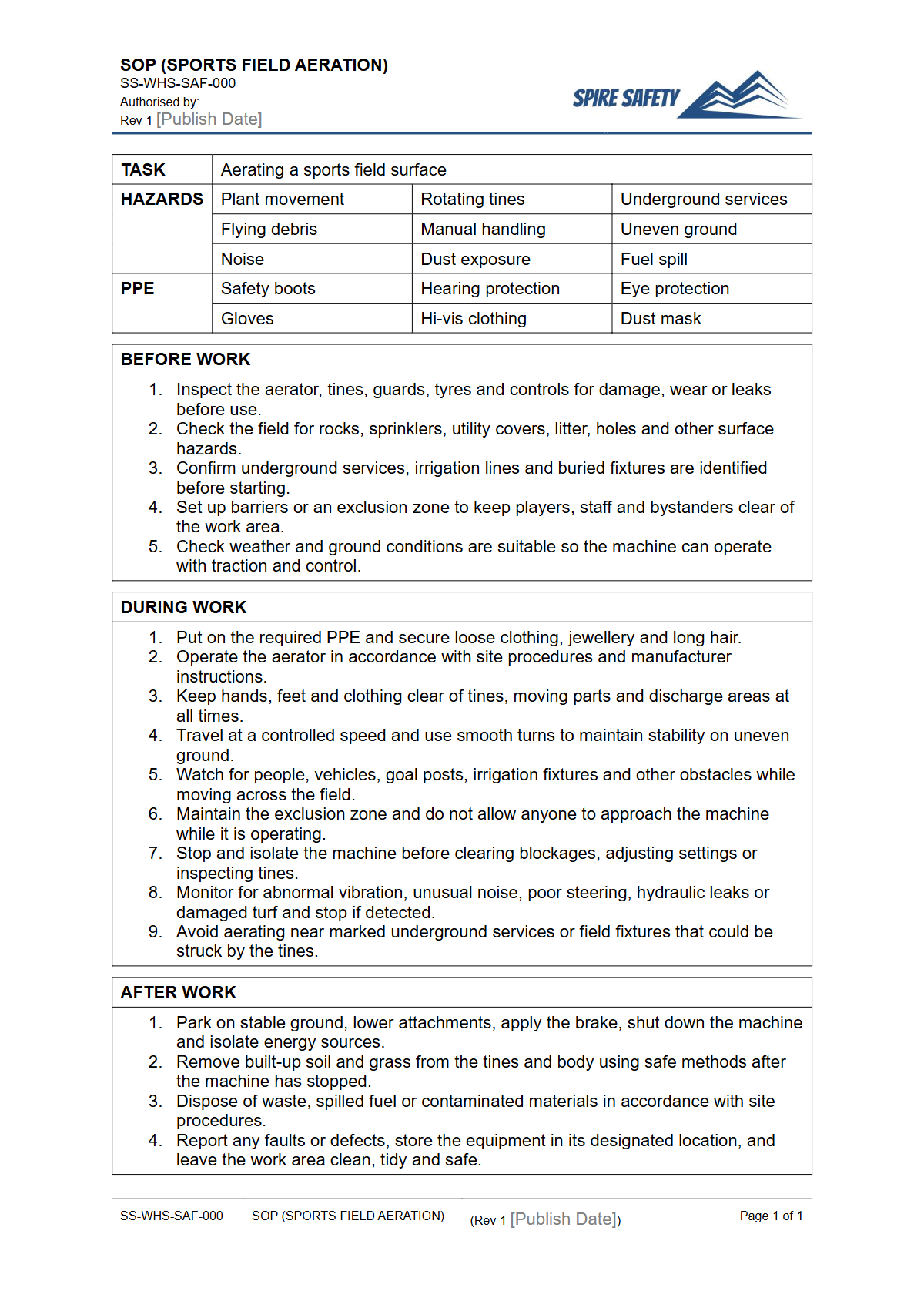
Download our free Safe Operating Procedure template for sports field aeration. This customisable document helps outline key safety steps.
Free Safe Operating Procedure (Sports Field Aeration) Template
DOCX • 126 KB + PDF
Updated Oct 2026
No signup required
Purpose of the Free Safe Operating Procedure (Sports Field Aeration) Template
This free Safe Operating Procedure (Sports Field Aeration) template provides a structured starting point for documenting the safety steps required to operate mechanical turf aerators. Properly aerating sports fields is crucial for turf health, but the machinery involved introduces significant workplace risks if not managed correctly.
Using a documented SOP helps ensure all operators understand the hazards and control measures before they begin work.
The primary purpose of this SOP is to establish a clear, repeatable, and safe method for the task. It serves as a vital tool for operator training, risk management, and incident prevention.
A comprehensive SOP is a fundamental part of broader WHS management systems, helping your organisation meet its duty of care. Key hazards addressed include mechanical entanglement in rotating tines, machine rollovers on uneven or sloped ground, striking underground services, noise exposure, and manual handling risks when attaching equipment.
Video walkthrough
How to use the Free Safe Operating Procedure (Sports Field Aeration) Template
Begin by downloading the template in your preferred format (DOCX for easy editing or PDF). The document is pre-filled with common sections relevant to sports field aeration, such as PPE requirements, pre-start checks, operational steps, and emergency procedures.
You can use it as a robust foundation, saving you the time of starting from scratch.
IMPORTANT: This document is a template only. We have designed it to be a helpful guide, but you must customise it to reflect the specific aerator models, site conditions, and organisational procedures in your workplace.
We recommend a competent person, such as a grounds manager or WHS advisor, reviews and approves the final document after customisation to ensure it is fit for purpose. For a simpler, more generalised structure, you can also reference our Free Safe Operating Procedure (SOP) Template.
When to use it
A Safe Operating Procedure for sports field aeration should be used consistently before, during, and after every aeration task. It is not a document to be filed away; it is an active tool for daily safety management. Its primary applications include:
- Operator Training: Use the SOP as the basis for training new operators and conducting refresher courses for experienced staff.
- Pre-Task Planning: Supervisors and operators should review the SOP during pre-start meetings to confirm safety protocols and identify any site-specific hazards for that day.
- On-the-Job Reference: A laminated copy should be available near the machinery storage area or with the operator as a quick reference guide.
- Incident Investigation: Following an incident or near miss, the SOP is a key document to review to determine if procedures were followed and if they need improvement.
Integrating this procedure alongside those for related tasks ensures a consistent approach to grounds maintenance. For example, it can be used in conjunction with a FREE Spreader SOP Template when planning overall turf care activities.
Who should use it
This SOP is intended for a range of personnel within an organisation responsible for maintaining sports fields and turf areas. This includes:
- Groundskeepers and Turf Technicians: The primary operators of the aeration equipment who must follow the procedure step-by-step.
- Supervisors and Grounds Managers: Those responsible for overseeing the work, providing training, and ensuring procedures are correctly implemented.
- WHS Managers and Advisors: Professionals who develop and review safety documentation to ensure it aligns with the organisation's safety framework and legislative requirements.
- Maintenance Personnel: Staff responsible for servicing the equipment can use the SOP to understand operational risks and lockout/tagout requirements.
Periodically reviewing the effectiveness of your SOPs is a key part of the safety lifecycle. This can be integrated into your internal review schedule or formalised through a WHS compliance auditing process to ensure ongoing suitability.
Key Areas to Customise
When adapting this template, pay close attention to the following sections to ensure they accurately reflect your specific operations:
- Plant and Equipment Details: List the exact make and model of the aerator(s) in use.
- Pre-Start Inspection Checklist: Tailor the checklist to your machine, including checks for guards, tine condition, hydraulics, tyre pressure, and fluid levels.
- Site-Specific Hazards: Add details about known hazards at your facility, such as steep embankments, soft ground, overhead powerlines, or proximity to public areas. Crucially, include your procedure for identifying and marking underground services like irrigation or electrical lines, a critical step also found in our FREE Trencher SOP Template.
- Emergency Procedures: Detail the specific steps for emergency shutdown, first aid response, and reporting incidents within your organisation.
By implementing a robust and customised SOP, you create a safer, more predictable working environment for your team. Find more helpful documents by exploring our complete free WHS resources library to support your safety management system.
Common mistakes
Common mistakes to avoid
- Failing to check for and mark underground services before starting work.
- Operating on slopes or inclines that exceed the machine's stability limits, increasing rollover risk.
- Neglecting to check that all safety guards, particularly around rotating tines or drums, are in place and functional.
- Not wearing appropriate personal protective equipment (PPE), such as hearing protection and steel-capped boots.
Legal references
Legal considerations
The following legal requirements may be relevant to this type of work.
- Work Health and Safety Act (Harmonised) — Provides the primary duties for protecting workers and other people from work health and safety risks.
- Work Health and Safety Regulations (Harmonised) — Sets out requirements supporting the management of workplace hazards and risks.
The following codes may be relevant to this type of work.
- Managing WHS Risks Code of Practice — Provides practical guidance on identifying hazards, assessing risks and applying effective controls.
- Work Health and Safety Consultation, Cooperation and Coordination Code of Practice — Provides practical guidance on consulting workers and coordinating with other duty holders.
- Managing the Work Environment and Facilities Code of Practice — Provides practical guidance on safe work environments, workplace facilities and related controls.
Did you know
Soil Compaction
Heavily used sports fields can suffer from soil compaction, which reduces air and water flow to the turf's roots. Aeration is critical for relieving this compaction and promoting a healthier, safer playing surface.
Underground Dangers
Before aerating, it's vital to locate all underground services like irrigation lines, electrical cables, and gas pipes. Puncturing a service can lead to costly repairs and severe safety incidents.
FAQ
Frequently asked questions
01What should be included in a Safe Operating Procedure for sports field aeration?
02Is an SOP a legal requirement for operating a turf aerator in Australia?
03How often should an SOP for sports field aeration be reviewed?
04Who is responsible for training workers on the sports field aeration SOP?
Share this resource
Free Safe Operating Procedure (Sports Field Aeration) Template
Browse Categories
How To Use It
- 1Download and open in Word or PDF.
- 2Replace the placeholders with your business details.
- 3Get it reviewed by a WHS specialist before rollout.
Need it customised?
Our WHS consultants can adapt this template to your site, run a gap analysis, or audit what you already have in place.
Book a Free Consultation WHS consulting servicesor call 1300 156 382
Related templates
- Free Safe Operating Procedure (Sports Field Divoting) Template
- Free Safe Operating Procedure (Sports Field Fertilise) Template
- Free Safe Operating Procedure (Sports Field Line Prep) Template
- Free Safe Operating Procedure (Sports Field Overseed) Template
- Free Safe Operating Procedure (Sports Field Topdress) Template
- Free Safe Operating Procedure (Sports Net Inspection) Template