
Free Safe Operating Procedure (Sports Field Divoting) Template
Detail the key steps for safely repairing turf on sports fields after use. Download our free Safe Operating Procedure for sports field divoting.
Free Safe Operating Procedure (Sports Field Divoting) Template
DOCX • 126 KB + PDF
Updated Oct 2026
No signup required
Purpose of the Free Safe Operating Procedure (Sports Field Divoting) Template
Maintaining a safe and pristine playing surface is crucial for any sports club or facility. Divoting—the process of repairing indentations in the turf—is a common but essential maintenance task.
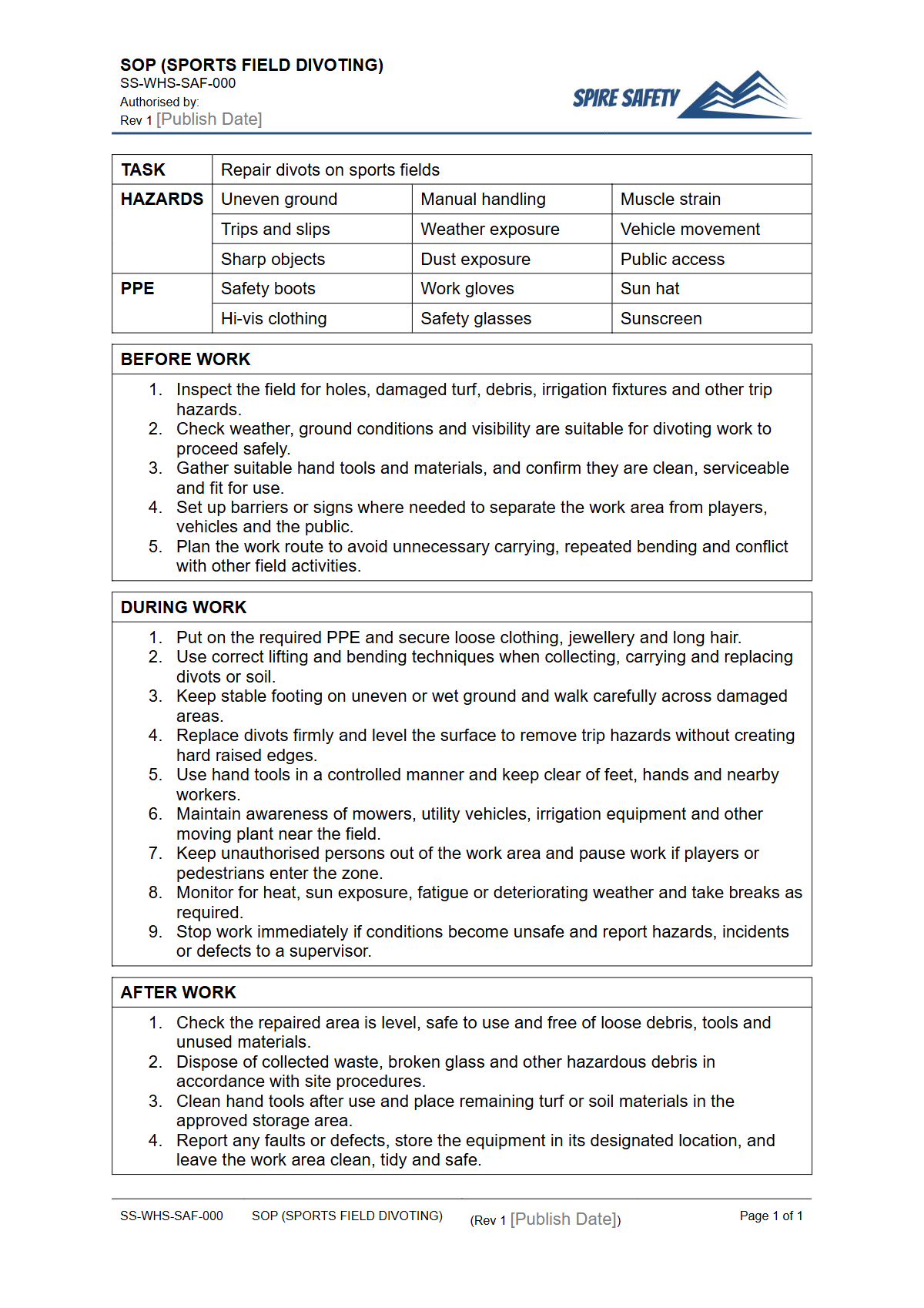
This free Safe Operating Procedure (Sports Field Divoting) Template provides a structured framework for documenting the hazards and control measures associated with this job. It helps organisations meet their work health and safety obligations by outlining a clear, step-by-step process for workers and volunteers to follow, minimising risks such as manual handling injuries, slips, and environmental exposure.
Using a documented SOP ensures consistency in how the task is performed, regardless of who is carrying it out. It serves as a vital training tool for new groundskeepers or volunteers and acts as a benchmark for safety performance.
An SOP is a core component of a comprehensive WHS management system, demonstrating a proactive approach to risk management for grounds maintenance activities.
Video walkthrough
How to use the Free Safe Operating Procedure (Sports Field Divoting) Template
This template is provided as a fully editable DOCX file and a ready-to-print PDF. To use it, simply download the file and open it in your preferred word processor.
The document is logically structured with sections for identifying required personal protective equipment (PPE), outlining potential hazards, and detailing the sequential steps for performing the task safely, from pre-operational checks to clean-up.
Important: This document is a template and must be customised to reflect the specific circumstances of your workplace. You must review, add, and remove content to align with your equipment (e.g., specific utility vehicles or tools), materials (sand or soil mixes), site layout, and internal procedures.
We provide this as a starting point to help you build a site-specific SOP; it is not a complete, out-of-the-box safety solution.
While this SOP is specific to divoting, our more general Safe Operating Procedure (SOP) Template can be adapted for a wide range of other tasks around your facility.
When to use it
A sports field divoting SOP should be used whenever the task is performed. This is most common after sporting events, particularly in sports like polo, rugby, or golf, where the turf is subject to significant wear and tear.
It should also be a standard part of your scheduled grounds maintenance program to ensure the field remains in safe playing condition at all times.
The procedure is particularly important during peak seasons or when training new staff or inducting volunteers, as it provides a clear and authoritative guide. It should also be reviewed and referenced during incident investigations or when a change in process or equipment occurs.
For more complex turf repair involving machinery like a mechanical topdresser, our free Spreader SOP template provides a relevant framework.
Who should use it
This Safe Operating Procedure is intended for use by any person involved in sports field maintenance. This includes:
- Professional groundskeepers and maintenance staff.
- Employees of local councils or facility management companies.
- Volunteers at community sports clubs.
- Supervisors and managers responsible for overseeing grounds work.
Before undertaking the task, all individuals must be trained in the procedure and be deemed competent to perform it safely. This includes training on correct manual handling techniques, proper use of any tools or small vehicles, and understanding the specific hazards of the work environment. Supervisors can use the SOP as a checklist to verify that work is being conducted safely and in accordance with the organisation's safety standards. If you are unsure how to tailor this document or implement it effectively, our WHS consulting services can provide expert guidance.
For associated earthmoving tasks like levelling large areas, you may need a procedure like our Scraper SOP template. You can explore our entire free WHS resources library to find other documents that support your safety management system.
Common mistakes
Common mistakes to avoid
- Using the wrong type of sand or soil mix, which can harm turf health.
- Failing to properly assess the work area for slip, trip, and fall hazards before starting.
- Applying incorrect manual handling techniques when lifting or moving heavy bags of sand.
- Neglecting to provide adequate sun protection (hats, sunscreen, water) for workers or volunteers.
Legal references
Legal considerations
The following legal requirements may be relevant to this type of work.
- Work Health and Safety Act (Harmonised) — Provides the primary duties for protecting workers and other people from work health and safety risks.
- Work Health and Safety Regulations (Harmonised) — Sets out requirements supporting the management of workplace hazards and risks.
The following codes may be relevant to this type of work.
- Managing WHS Risks Code of Practice — Provides practical guidance on identifying hazards, assessing risks and applying effective controls.
- Work Health and Safety Consultation, Cooperation and Coordination Code of Practice — Provides practical guidance on consulting workers and coordinating with other duty holders.
- Managing the Work Environment and Facilities Code of Practice — Provides practical guidance on safe work environments, workplace facilities and related controls.
Did you know
Stomping Ground
The tradition of "stomping the divots" at halftime during polo matches is a social event for spectators, but it also serves as a practical and rapid method of repairing the playing surface.
Sand Composition
The material used for divoting is often a specific mix of sand, soil, and grass seed. The composition is carefully chosen to match the existing turf profile and promote fast, healthy regrowth.
FAQ
Frequently asked questions
01What are the main hazards involved in sports field divoting?
02Is a Safe Operating Procedure legally required for divoting?
03Who is responsible for creating a divoting SOP?
04Can volunteers use a divoting SOP?
Share this resource
Free Safe Operating Procedure (Sports Field Divoting) Template
Browse Categories
How To Use It
- 1Download and open in Word or PDF.
- 2Replace the placeholders with your business details.
- 3Get it reviewed by a WHS specialist before rollout.
Need it customised?
Our WHS consultants can adapt this template to your site, run a gap analysis, or audit what you already have in place.
Book a Free Consultation WHS consulting servicesor call 1300 156 382
Related templates
- Free Safe Operating Procedure (Sports Field Fertilise) Template
- Free Safe Operating Procedure (Sports Field Line Prep) Template
- Free Safe Operating Procedure (Sports Field Overseed) Template
- Free Safe Operating Procedure (Sports Field Topdress) Template
- Free Safe Operating Procedure (Sports Net Inspection) Template
- Free Safe Operating Procedure (Spot Welder) Template