
Free Safe Operating Procedure (Sports Field Overseed) Template
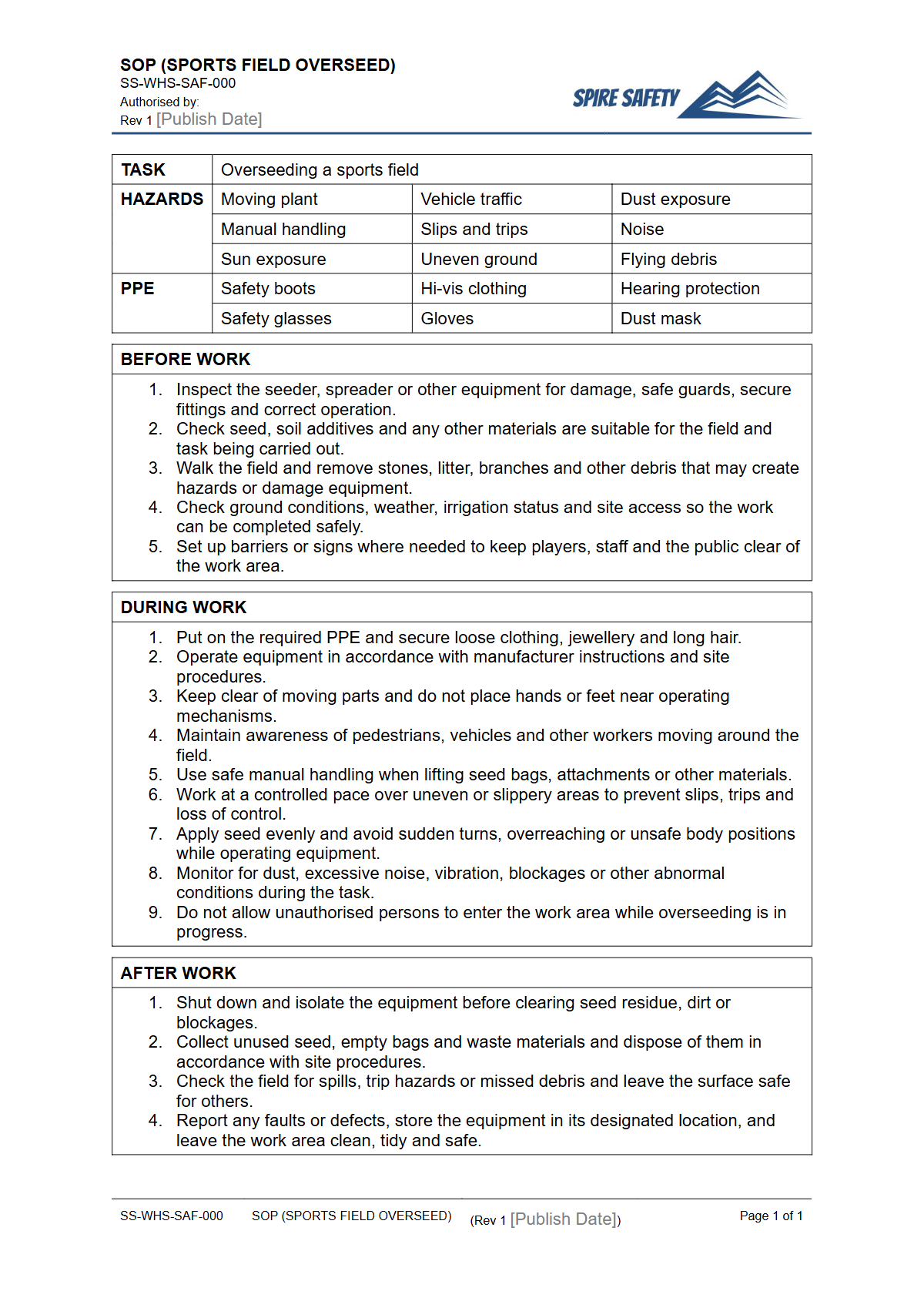
Download our free Safe Operating Procedure for sports field overseeding. This template helps you document safety steps for equipment use and task execution.
Free Safe Operating Procedure (Sports Field Overseed) Template
DOCX • 126 KB + PDF
Updated Oct 2026
No signup required
Purpose of the Free Safe Operating Procedure (Sports Field Overseed) Template
Overseeding is a common but complex task in sports field maintenance, involving machinery, manual handling, and variable environmental conditions. This Safe Operating Procedure for sports field overseeding provides a structured framework to identify and control the risks associated with the job.
Its purpose is to standardise the process, ensuring that every worker follows a consistent, safe method for preparing the ground, operating machinery like seeders and spreaders, and handling materials. By documenting these steps, you create a vital training resource for new staff and a clear reference point for experienced groundskeepers.
A well-defined SOP is a cornerstone of effective safety management. It demonstrates a commitment to managing workplace risks and forms an integral part of developing a broader WHS management system. This template helps your organisation meet its duty of care by formalising procedures for hazard identification, risk assessment, and the implementation of control measures specific to overseeding tasks, such as machinery entanglement, manual handling injuries, and exposure to dust or chemicals.
Video walkthrough
How to use the Free Safe Operating Procedure (Sports Field Overseed) Template
This downloadable template is provided in both DOCX and PDF formats for your convenience. The DOCX file is fully editable, allowing you to tailor the procedure to the specific machinery, site conditions, and workforce at your facility.
It serves as a comprehensive starting point, aligned with Australian WHS principles, but it is not a complete, out-of-the-box solution. It is crucial that you customise it to reflect your unique operational environment.
To effectively use this resource:
- Download and Review: Start by downloading the template and familiarising yourself with its sections, which cover pre-operational checks, operational steps, and post-task procedures.
- Conduct a Risk Assessment: Identify all potential hazards associated with your specific overseeding equipment and environment. Consider machinery operation, refueling, maintenance, and material handling.
- Customise the Content: Add, remove, or modify sections to match your equipment (e.g., slit-seeders, drop spreaders, tractor-mounted implements) and site-specific rules. Reference the manufacturer’s operating manual for key safety information. The process for using a broadcast spreader will differ from using a precision seeder, just as our grain drill SOP template outlines different steps.
- Consult with Workers: Involve the groundskeepers and operators who perform the task. Their direct experience is invaluable for identifying practical risks and effective controls. Worker consultation is a key requirement of WHS legislation.
- Approve and Implement: Once finalised, have the SOP approved by a manager or supervisor. Ensure it is communicated to all relevant workers and used as part of job training and supervision.
A Note on Customisation
This document is a template and must be customised to suit your specific workplace. We are not responsible for the outcomes of any action taken based on the information provided in this document.
You must ensure that the procedures you develop are safe and appropriate for your circumstances.
When to use a Sports Field Overseed SOP
A Safe Operating Procedure for overseeding should be a living document that is used actively within your operations, not just filed away. It is most effective when used in the following situations:
- Training and Induction: Use the SOP as the primary training document for any new or inexperienced staff tasked with operating overseeding machinery.
- Pre-Task Planning: It should be reviewed by operators before commencing work, especially if the task is performed infrequently. This serves as a critical refresher on key safety checks and procedures.
- Toolbox Talks: The SOP can be the focus of a safety meeting or toolbox talk to discuss specific hazards, review past incidents, or introduce new equipment.
- Incident Investigation: If an incident or near-miss occurs during an overseeding task, the SOP should be reviewed to determine if the procedure was followed and whether it needs to be updated to prevent a recurrence. For complex situations, seeking specialist WHS consulting can provide valuable external insight.
Who should use this Safe Operating Procedure
This template is designed for a range of personnel responsible for safety and operations in sports turf management. The primary users include:
- Grounds Managers and Head Curators: Responsible for developing, implementing, and reviewing safety procedures for all turf maintenance tasks.
- WHS Managers and Officers: Who oversee the organisation's safety management system and ensure procedures align with legislative requirements.
- Supervisors: Who are responsible for the direct supervision of workers and ensuring they are trained and competent to perform tasks safely.
- Business Owners: For landscaping, turf management, and contracting companies, this SOP helps standardise services and demonstrate safety diligence to clients. While this document focuses on overseeding, procedures for related tasks can be developed using a planter SOP template or similar resources.
- Workers and Operators: As the end-users, they rely on the SOP for clear, step-by-step instructions on how to perform their job without risk to themselves or others.
Common mistakes
Common mistakes to avoid
- Failing to conduct and document pre-operational checks on the seeder, spreader, or tractor.
- Neglecting to wear appropriate Personal Protective Equipment (PPE), such as safety boots, gloves, and respiratory protection for dust.
- Incorrectly calibrating machinery, leading to uneven application or wasted seed.
- Operating machinery on excessively steep or wet slopes, increasing the risk of rollovers.
Legal references
Legal considerations
The following legal requirements may be relevant to this type of work.
- Work Health and Safety Act (Harmonised) — Provides the primary duties for protecting workers and other people from work health and safety risks.
- Work Health and Safety Regulations (Harmonised) — Sets out requirements supporting the management of workplace hazards and risks.
The following codes may be relevant to this type of work.
- Managing WHS Risks Code of Practice — Provides practical guidance on identifying hazards, assessing risks and applying effective controls.
- Work Health and Safety Consultation, Cooperation and Coordination Code of Practice — Provides practical guidance on consulting workers and coordinating with other duty holders.
- Managing the Work Environment and Facilities Code of Practice — Provides practical guidance on safe work environments, workplace facilities and related controls.
Did you know
Soil Compaction
One of the primary reasons for overseeding is to repair turf damage caused by soil compaction. Aeration is often performed before overseeding to relieve this compaction, improving water, nutrient, and oxygen flow to the plant roots.
Calibration is Key
Incorrect calibration of a seeder or spreader is a major cause of poor results. It can lead to wasted seed and money, or an uneven, patchy turf surface that is unsuitable for sports.
FAQ
Frequently asked questions
01What is a Safe Operating Procedure for sports field overseeding?
02What key hazards should be included in an overseeding SOP?
03Who is responsible for creating and reviewing an overseeding SOP?
04How often should a sports field overseeding SOP be reviewed?
Share this resource
Free Safe Operating Procedure (Sports Field Overseed) Template
Browse Categories
How To Use It
- 1Download and open in Word or PDF.
- 2Replace the placeholders with your business details.
- 3Get it reviewed by a WHS specialist before rollout.
Need it customised?
Our WHS consultants can adapt this template to your site, run a gap analysis, or audit what you already have in place.
Book a Free Consultation WHS consulting servicesor call 1300 156 382
Related templates
- Free Safe Operating Procedure (Sports Field Topdress) Template
- Free Safe Operating Procedure (Sports Net Inspection) Template
- Free Safe Operating Procedure (Spot Welder) Template
- Free Safe Operating Procedure (Spray Adhesive) Template
- Free Safe Operating Procedure (Spray Booth Cleaning) Template
- Free Safe Operating Procedure (Spray Painting) Template