
Free Safe Operating Procedure (Spray Booth Cleaning) Template
Download our free Safe Operating Procedure (Spray Booth Cleaning) Template to manage hazards like chemical exposure and fire. Get your DOCX and PDF template.
Free Safe Operating Procedure (Spray Booth Cleaning) Template
DOCX • 126 KB + PDF
Updated Oct 2026
No signup required
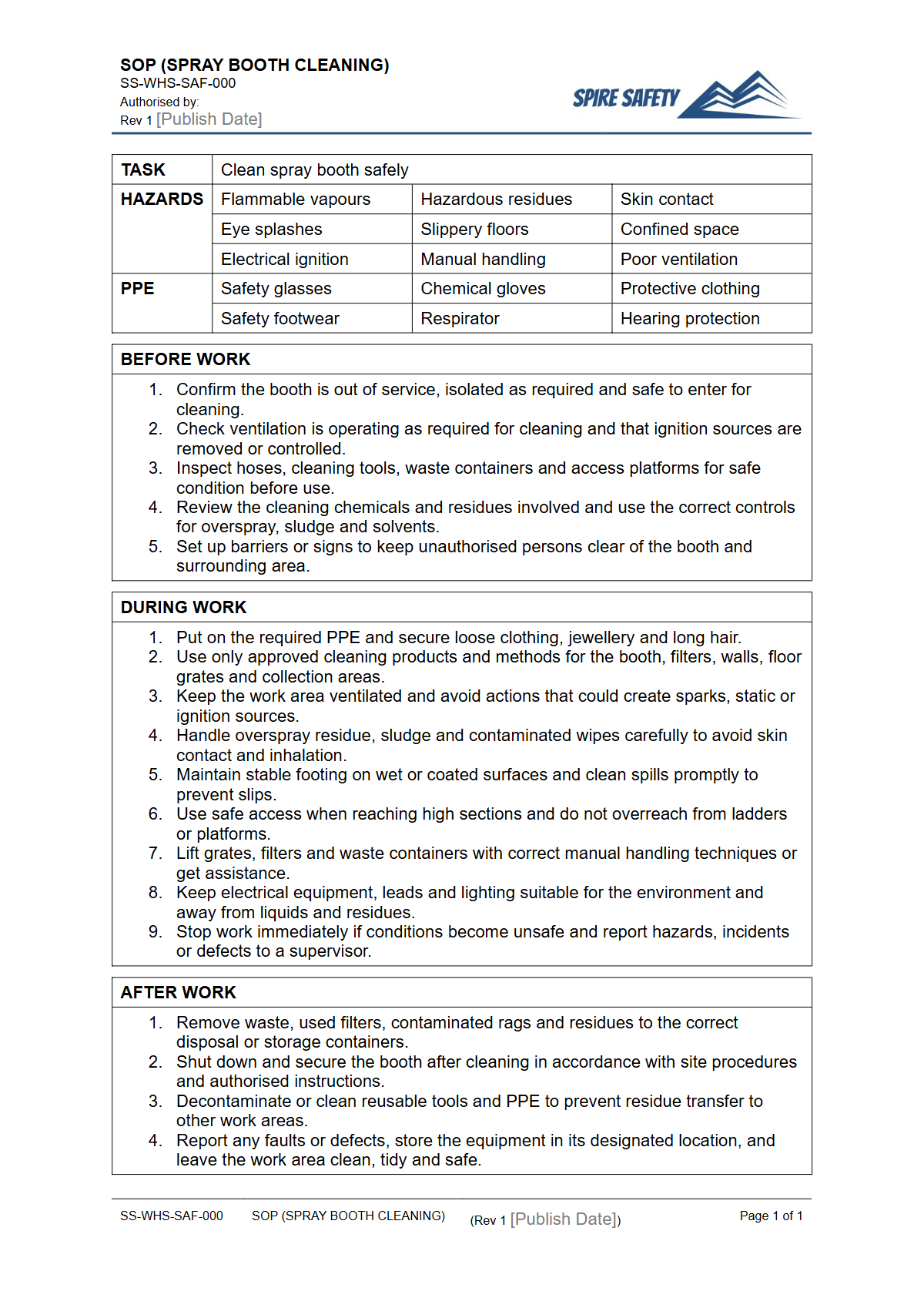
Purpose of the Free Safe Operating Procedure (Spray Booth Cleaning) Template
Cleaning a spray booth involves significant risks, including exposure to hazardous chemicals, fire, and potential confined space entry. This Free Safe Operating Procedure (Spray Booth Cleaning) Template provides a structured starting point for documenting the required safety controls for this high-risk task.
Using a standardised SOP helps ensure that all workers follow a consistent, safe method every time, minimising the chance of incidents and injuries. It outlines critical steps for preparation, cleaning, and waste disposal, forming an essential part of your overall site safety documentation.
A well-drafted SOP is a key administrative control measure and a fundamental component of robust WHS management systems. It serves as a practical tool for worker training, competency verification, and risk management, demonstrating your organisation's commitment to providing a safe working environment as required by Australian WHS legislation.
Video walkthrough
How to use the Free Safe Operating Procedure (Spray Booth Cleaning) Template
This downloadable template is provided in both DOCX and PDF formats for your convenience. The DOCX file is fully editable, allowing you to tailor the content to your specific operational needs.
To effectively use this resource, you should consult with the workers who actually perform the cleaning tasks, as their practical experience is invaluable for creating a procedure that is both safe and workable.
Important: This document is a template and must be customised for your workplace. It is not a complete, ready-to-use safety document.
We recommend that a competent person with knowledge of your specific spray booth, the chemicals in use (referencing their Safety Data Sheets), and relevant legislation reviews and approves the final document before it is implemented. For a more general guide, you can also download our Free Safe Operating Procedure (SOP) Template to see the basic structure.
When to Use a Safe Operating Procedure for Spray Booth Cleaning
A specific SOP for spray booth cleaning should be used for all cleaning activities, whether scheduled or unscheduled. This includes routine daily or weekly clean-downs to remove overspray and residues, as well as more intensive periodic deep cleans, such as changing filters or stripping built-up paint from walls and floors.
The procedure should also be referenced before any maintenance or repair work is conducted inside the booth to ensure the area is free from atmospheric and residue hazards. Furthermore, the SOP is a critical resource for initial worker training, refresher courses, and competency assessments.
Maintaining the equipment associated with the booth, such as the ventilation and air supply systems, is also critical. These tasks should have their own documented procedures, like our free Air Compressor SOP, to ensure all related plant is operated and maintained safely.
Who Should Use This Safe Operating Procedure
This Safe Operating Procedure is intended for several groups within an organisation:
- Operators and Technicians: The primary users are the workers assigned to clean the spray booth. They must be trained on the SOP's contents and follow it step-by-step.
- Supervisors and Managers: They use the SOP to supervise work, deliver training, and ensure that safety standards are consistently met. In the event of an incident, the SOP serves as a benchmark for investigation.
- WHS/OHS Personnel: Safety advisors and managers use the SOP as part of the risk assessment process and to assist in developing the broader safety framework. It is also a key document reviewed during WHS compliance auditing to verify that administrative controls for high-risk tasks are in place and adequate.
Key Hazards in Spray Booth Cleaning
Understanding the specific hazards is the first step in controlling them. Spray booth cleaning presents several major risks that must be addressed in your SOP.
Chemical Exposure
Cleaning solvents, thinners, and leftover paint residues (including isocyanates from two-pack paints) can be inhaled or absorbed through the skin. This can cause immediate health effects or long-term occupational illness.
Controls include mechanical ventilation, air-fed respirators, chemical-resistant gloves, and disposable coveralls.
Fire and Explosion
Solvent vapours and fine dust from paint overspray can create a highly flammable or explosive atmosphere. Ignition sources like static electricity, non-intrinsically safe electrical tools, or sparks from metal scrapers can lead to a fire.
Controls involve using non-sparking tools, grounding equipment, ensuring proper ventilation is active, and strictly following lockout-tagout procedures to de-energise all non-essential electrical equipment. Similar principles of managing flammable substances are detailed in our FREE Oxy Acetylene SOP.
Confined Spaces
Depending on its size and configuration, a spray booth may be considered a confined space during certain deep cleaning tasks, especially if entry and exit are restricted and ventilation is compromised. If so, a formal confined space entry permit system, including atmospheric monitoring and a standby person, may be required.
By systematically addressing these hazards, your customised SOP becomes a powerful tool for preventing harm. Explore our entire free WHS resources library for more templates to support your safety management system.
Common mistakes
Common mistakes to avoid
- Using metal scrapers or other tools that can create sparks in a flammable atmosphere.
- Failing to implement a full lockout-tagout (LOTO) procedure to isolate electrical energy before starting.
- Neglecting to wear the correct respiratory protection, or using a dust mask instead of a chemical vapour respirator.
- Disposing of solvent-soaked rags and residues in general waste bins, creating a serious fire hazard.
Legal references
Legal considerations
The following legal requirements may be relevant to this type of work.
- Work Health and Safety Act (Harmonised) — Provides the primary duties for protecting workers and other people from work health and safety risks.
- Work Health and Safety Regulations (Harmonised) — Sets out requirements supporting the management of workplace hazards and risks.
The following codes may be relevant to this type of work.
- Managing WHS Risks Code of Practice — Provides practical guidance on identifying hazards, assessing risks and applying effective controls.
- Work Health and Safety Consultation, Cooperation and Coordination Code of Practice — Provides practical guidance on consulting workers and coordinating with other duty holders.
- Managing the Work Environment and Facilities Code of Practice — Provides practical guidance on safe work environments, workplace facilities and related controls.
Did you know
Static Spark
A static electricity spark from a person's body can have enough energy (around 10-30 millijoules) to ignite the flammable vapours of common industrial solvents, highlighting the need for proper grounding and bonding.
Isocyanate Exposure
Isocyanates, found in many two-pack automotive paints, are a leading cause of occupational asthma in Australia. The risk of exposure is particularly high during cleaning when dried residues can become airborne.
FAQ
Frequently asked questions
01What are the main hazards when cleaning a spray booth?
02What PPE is required for cleaning a spray booth?
03How often should a spray booth be cleaned?
04Can I use any cleaning solvent in a spray booth?
Share this resource
Free Safe Operating Procedure (Spray Booth Cleaning) Template
Browse Categories
How To Use It
- 1Download and open in Word or PDF.
- 2Replace the placeholders with your business details.
- 3Get it reviewed by a WHS specialist before rollout.
Need it customised?
Our WHS consultants can adapt this template to your site, run a gap analysis, or audit what you already have in place.
Book a Free Consultation WHS consulting servicesor call 1300 156 382
Related templates
- Free Safe Operating Procedure (Spray Painting) Template
- Free Safe Operating Procedure (Spreader Beam) Template
- Free Safe Operating Procedure (Spring Coiler) Template
- Free Safe Operating Procedure (Spring Compressor) Template
- Free Safe Operating Procedure (Sprinkler Head Change) Template
- Free Safe Operating Procedure (Sprinkler Head Cleaning) Template