
Free Safe Operating Procedure (Sprinkler Head Cleaning) Template
This Safe Operating Procedure for Sprinkler Head Cleaning provides a framework for outlining safe work practices. Download your free template today.
Free Safe Operating Procedure (Sprinkler Head Cleaning) Template
DOCX • 126 KB + PDF
Updated Oct 2026
No signup required
Purpose of the Free Safe Operating Procedure (Sprinkler Head Cleaning) Template
Fire sprinkler systems are a critical first line of defence against fire, but their effectiveness depends on proper maintenance. Sprinkler heads can become covered in dust, grease, paint, or other contaminants, which can insulate the heat-sensitive element and delay or prevent activation.
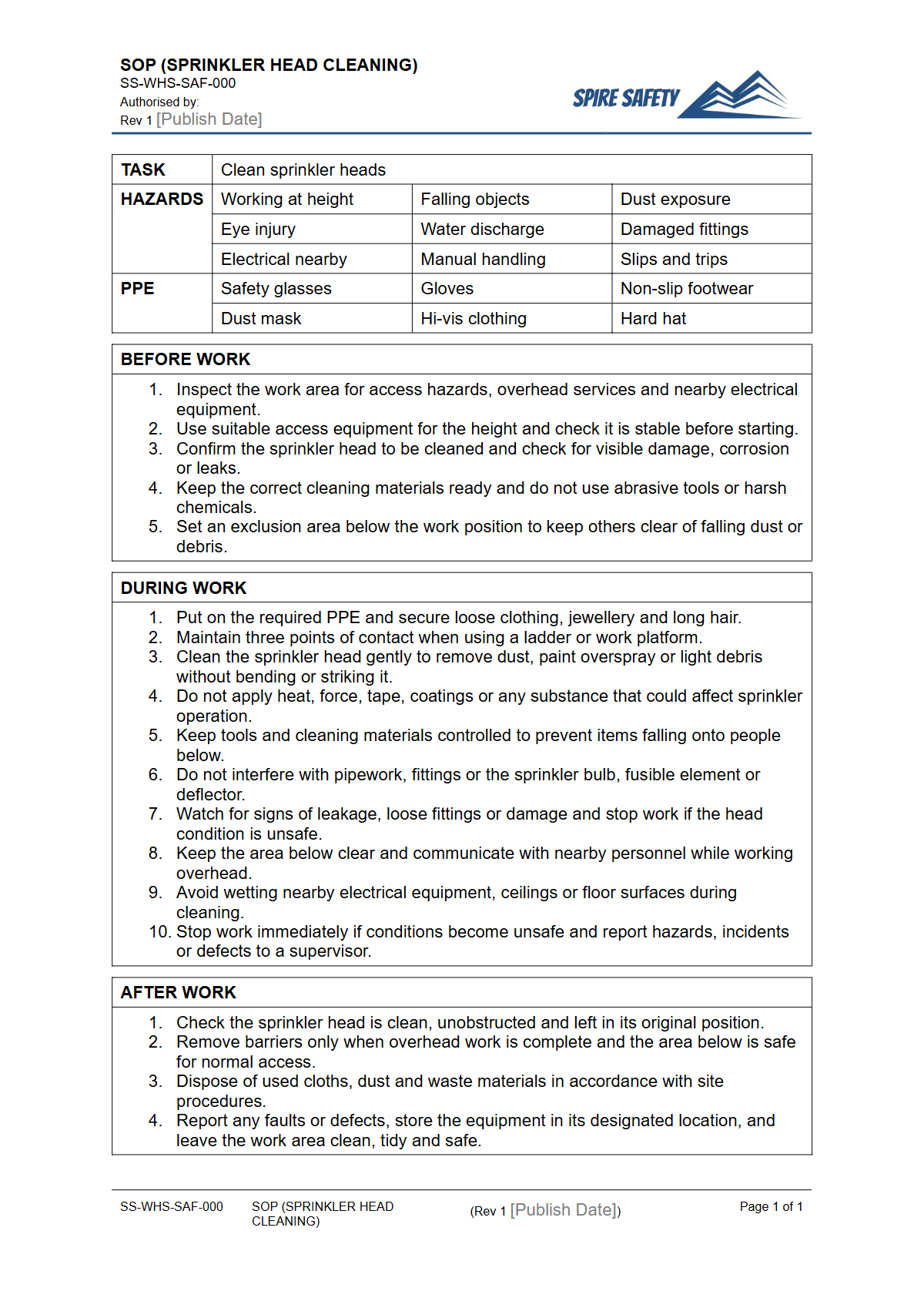
This Free Safe Operating Procedure (Sprinkler Head Cleaning) Template provides a structured starting point for documenting the approved process for cleaning sprinkler heads safely and effectively. Using a formal SOP helps ensure that maintenance is performed consistently, reduces the risk of accidental activation, and addresses hazards like working at heights and chemical exposure.
A well-defined SOP is a fundamental component of a building's fire safety plan and overall risk management strategy. It helps organisations meet their duty of care under Australian WHS laws by formalising safe systems of work for high-risk maintenance tasks.
This template guides you in detailing the specific steps, PPE requirements, and precautions necessary for the task, forming part of your broader safety documentation. Implementing such procedures is a key element within comprehensive WHS management systems.
Video walkthrough
How to use the Free Safe Operating Procedure (Sprinkler Head Cleaning) Template
This Safe Operating Procedure for Sprinkler Head Cleaning is provided as a downloadable DOCX file for easy editing, as well as a print-ready PDF. To use it effectively, you must customise it to reflect the specific circumstances of your workplace.
Start by adding your company name, the date of issue, review dates, and the names of personnel authorised to perform the work. Critically, you must review and adapt the procedure steps, risk controls, and PPE requirements to match your site's specific sprinkler system, the cleaning agents used, and the environment in which the work will occur.
Important: This is a template, not a finished document. We have drafted it as a guide aligned with Australian WHS principles, but your workplace has unique risks and requirements.
You are responsible for ensuring the final document is accurate, complete, and suitable for your specific operations. A thorough risk assessment should always be conducted before finalising and implementing any SOP.
For a more generic framework that you can adapt for other tasks, you might find our general Free Safe Operating Procedure (SOP) Template useful.
Key Sections to Customise:
- Risk Assessment: Identify all potential hazards associated with the task (e.g., falls from height, chemical exposure, manual handling, system malfunction) and detail the control measures implemented.
- Personal Protective Equipment (PPE): List the mandatory PPE based on your risk assessment, which might include safety glasses, gloves, and harnesses for working at height.
- Pre-operational Checks: Detail the steps for system isolation, communication with building occupants, and equipment inspection (e.g., ladders, cleaning tools).
- Step-by-Step Procedure: Clearly outline the cleaning process. Specify approved cleaning methods (e.g., soft brush, vacuum) and explicitly forbid damaging actions like pressure washing, scraping, or using abrasive materials.
- Post-operational Checks: Include steps for de-isolating the system, checking for leaks or damage, cleaning the work area, and completing maintenance logs.
When to use it
This Safe Operating Procedure should be implemented whenever sprinkler heads require cleaning as part of a scheduled maintenance program, as stipulated by Australian Standard AS 1851. It is also used for reactive cleaning following construction activities that create dust, or when visual inspections reveal contamination like grease, dust build-up, or light overspray that can be safely removed.
The SOP should not be used for sprinkler heads that have been painted over; these must be replaced, not cleaned. Following these procedures consistently can be verified through routine WHS compliance auditing.
Who should use it
This SOP is intended for use by trained and competent personnel responsible for building and fire systems maintenance. This includes facilities managers, maintenance supervisors, and fire safety technicians.
It is also a critical document for the Person Conducting a Business or Undertaking (PCBU), as it provides evidence of a formalised safe system of work for a specific maintenance task. Before any worker undertakes this task, they must be trained on the contents of the finalised SOP and demonstrate their competency in performing the work safely.
Developing clear procedures for specialist equipment is a common challenge, and our Air Compressor SOP provides another example of a task-specific maintenance document.
Ultimately, anyone involved in the lifecycle of the task—from planning and supervision to execution and record-keeping—should be familiar with this procedure. For organisations needing assistance in developing a suite of SOPs or defining competency requirements, engaging with an expert WHS consulting service can provide valuable guidance and support.
You can find many more examples of specific SOPs in our free WHS resources library to help build out your safety system.
Common mistakes
Common mistakes to avoid
- Using abrasive materials, wire brushes, or high-pressure tools that damage the sprinkler head or its operating element.
- Painting over sprinkler heads during renovations, which insulates them and renders them ineffective.
- Failing to properly isolate the correct sprinkler system zone before starting work, leading to accidental water discharge.
- Neglecting to replace sprinkler heads that are visibly corroded, damaged, or have been painted over.
Legal references
Legal considerations
The following legal requirements may be relevant to this type of work.
- Work Health and Safety Act (Harmonised) — Provides the primary duties for protecting workers and other people from work health and safety risks.
- Work Health and Safety Regulations (Harmonised) — Sets out requirements supporting the management of workplace hazards and risks.
The following codes may be relevant to this type of work.
- Managing WHS Risks Code of Practice — Provides practical guidance on identifying hazards, assessing risks and applying effective controls.
- Work Health and Safety Consultation, Cooperation and Coordination Code of Practice — Provides practical guidance on consulting workers and coordinating with other duty holders.
- Managing the Work Environment and Facilities Code of Practice — Provides practical guidance on safe work environments, workplace facilities and related controls.
Did you know
The Fusible Link
Most sprinkler heads have a small, heat-sensitive glass bulb or a two-part metal link held together by a fusible alloy. These are designed to fail at a specific temperature, releasing the water.
Colour Coding
The liquid inside glass bulb sprinklers is colour-coded to indicate its activation temperature. This ensures the correct type of sprinkler is installed for the specific environment, from ordinary offices to high-heat industrial areas.
FAQ
Frequently asked questions
01What PPE is needed for cleaning sprinkler heads?
02Can I use compressed air to clean a sprinkler head?
03How often should fire sprinkler heads be cleaned?
04What should I do if a sprinkler head is covered in paint?
Share this resource
Free Safe Operating Procedure (Sprinkler Head Cleaning) Template
Browse Categories
How To Use It
- 1Download and open in Word or PDF.
- 2Replace the placeholders with your business details.
- 3Get it reviewed by a WHS specialist before rollout.
Need it customised?
Our WHS consultants can adapt this template to your site, run a gap analysis, or audit what you already have in place.
Book a Free Consultation WHS consulting servicesor call 1300 156 382
Related templates
- Free Safe Operating Procedure (Sprinkler Pump Test) Template
- Free Safe Operating Procedure (Sprinkler Valve Test) Template
- Free Safe Operating Procedure (Stable Bedding Change) Template
- Free Safe Operating Procedure (Stable Manure Removal) Template
- Free Safe Operating Procedure (Stadium Seat Cleaning) Template
- Free Safe Operating Procedure (Stair Chair Operation) Template