
Free Safe Operating Procedure (Sprinkler Valve Test) Template
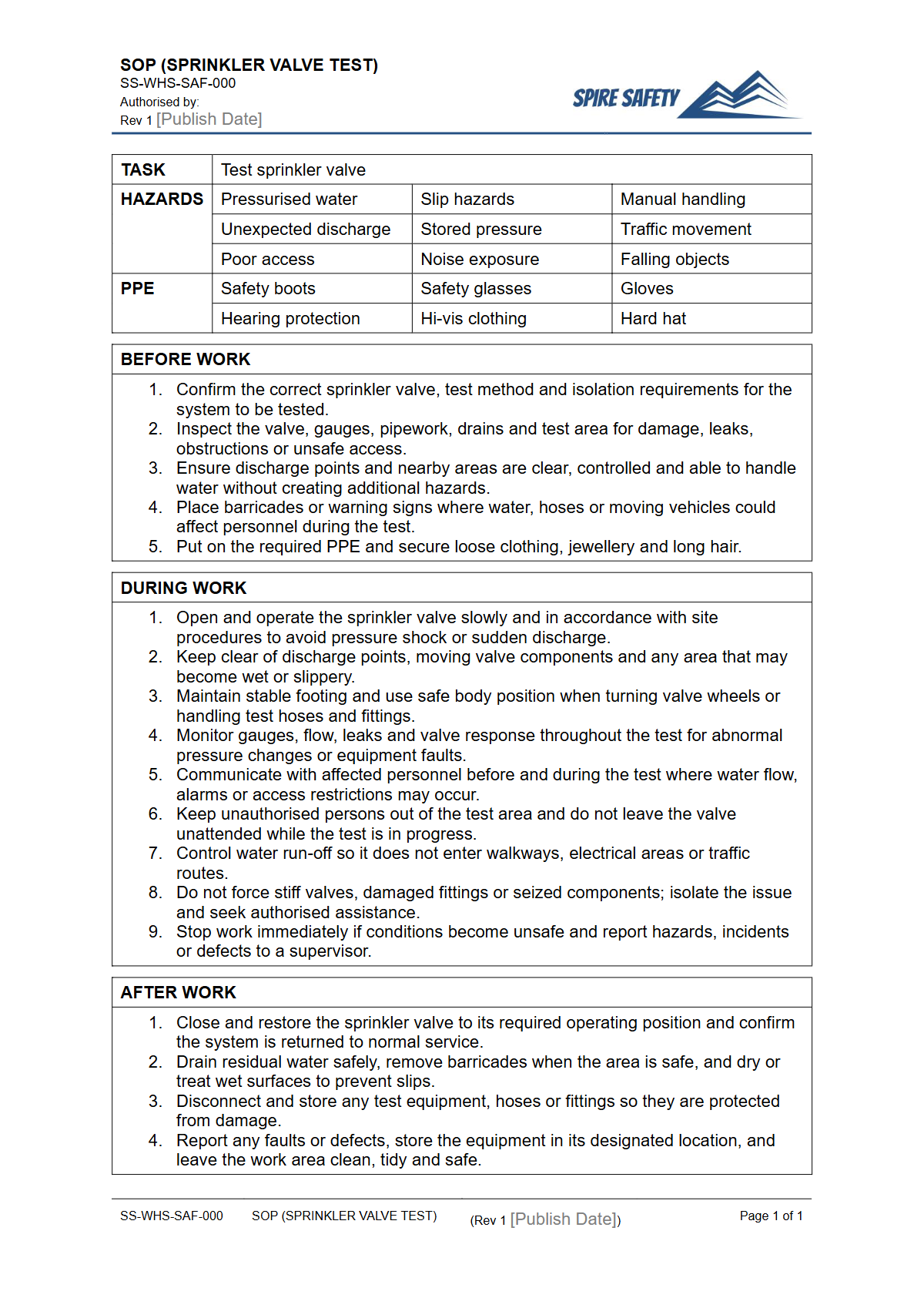
Formalise fire safety protocols with our free Safe Operating Procedure (Sprinkler Valve Test) Template. This structured document helps you outline key steps.
Free Safe Operating Procedure (Sprinkler Valve Test) Template
DOCX • 126 KB + PDF
Updated Oct 2026
No signup required
Purpose of the Free Safe Operating Procedure (Sprinkler Valve Test) Template
Regularly testing fire sprinkler systems is a critical component of property and personnel safety. A sprinkler valve test verifies that the control valves are in the correct (open) position and that the system has an adequate water supply.
This free Safe Operating Procedure (Sprinkler Valve Test) Template provides a structured framework for documenting the required steps to perform these tests safely and consistently. Using a standardised procedure helps ensure that tests are conducted correctly every time, preventing accidental system impairment and ensuring the system will function as designed during a fire emergency.
It also serves as a crucial training tool for new personnel.
Formalising this process is a key part of demonstrating due diligence and forms an essential record within your broader safety framework. An effective SOP is a practical tool for managing high-risk tasks and is a fundamental element of robust WHS management systems that actively reduce workplace risk.
This template helps you define responsibilities, required personal protective equipment (PPE), and the specific sequence of actions to mitigate hazards associated with the task, such as unexpected water discharge or incorrect valve operation.
Video walkthrough
How to use the Free Safe Operating Procedure (Sprinkler Valve Test) Template
This template is provided as a starting point in DOCX and PDF formats. It is designed to be adapted to the specific sprinkler systems, equipment, and environmental conditions at your workplace.
To use it effectively, download the document and begin customising it with site-specific details. This includes identifying the exact locations of valves, alarm panels, and testing points relevant to your facility.
It is crucial to consult with the workers who will actually be performing the tests; their direct experience is invaluable for creating a practical and effective procedure.
Important: This is a template only. We are not familiar with your unique operational environment, the specific plant and equipment you use, or the competency of your people.
You MUST customise this document to reflect the specific hazards and control measures relevant to your workplace. Once finalised, the SOP should be used as part of your training program and made easily accessible to all relevant staff.
For tasks not covered here, you can use our general Free Safe Operating Procedure (SOP) Template as a base.
Key Components of a Sprinkler Valve Test SOP
A comprehensive SOP for sprinkler valve testing should cover several key areas to ensure safety and effectiveness. The procedure should begin with pre-test checks, including notifying the fire alarm monitoring company, building management, and occupants to prevent false alarms and unnecessary emergency responses.
It must clearly list the required PPE, which may include safety glasses, gloves, and non-slip footwear. The core of the document is the step-by-step testing sequence, which typically includes instructions for both the main drain test (to check water supply) and alarm tests (to verify that flow switches and pressure switches are working). For dry-pipe systems, this may also involve specific procedures related to the system's air pressure, which could be managed using equipment outlined in a separate Free Air Compressor SOP (Safe Operating Procedure) Template.
Finally, the SOP must detail post-test procedures. This is a critical step that is often overlooked.
It involves confirming that all valves (especially control valves) are returned to their normal operational position and securely locked or supervised. The procedure should conclude with requirements for documenting the test results, including water pressure readings, the time it took for alarms to activate, and any deficiencies or issues identified.
This record-keeping is vital for demonstrating compliance and planning corrective actions.
When to perform a sprinkler valve test
Sprinkler valve tests should be performed as part of a regular, scheduled maintenance program. The frequency is dictated by Australian Standard AS 1851, which outlines routine service requirements for fire protection systems.
This typically includes weekly, monthly, and annual checks of different system components. Tests should also be conducted any time there has been maintenance or modification to the sprinkler system or the main water supply.
Additionally, conducting a test is prudent after any event that may have affected the system, such as nearby major construction or a seismic event, to ensure it remains fully operational.
Who should perform the test
Only competent and trained personnel should conduct sprinkler valve tests. This typically includes qualified fire protection technicians, facilities maintenance staff with specific training on fire systems, or designated fire safety officers.
The person performing the task must understand the function of each component, recognise the potential hazards involved, and know the correct emergency response in case of a malfunction. Their competency should be verified and documented.
The outcomes and records from these tests are often reviewed during a thorough WHS compliance auditing process to verify that safety and maintenance obligations are being met. If you need more guidance or documents to support your safety framework, you can browse our complete free WHS resources library for a wide range of templates and guides.
Common mistakes
Common mistakes to avoid
- Failing to notify the alarm monitoring company, causing a false fire brigade call-out.
- Not fully reopening a control valve after the test, leaving the system impaired or inoperable.
- Using personnel who are not trained or competent in the specific system they are testing.
- Poor record-keeping of test results, making it difficult to track system performance over time.
Legal references
Legal considerations
The following legal requirements may be relevant to this type of work.
- Work Health and Safety Act (Harmonised) — Provides the primary duties for protecting workers and other people from work health and safety risks.
- Work Health and Safety Regulations (Harmonised) — Sets out requirements supporting the management of workplace hazards and risks.
The following codes may be relevant to this type of work.
- Managing WHS Risks Code of Practice — Provides practical guidance on identifying hazards, assessing risks and applying effective controls.
- Work Health and Safety Consultation, Cooperation and Coordination Code of Practice — Provides practical guidance on consulting workers and coordinating with other duty holders.
- Managing the Work Environment and Facilities Code of Practice — Provides practical guidance on safe work environments, workplace facilities and related controls.
Did you know
System Reliability
According to international studies, automatic fire sprinkler systems are highly reliable, successfully controlling fires in over 96% of incidents where they operate.
The Australian Standard
The primary standard governing the maintenance of fire protection systems in Australia is AS 1851, 'Routine service of fire protection systems and equipment'.
FAQ
Frequently asked questions
01How often should sprinkler valve tests be performed in Australia?
02What is the main purpose of a main drain test on a sprinkler system?
03Does this SOP template cover all types of sprinkler systems?
04Is a Safe Operating Procedure a legal requirement for a sprinkler valve test?
Share this resource
Free Safe Operating Procedure (Sprinkler Valve Test) Template
Browse Categories
How To Use It
- 1Download and open in Word or PDF.
- 2Replace the placeholders with your business details.
- 3Get it reviewed by a WHS specialist before rollout.
Need it customised?
Our WHS consultants can adapt this template to your site, run a gap analysis, or audit what you already have in place.
Book a Free Consultation WHS consulting servicesor call 1300 156 382
Related templates
- Free Safe Operating Procedure (Stable Bedding Change) Template
- Free Safe Operating Procedure (Stable Manure Removal) Template
- Free Safe Operating Procedure (Stadium Seat Cleaning) Template
- Free Safe Operating Procedure (Stair Chair Operation) Template
- Free Safe Operating Procedure (Stair Handrail Clean) Template
- Free Safe Operating Procedure (Stair Tread Cleaning) Template