
Free Safe Operating Procedure (Stair Tread Cleaning) Template
Formalise your cleaning processes with our free Safe Operating Procedure for stair tread cleaning. Download the customisable DOCX and PDF to get started.
Free Safe Operating Procedure (Stair Tread Cleaning) Template
DOCX • 126 KB + PDF
Updated Oct 2026
No signup required
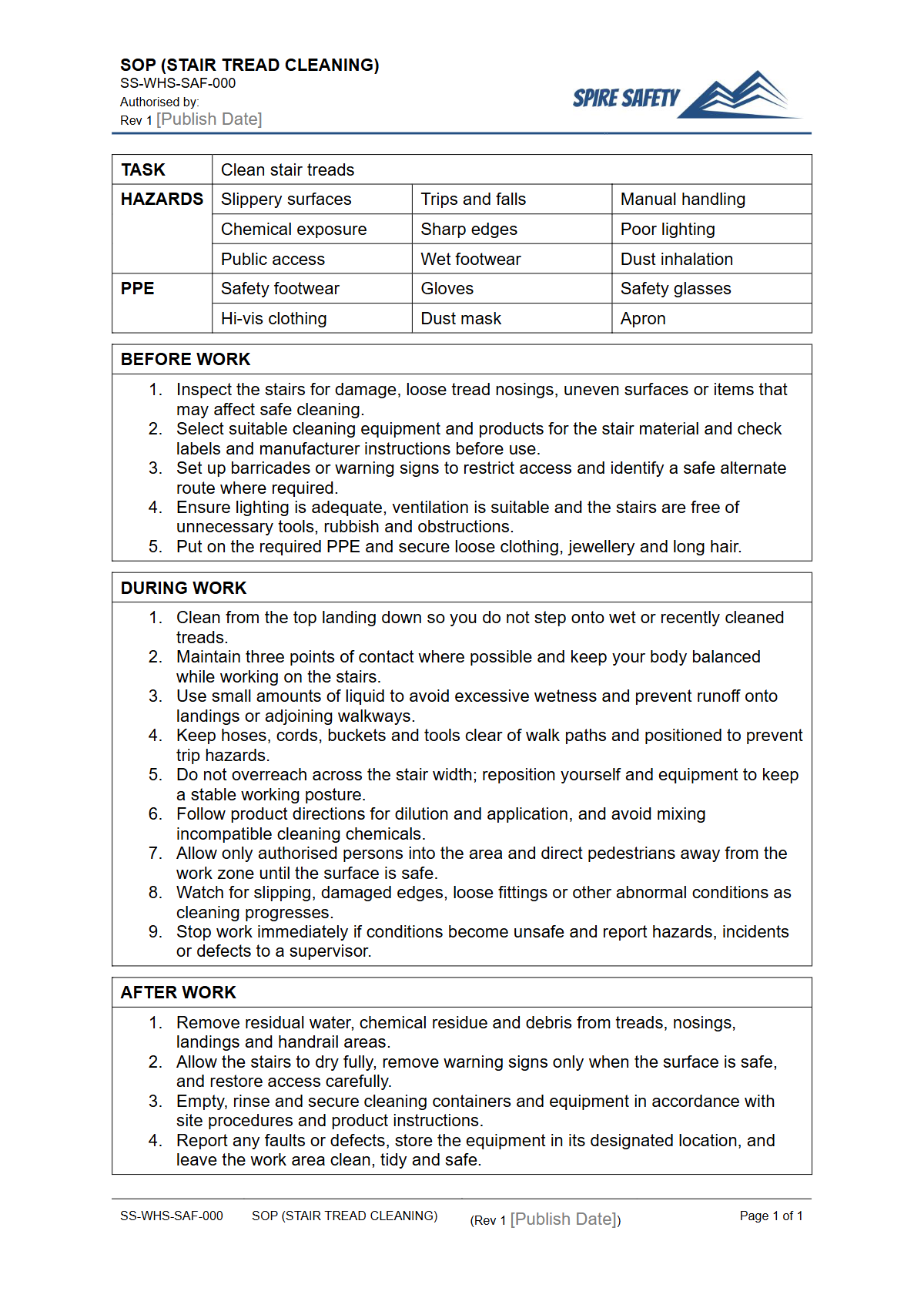
Purpose of the Free Safe Operating Procedure (Stair Tread Cleaning) Template
Cleaning stair treads seems like a simple task, but it carries significant risks, including slips, trips, falls, and exposure to hazardous chemicals. This Free Safe Operating Procedure (Stair Tread Cleaning) Template provides a structured framework for documenting a safe system of work to manage these risks effectively.
By formalising the process, you can ensure tasks are performed consistently and safely every time, reducing the likelihood of incidents and injuries. An effective SOP is a critical tool for demonstrating due diligence and fulfilling your primary duty of care under Australian WHS legislation.
This document guides users through the necessary steps, from pre-operational checks and hazard identification to the cleaning process itself and post-task clean-up. It prompts you to specify required Personal Protective Equipment (PPE), detail emergency procedures, and outline training requirements.
Implementing a clear SOP helps embed a culture of safety, ensuring all workers, including new or temporary staff, understand the non-negotiable safety standards for the task.
Video walkthrough
How to use the Free Safe Operating Procedure (Stair Tread Cleaning) Template
This downloadable resource serves as a comprehensive starting point aligned with Australian WHS principles. To make it effective, you must adapt it to the unique context of your workplace.
Important: This is a template, not a finished document. We have drafted it as a starting point, but you must customise it to reflect the specific equipment, cleaning agents, flooring materials, hazards, and control measures relevant to your worksite.
A generic procedure is not sufficient; it must be site-specific to be useful.
- Download: Choose either the DOCX for easy editing or the PDF for straightforward printing.
- Customise: Walk through each section and fill in the details. Identify the specific types of stair treads (e.g., non-slip, metal, carpeted, concrete), the cleaning chemicals used (and reference their Safety Data Sheets), and the equipment required (e.g., specific mops, buckets, wet vacuums, or scrubbing machines).
- Consult: Involve the workers who actually perform the cleaning tasks in the drafting and review process. Their hands-on experience is invaluable for identifying practical hazards and effective controls. This consultation is a key requirement under WHS law.
- Train: Once finalised, use the SOP as a training tool. Ensure all relevant personnel are instructed on the procedure and have an opportunity to ask questions. Keep a record of this training.
- Review: Schedule regular reviews of the SOP (e.g., annually) or update it immediately following any incident, near miss, or change in equipment, chemicals, or process. An effective SOP is a living document that evolves with your operational needs.
Integrating individual procedures like this one into a cohesive framework is essential for systematic risk management. For businesses looking to establish a robust safety framework, developing comprehensive WHS management systems provides the structure needed to manage all safety documentation and processes effectively.
When to use this Safe Operating Procedure
This SOP should be implemented and followed every time stair treads are cleaned, whether as part of a daily routine or periodic deep cleaning. It is particularly critical in environments with high foot traffic, such as commercial buildings, shopping centres, manufacturing facilities, hospitals, and educational institutions, where the risk of a slip or fall can affect employees and the public.
It should also be used as the basis for risk assessments, worker training sessions, and incident investigations related to this task. Having a documented procedure for routine but hazardous tasks is a cornerstone of proactive safety management, much like having a specific deep fryer operation SOP is essential in a commercial kitchen.
Who should use this Safe Operating Procedure
This document is designed for a range of personnel within an organisation. Primarily, it is for the workers and contractors who physically carry out the stair cleaning tasks.
It gives them clear, step-by-step instructions to follow to keep themselves and others safe.
Supervisors and managers should also use the SOP to induct new team members, conduct refresher training, and perform workplace inspections or observations to verify that the prescribed safety measures are being followed. WHS officers and facility managers will find the template useful for standardising procedures across a site or multiple sites, ensuring a consistent approach to risk control. Conducting periodic checks against these documented standards is a key function of internal WHS compliance auditing.
Creating and maintaining robust SOPs requires careful consideration of your specific operational risks. If you need assistance tailoring this template or developing other safety documents, engaging professional WHS consulting services can provide the necessary expertise.
Beyond manual tasks like cleaning, SOPs are vital for operating machinery and equipment. For example, many workplaces rely on standardised procedures like a free Air Compressor SOP (Safe Operating Procedure) Template to control the risks associated with pneumatic tools and systems.
You can find many more examples in our free WHS resources library to help you build out your safety documentation.
Common mistakes
Common mistakes to avoid
- Using a generic SOP that hasn't been customised for the specific chemicals and equipment in use.
- Failing to adequately train all relevant workers on the finalised procedure.
- Not providing or maintaining the specific Personal Protective Equipment (PPE) listed in the SOP.
- Forgetting to use 'wet floor' signs and physical barricades, creating a significant hazard for others in the area.
Legal references
Legal considerations
The following legal requirements may be relevant to this type of work.
- Work Health and Safety Act (Harmonised) — Provides the primary duties for protecting workers and other people from work health and safety risks.
- Work Health and Safety Regulations (Harmonised) — Sets out requirements supporting the management of workplace hazards and risks.
The following codes may be relevant to this type of work.
- Managing WHS Risks Code of Practice — Provides practical guidance on identifying hazards, assessing risks and applying effective controls.
- Work Health and Safety Consultation, Cooperation and Coordination Code of Practice — Provides practical guidance on consulting workers and coordinating with other duty holders.
- Managing the Work Environment and Facilities Code of Practice — Provides practical guidance on safe work environments, workplace facilities and related controls.
Did you know
A Leading Cause of Injury
Slips, trips, and falls are the second leading cause of serious workers' compensation claims in Australia, highlighting the critical need for robust controls like barricading and safe cleaning procedures.
The Role of the SDS
For every cleaning chemical used, a current Safety Data Sheet (SDS) must be readily accessible to workers. The SOP should reference the SDS, which provides vital information on hazards, handling, and first aid.
FAQ
Frequently asked questions
01Is a Safe Operating Procedure legally required for cleaning stairs in Australia?
02What key hazards should a stair tread cleaning SOP cover?
03How often should our stair cleaning SOP be reviewed?
04Can I use this template for cleaning other floor surfaces?
Share this resource
Free Safe Operating Procedure (Stair Tread Cleaning) Template
Browse Categories
How To Use It
- 1Download and open in Word or PDF.
- 2Replace the placeholders with your business details.
- 3Get it reviewed by a WHS specialist before rollout.
Need it customised?
Our WHS consultants can adapt this template to your site, run a gap analysis, or audit what you already have in place.
Book a Free Consultation WHS consulting servicesor call 1300 156 382
Related templates
- Free Safe Operating Procedure (Stand Up Paddleboard) Template
- Free Safe Operating Procedure (Standing Aid Check) Template
- Free Safe Operating Procedure (Standing Aid Cleaning) Template
- Free Safe Operating Procedure (Static Line Use) Template
- Free Safe Operating Procedure (Steam Cleaner) Template
- Free Safe Operating Procedure (Steam Iron) Template