
Free Safe Operating Procedure (Standing Aid Check) Template
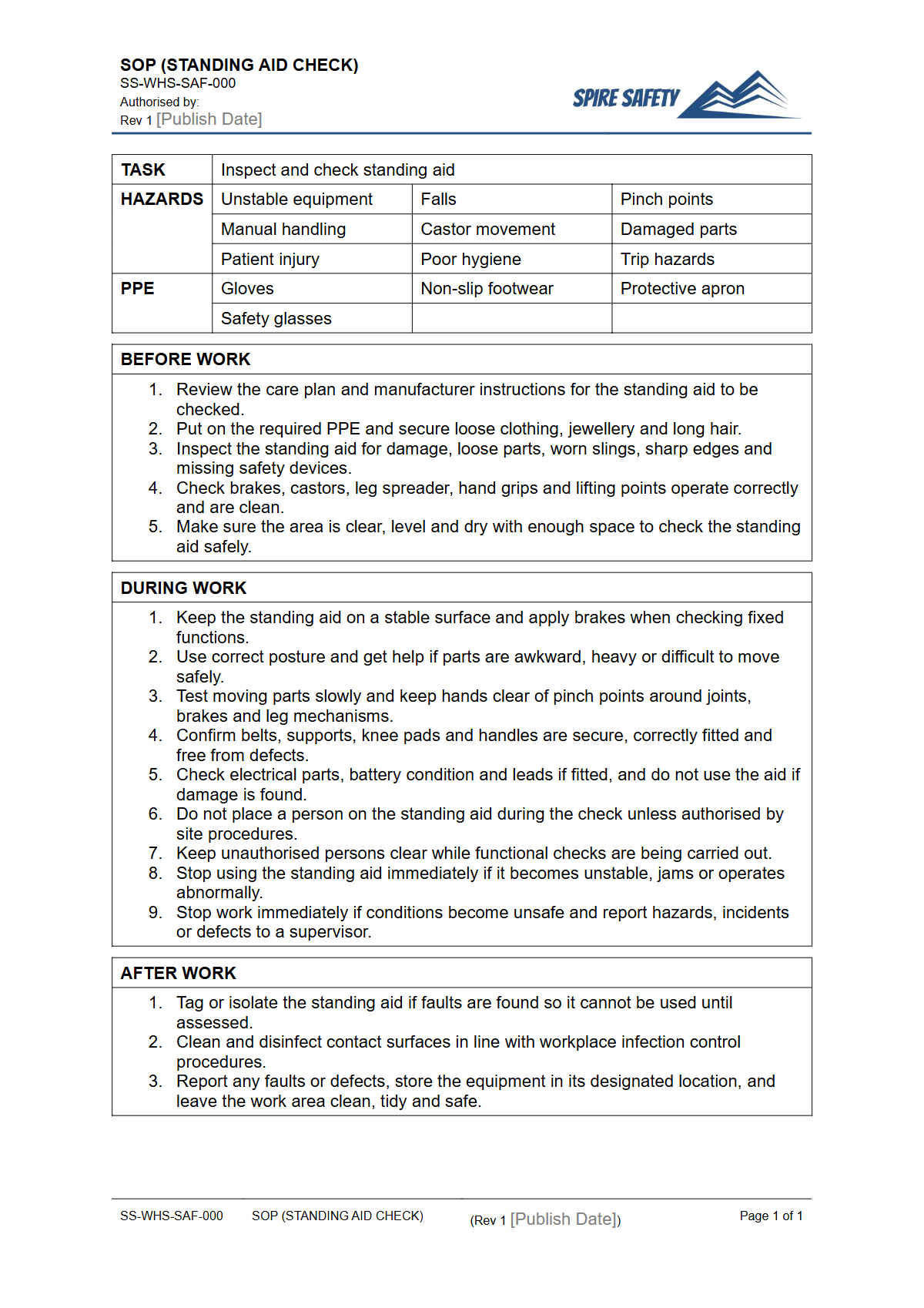
Ensure patient and carer safety with our free Safe Operating Procedure for standing aid checks. Download this customisable template to formalise your checks.
Free Safe Operating Procedure (Standing Aid Check) Template
DOCX • 126 KB + PDF
Updated Oct 2026
No signup required
Purpose of the Free Safe Operating Procedure (Standing Aid Check) Template
A standing aid is a critical piece of equipment in healthcare, aged care, and disability support settings, designed to assist individuals with mobility. Ensuring this equipment is safe and fully functional before every use is non-negotiable.
This free Safe Operating Procedure (Standing Aid Check) Template provides a structured framework for documenting pre-operational and periodic inspections, helping your organisation manage risks associated with equipment failure. It helps protect both the person being assisted and the staff operating the aid from potential injury.
Using a formal SOP demonstrates a commitment to proactive safety management and helps meet your WHS obligations. It creates a clear, repeatable process that reduces the chance of human error and ensures that any defects are identified, reported, and rectified promptly.
Implementing this procedure is a key component of a robust WHS management system, providing evidence of your due diligence in maintaining safe plant and equipment. This systematic approach is fundamental to workplace safety, whether managing patient aids or industrial tools like those covered in our Air Compressor SOP (Safe Operating Procedure) Template.
Video walkthrough
How to use the Free Safe Operating Procedure (Standing Aid Check) Template
This resource is available as a fully editable DOCX file, allowing for complete customisation, and a PDF for easy printing and distribution. To use the template effectively, you should adapt it to reflect the specific make and model of the standing aids used in your facility.
Your procedure should also consider the unique environmental factors of your workplace and the specific tasks for which the aid is used.
Please note: We have designed this document as a template. You must customise it to suit the specific models of standing aid, tasks, environment, and workers at your organisation.
Always consult the manufacturer’s instructions and integrate their specific maintenance and safety recommendations into your final SOP.
The principle of customisation applies to all SOPs, just as our Safe Operating Procedure for a Deep Fryer must be adapted for the specific model and kitchen environment. If you require assistance in tailoring safety documents to your specific operational needs, our WHS consulting services can provide expert guidance.
When to use a Standing Aid Check SOP
A Safe Operating Procedure for a standing aid should be used consistently as part of daily operations and scheduled maintenance. The checks outlined within the SOP should be performed:
- Before first use each day or shift: A pre-operational check ensures the equipment is safe to start the day.
- Before each individual use: A quick visual check can spot issues that may have developed since the last use.
- As part of a regular, scheduled inspection program: More detailed periodic checks (e.g., weekly or monthly) should be documented to track wear and tear over time.
- Following any incident, repair, or maintenance: The aid must be thoroughly checked to confirm it is safe to return to service.
This discipline of pre-use inspection is a critical control for all equipment, including hazardous items detailed in procedures like our FREE Oxy Acetylene SOP Template. It transforms safety from an afterthought into a routine behaviour.
Who should use this Safe Operating Procedure
This SOP should be used by all personnel who are trained and authorised to operate standing aids. This typically includes nurses, personal care assistants, allied health professionals, and disability support workers.
It is the responsibility of supervisors and managers to ensure that workers are not only provided with the SOP but are also trained on its contents and are competent in performing the required checks.
Competency includes understanding how to identify faults, knowing the correct procedure for reporting defects, and having the authority to remove faulty equipment from service immediately. The consistent application of the SOP across all relevant staff can be verified through processes like a WHS compliance audit. For more templates and safety resources, you can browse our complete free WHS resources library.
Common mistakes
Common mistakes to avoid
- Failing to customise the template for the specific make and model of the standing aid.
- Operators completing the checklist as a tick-and-flick exercise without performing a genuine physical inspection.
- Not immediately removing faulty or damaged equipment from service and clearly tagging it as 'Out of Service'.
- Neglecting to train new staff or provide refresher training on the correct inspection procedure.
Legal references
Legal considerations
The following legal requirements may be relevant to this type of work.
- Work Health and Safety Act (Harmonised) — Provides the primary duties for protecting workers and other people from work health and safety risks.
- Work Health and Safety Regulations (Harmonised) — Sets out requirements supporting the management of workplace hazards and risks.
The following codes may be relevant to this type of work.
- Managing WHS Risks Code of Practice — Provides practical guidance on identifying hazards, assessing risks and applying effective controls.
- Work Health and Safety Consultation, Cooperation and Coordination Code of Practice — Provides practical guidance on consulting workers and coordinating with other duty holders.
- Managing the Work Environment and Facilities Code of Practice — Provides practical guidance on safe work environments, workplace facilities and related controls.
Did you know
Manual Handling in Healthcare
In Australia, the healthcare and social assistance industry has one of the highest rates of serious workers' compensation claims, with hazardous manual tasks being a primary cause of injury.
Equipment Lifespan
Patient lifting equipment doesn't last forever. Manufacturers often specify a 'service life' (e.g., 7-10 years), after which the equipment should be decommissioned regardless of its apparent condition to prevent failures from metal fatigue.
FAQ
Frequently asked questions
01What is a standing aid and why does it need an SOP?
02How often should standing aids be checked?
03Who is responsible for checking a standing aid?
04Can I use this template for other patient lifting equipment?
Share this resource
Free Safe Operating Procedure (Standing Aid Check) Template
Browse Categories
How To Use It
- 1Download and open in Word or PDF.
- 2Replace the placeholders with your business details.
- 3Get it reviewed by a WHS specialist before rollout.
Need it customised?
Our WHS consultants can adapt this template to your site, run a gap analysis, or audit what you already have in place.
Book a Free Consultation WHS consulting servicesor call 1300 156 382
Related templates
- Free Safe Operating Procedure (Standing Aid Cleaning) Template
- Free Safe Operating Procedure (Static Line Use) Template
- Free Safe Operating Procedure (Steam Cleaner) Template
- Free Safe Operating Procedure (Steam Iron) Template
- Free Safe Operating Procedure (Steam Room Cleaning) Template
- Free Safe Operating Procedure (Steam Wand Cleaning) Template