
Free Safe Operating Procedure (Steam Wand Cleaning) Template
Formalise your cafe or kitchen's safety protocols with our structured starting point. Download this free Safe Operating Procedure for steam wand cleaning today.
Free Safe Operating Procedure (Steam Wand Cleaning) Template
DOCX • 126 KB + PDF
Updated Oct 2026
No signup required
Purpose of the Free Safe Operating Procedure (Steam Wand Cleaning) Template
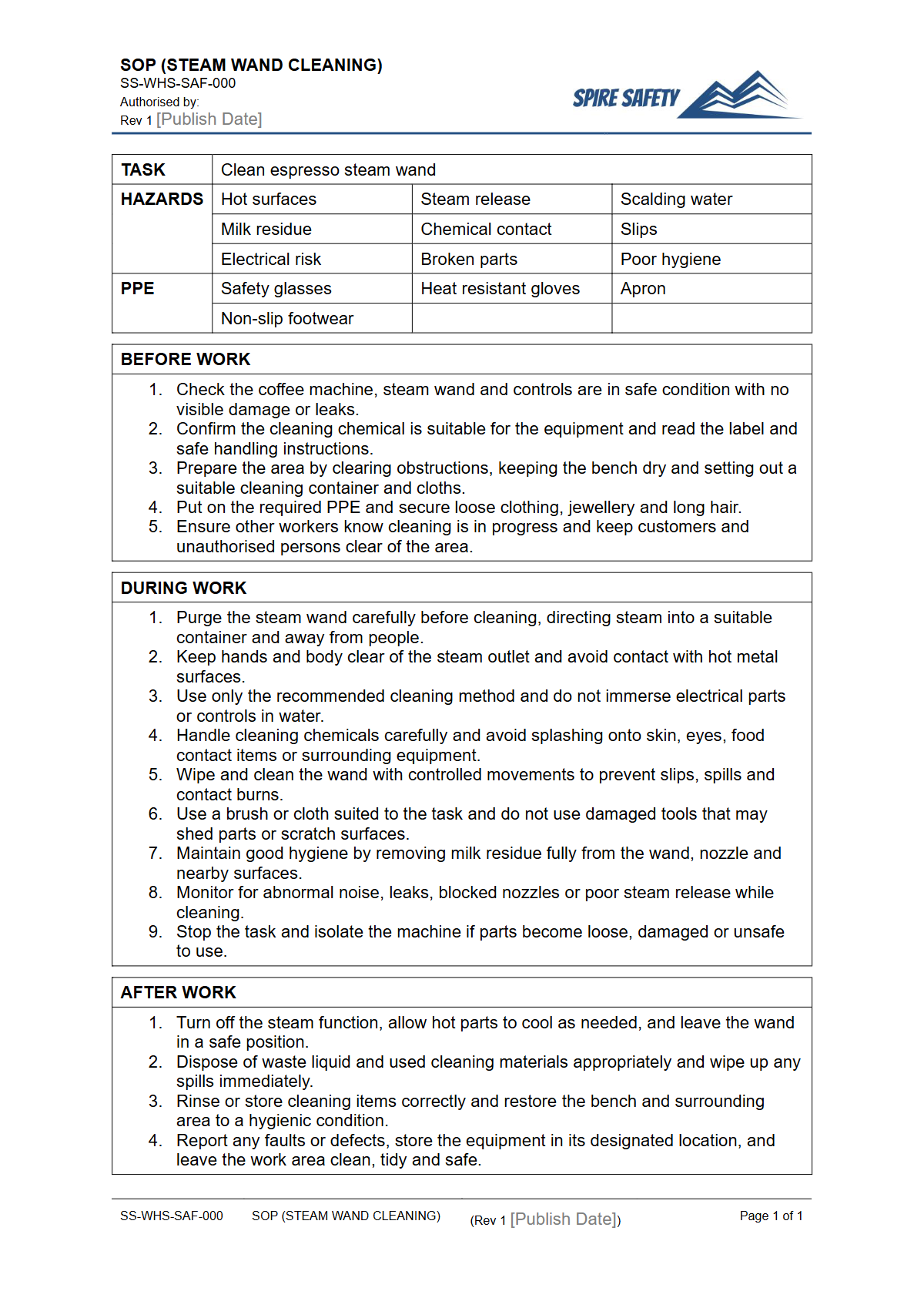
Cleaning an espresso machine's steam wand is a routine task in any hospitality setting, but it carries inherent risks, primarily severe burns from hot steam and surfaces. This free Safe Operating Procedure (Steam Wand Cleaning) Template provides a structured framework to document the safest method for this task.
A documented SOP ensures that all workers, from new trainees to experienced baristas, follow a consistent, safe, and hygienic process. This minimises the risk of injury, prevents equipment damage, and helps maintain food safety standards by preventing bacterial buildup from milk residue.
By formalising this process, a Person Conducting a Business or Undertaking (PCBU) demonstrates a commitment to managing workplace hazards, a core duty under Australian WHS laws. This is similar in principle to documenting procedures for other high-risk kitchen equipment, as outlined in our Safe Operating Procedure for deep fryer operation.
Video walkthrough
How to use the Free Safe Operating Procedure (Steam Wand Cleaning) Template
This template is provided as a fully editable DOCX file, with a PDF version also available for easy printing and distribution. To use this Safe Operating Procedure for steam wand cleaning effectively, you must adapt it to the specific context of your workplace.
This involves a thorough review and customisation process. Add details about your specific make and model of espresso machine, the approved cleaning chemicals used on-site, the location of safety equipment like first aid kits, and your business's specific emergency contacts.
Integrating this SOP into your broader safety framework is crucial for its success. For businesses looking to develop a holistic safety approach, these individual documents are key components of comprehensive WHS management systems.
Important Customisation Note
This document is a template and not a complete Safe Operating Procedure. It is essential that you consult with your team and customise the content to reflect the unique hazards, equipment, and control measures in your specific work environment.
We are not responsible for the outcomes of the use of this document; you are. Your final SOP should be a practical tool developed in consultation with the workers who will use it.
When to use this SOP
A Safe Operating Procedure for steam wand cleaning should be a living document integrated into your daily operations. It is most effective when used as a primary training tool during the induction of new cafe or kitchen staff, ensuring they learn the correct, safe method from their first day.
It should also be readily accessible near the coffee machine as a constant reference for all workers. The SOP serves as a checklist for routine tasks and a basis for refresher training sessions to prevent procedural drift.
Furthermore, it is a key document to review and update after any incident, near miss, or when new equipment or cleaning agents are introduced. Having such procedures in place is a fundamental aspect checked during regular WHS compliance auditing.
Who should use this Safe Operating Procedure
This SOP is intended for all personnel who operate or clean commercial espresso machines. This includes:
- Baristas
- Cafe all-rounders
- Kitchen hands and support staff
- Apprentices and trainees
Supervisors and managers also have a critical role. They are responsible for using the SOP to train staff, verifying their competency in the task, and ensuring the documented procedure is consistently followed.
For business owners and WHS managers, the SOP is a tool for fulfilling their legal duty of care by providing a safe system of work. If you require assistance implementing procedures like this across your organisation, engaging with specialist WHS consulting services can provide expert guidance and support.
Key Hazards in Steam Wand Cleaning
While seemingly simple, cleaning a steam wand presents several significant hazards that this SOP helps to control. The most obvious is the risk of thermal burns from direct contact with high-temperature steam, the hot metal wand, or scalding water.
There is also a risk of chemical exposure if inappropriate or harsh cleaning agents are used, which can lead to skin irritation or respiratory issues. Slips, trips, and falls are another common hazard in a cafe environment, often caused by water or milk spilt during the cleaning process.
Finally, poor cleaning practices can lead to hygiene issues, creating a food safety risk. Properly identifying and controlling these hazards is the primary function of a well-drafted SOP. You can find more templates to help manage various workplace hazards in our free WHS resources library.
Common mistakes
Common mistakes to avoid
- Failing to purge the steam wand before and after cleaning, leaving old milk or cleaning solution inside.
- Using a multi-purpose cloth instead of a dedicated, sanitised cloth for the steam wand, causing cross-contamination.
- Submerging the entire steam wand assembly in water or cleaning solution, which can damage internal components.
- Leaving milk to bake onto the wand, making it much harder to clean and increasing the risk of bacterial growth.
Legal references
Legal considerations
The following legal requirements may be relevant to this type of work.
- Work Health and Safety Act (Harmonised) — Provides the primary duties for protecting workers and other people from work health and safety risks.
- Work Health and Safety Regulations (Harmonised) — Sets out requirements supporting the management of workplace hazards and risks.
The following codes may be relevant to this type of work.
- Managing WHS Risks Code of Practice — Provides practical guidance on identifying hazards, assessing risks and applying effective controls.
- Work Health and Safety Consultation, Cooperation and Coordination Code of Practice — Provides practical guidance on consulting workers and coordinating with other duty holders.
- Managing the Work Environment and Facilities Code of Practice — Provides practical guidance on safe work environments, workplace facilities and related controls.
Did you know
Steam Temperature
The steam produced by an espresso machine's wand is typically between 120°C and 140°C, capable of causing severe scalds in a fraction of a second.
Bacterial Growth
Milk residue left on a steam wand provides an ideal breeding ground for bacteria. Purging and wiping the wand after every single use is a critical step for both hygiene and machine longevity.
FAQ
Frequently asked questions
01Why do I need a formal SOP for cleaning a steam wand?
02What PPE is generally required for cleaning an espresso machine steam wand?
03How often should a steam wand be cleaned?
04Can this SOP template be used for any brand of coffee machine?
Share this resource
Free Safe Operating Procedure (Steam Wand Cleaning) Template
Browse Categories
How To Use It
- 1Download and open in Word or PDF.
- 2Replace the placeholders with your business details.
- 3Get it reviewed by a WHS specialist before rollout.
Need it customised?
Our WHS consultants can adapt this template to your site, run a gap analysis, or audit what you already have in place.
Book a Free Consultation WHS consulting servicesor call 1300 156 382
Related templates
- Free Safe Operating Procedure (Stick Blender) Template
- Free Safe Operating Procedure (Stillages) Template
- Free Safe Operating Procedure (Stock Picking Trolley) Template
- Free Safe Operating Procedure (Stock Replenishment) Template
- Free Safe Operating Procedure (Stock Transfer Handover) Template
- Free Safe Operating Procedure (Stock Trough Cleaning) Template