
Free Safe Operating Procedure (Stock Picking Trolley) Template
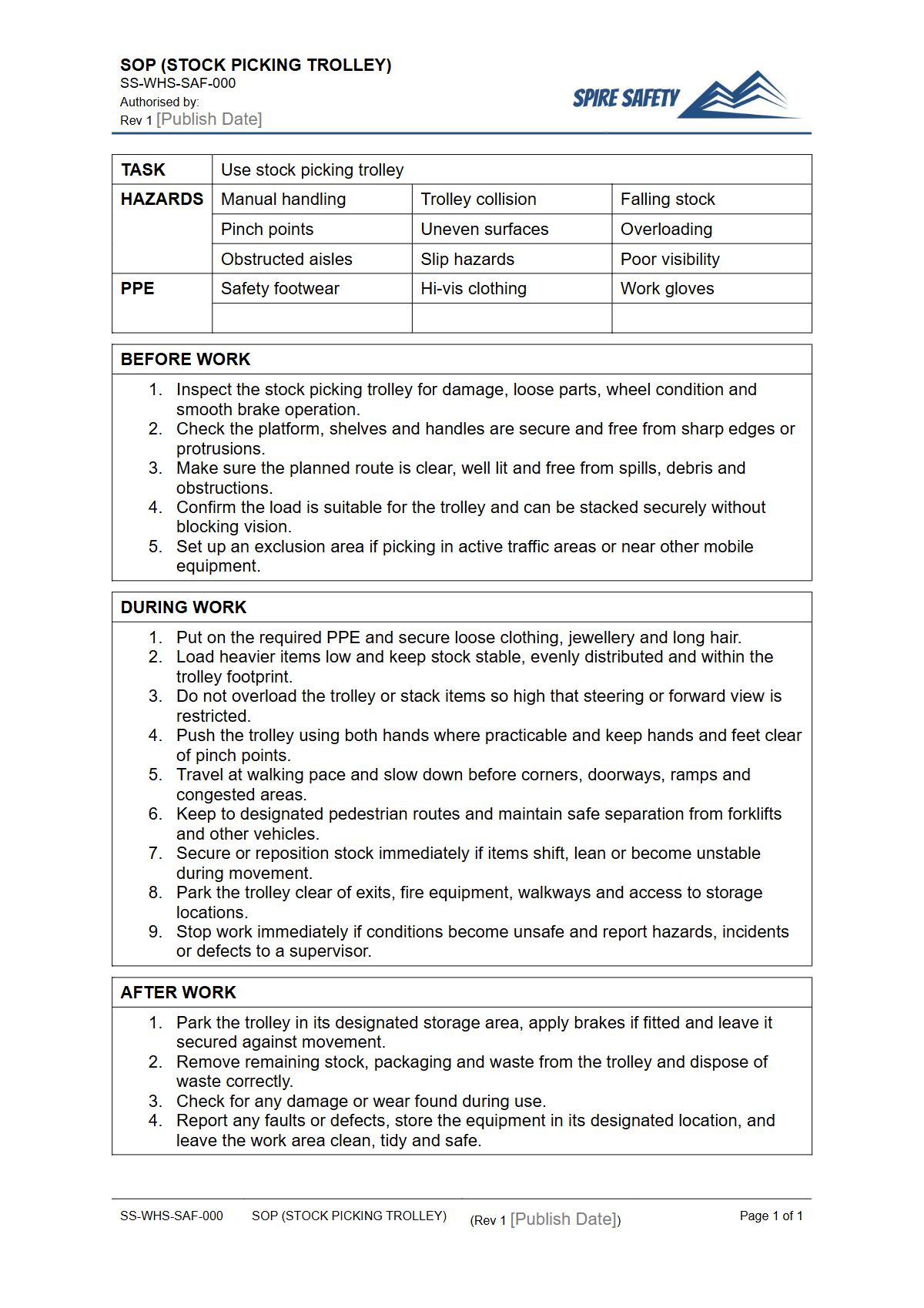
Download our free Safe Operating Procedure for stock picking trolleys. This template provides a structured starting point for developing your own site-specific safety document.
Free Safe Operating Procedure (Stock Picking Trolley) Template
DOCX • 126 KB + PDF
Updated Oct 2026
No signup required
Purpose of the Free Safe Operating Procedure (Stock Picking Trolley) Template
Using a stock picking trolley might seem like a simple task, but it carries risks that can lead to serious injuries if not managed correctly. This free Safe Operating Procedure (Stock Picking Trolley) template provides a structured starting point for documenting the required safety controls and work steps for using this common piece of warehouse equipment.
A well-drafted SOP is a key administrative control that helps your organisation meet its primary duty of care under Australian WHS laws.
The main goal is to control hazards associated with manual tasks, such as musculoskeletal injuries from pushing and pulling, as well as risks like collisions with people or infrastructure, items falling from height, and trolley instability. By clearly defining the expected safe behaviours and checks, you create a consistent, repeatable, and trainable process.
If you need assistance in conducting risk assessments to inform your SOPs, consider engaging professional WHS consulting services.
Video walkthrough
How to use the Free Safe Operating Procedure (Stock Picking Trolley) Template
This template is available for download as a fully editable DOCX file and a ready-to-print PDF. The DOCX version allows you to add your company branding and specific details directly into the document.
The process is straightforward: download, customise, consult, train, and implement.
Please note: This document is a template and is not a complete safety solution on its own. It must be customised to reflect the specific trolley models, work environment, types of products handled, and unique risks present in your workplace.
We strongly recommend you consult with the workers who actually use the equipment during the drafting process to ensure the procedure is practical and effective.
Safe Operating Procedures often work in conjunction with other safety documents to manage risks across a facility. For example, your trolley SOP might interact with procedures for working around automated equipment, such as a Conveyer System SOP.
What to Include in Your Safe Operating Procedure
A comprehensive Safe Operating Procedure for a stock picking trolley should be clear, concise, and easy for any worker to understand. It breaks the task down into logical phases to minimise the chance of error. Key sections to include after customisation are:
- Required PPE: Specify necessary personal protective equipment, such as safety-toed boots and gloves.
- Pre-Operational Checks: A simple checklist for workers to run through before use, covering wheel condition, frame integrity, handle security, and brake function (if applicable).
- Step-by-Step Operating Instructions: Detail the safe process for loading items (heaviest on the bottom), navigating the workplace, ascending/descending steps or ramps, and unloading. Emphasise maintaining clear lines of sight.
- Prohibited Actions: Clearly state what workers must not do, such as exceeding the rated load capacity, giving rides to other personnel, or leaving the trolley in a location where it could become a hazard.
- Emergency Procedures: Outline steps to take in case of a spill or incident.
- Maintenance and Storage: Describe cleaning requirements, where to report faults, and proper storage locations.
While a stock trolley SOP is relatively straightforward, procedures for more complex plant like a Telehandler SOP will involve far more detailed checks and operational steps.
Who Should Use This SOP?
This SOP is designed for several key roles within an organisation to ensure a unified approach to safety. Warehouse operators and storepersons are the primary users, as it directs their daily actions.
Supervisors and team leaders must use it to induct new staff, conduct refresher training, and monitor safe work practices on the floor. WHS managers and officers will use the SOP as a critical component of the organisation’s broader WHS management systems, ensuring that documented procedures are in place for identified risks.
Review and Maintenance
A Safe Operating Procedure is a living document that must be reviewed regularly to remain effective. A review should be triggered by specific events, such as after an incident or near miss, when a new model of trolley is introduced, or if the workplace layout changes.
It is also best practice to schedule periodic reviews—typically annually or biennially—as part of your standard safety processes. Regular reviews can be integrated into your organisation's internal audit schedule, a process which can be verified through a formal WHS compliance auditing program.
This ensures your procedures continue to reflect current practices and effectively control risk. You can find more templates to support your safety system in our free WHS resources library.
Common mistakes
Common mistakes to avoid
- Failing to perform pre-start checks on wheels, brakes, and frame integrity.
- Overloading the trolley beyond its rated capacity or stacking items with the heaviest goods on top.
- Leaving the trolley in a hazardous position, such as blocking an emergency exit, fire equipment, or a busy walkway.
- Pushing the trolley with a poor posture or trying to manoeuvre it in a way that obstructs the operator's view.
Legal references
Legal considerations
The following legal requirements may be relevant to this type of work.
- Work Health and Safety Act (Harmonised) — Provides the primary duties for protecting workers and other people from work health and safety risks.
- Work Health and Safety Regulations (Harmonised) — Sets out requirements supporting the management of workplace hazards and risks.
The following codes may be relevant to this type of work.
- Managing WHS Risks Code of Practice — Provides practical guidance on identifying hazards, assessing risks and applying effective controls.
- Work Health and Safety Consultation, Cooperation and Coordination Code of Practice — Provides practical guidance on consulting workers and coordinating with other duty holders.
- Managing the Work Environment and Facilities Code of Practice — Provides practical guidance on safe work environments, workplace facilities and related controls.
Did you know
Manual Handling Risk
Musculoskeletal disorders from manual tasks, including pushing and pulling trolleys, are one of Australia's most common and costly types of workplace injuries, making proper technique and equipment management crucial.
Centre of Gravity
Overloading the top basket of a stock picking trolley raises its centre of gravity, making it significantly more unstable and prone to tipping on uneven surfaces or during sharp turns.
FAQ
Frequently asked questions
01What is the purpose of a Safe Operating Procedure for a stock picking trolley?
02How often should we review our stock picking trolley SOP?
03Do I need a licence to operate a manual stock picking trolley?
04Can this SOP template be used for powered stock pickers or order pickers?
Share this resource
Free Safe Operating Procedure (Stock Picking Trolley) Template
Browse Categories
How To Use It
- 1Download and open in Word or PDF.
- 2Replace the placeholders with your business details.
- 3Get it reviewed by a WHS specialist before rollout.
Need it customised?
Our WHS consultants can adapt this template to your site, run a gap analysis, or audit what you already have in place.
Book a Free Consultation WHS consulting servicesor call 1300 156 382
Related templates
- Free Safe Operating Procedure (Stock Replenishment) Template
- Free Safe Operating Procedure (Stock Transfer Handover) Template
- Free Safe Operating Procedure (Stock Trough Cleaning) Template
- Free Safe Operating Procedure (Stockroom Cleaning) Template
- Free Safe Operating Procedure (Stockroom Ladder Use) Template
- Free Safe Operating Procedure (Stockroom Trolley Use) Template