
Free Safe Operating Procedure (Stockroom Ladder Use) Template
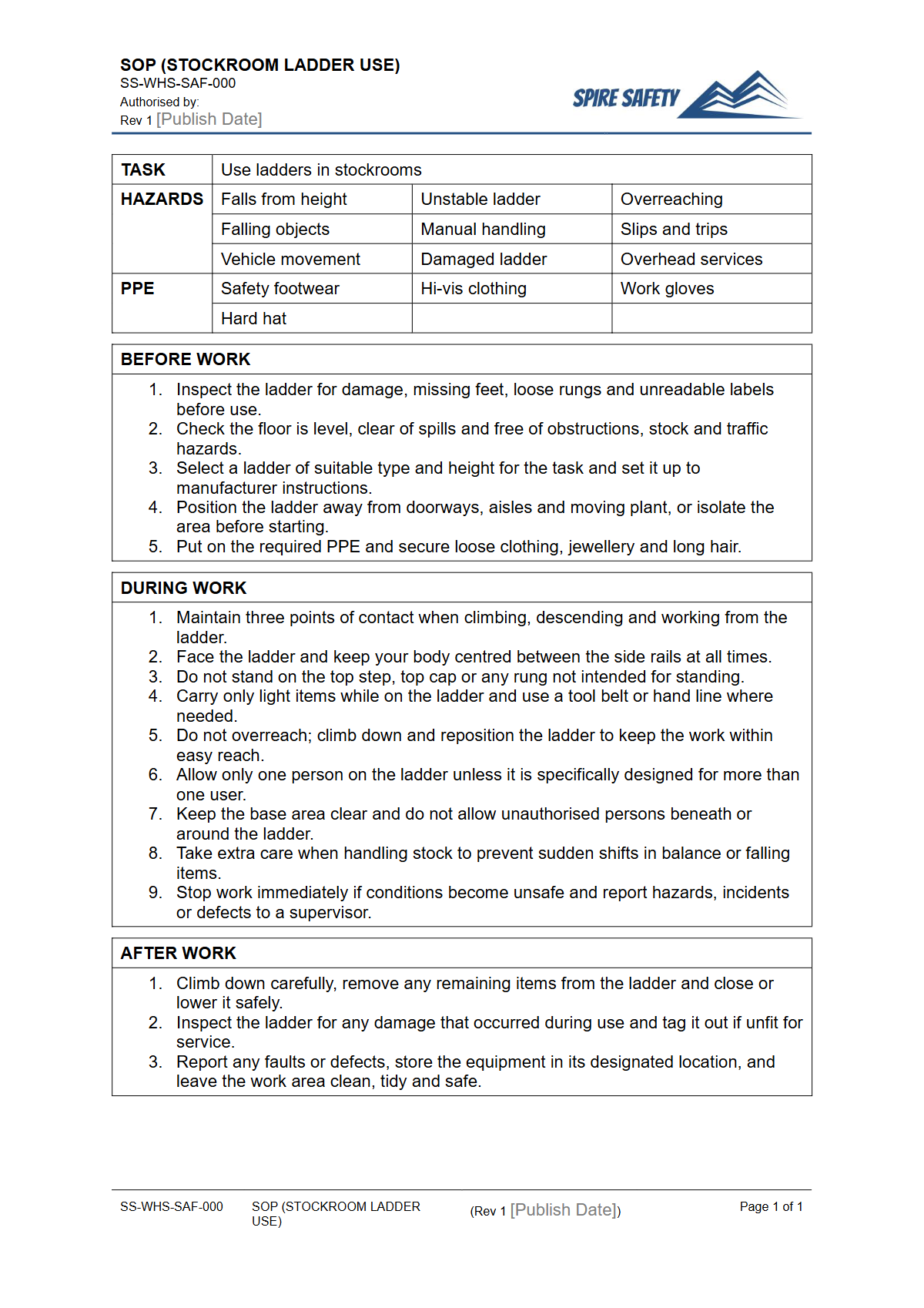
Manage stockroom risks with our free Safe Operating Procedure for ladder use. Download this customisable template to formalise your safety processes.
Free Safe Operating Procedure (Stockroom Ladder Use) Template
DOCX • 126 KB + PDF
Updated Oct 2026
No signup required
Purpose of the Free Safe Operating Procedure (Stockroom Ladder Use) Template
Even common tasks like using a ladder in a stockroom can lead to serious incidents if not performed correctly. Falls from height remain a leading cause of workplace injury in Australia.
This Free Safe Operating Procedure (Stockroom Ladder Use) Template provides a structured starting point for your business to formalise instructions, control risks, and ensure worker safety. Documenting your processes is a fundamental step in demonstrating due diligence and meeting your primary duty of care under WHS legislation.
Using a clear and consistent SOP helps standardise work methods, ensuring every worker understands the expected safety behaviours and steps. It serves as a critical training tool for new employees and a reference for experienced staff.
A well-defined procedure is a cornerstone of effective WHS management systems, integrating safety into your daily operations rather than treating it as an afterthought.
Video walkthrough
How to use the Free Safe Operating Procedure (Stockroom Ladder Use) Template
This template is designed to be adapted to your specific workplace. A generic procedure is not sufficient; effective safety comes from customisation.
Download the DOCX file and begin by adding your company logo and details. Then, walk through each section and modify it to reflect the specific types of ladders you use (e.g., A-frame, platform ladders), your stockroom environment, and the tasks your workers perform.
IMPORTANT: We have provided a comprehensive starting point, but you must consult with your workers to identify all relevant hazards and control measures. They have direct experience with the task and can provide invaluable feedback.
Once customised, the SOP should be approved by a manager or supervisor before being implemented. For other procedural documents, you might find inspiration in our free Conveyer System SOP, which follows a similar structure for a different type of warehouse equipment.
When to use this Safe Operating Procedure
A Safe Operating Procedure for stockroom ladder use should be an active document, not one that gathers dust on a shelf. It is essential during the induction and training of new stockroom or retail staff.
It should be used as the basis for practical demonstrations of safe ladder use and competency checks. The SOP should also be readily accessible in the work area for quick reference by any worker or supervisor.
Furthermore, the procedure should be a key document in your regular safety program. Refer to it during toolbox talks or safety meetings to reinforce key messages, especially the importance of pre-use inspections and maintaining three points of contact.
Similar to how a kitchen might reference its Safe Operating Procedure for a deep fryer before starting a shift, your team should be familiar with the ladder SOP before undertaking tasks at height.
Who should use it
This SOP is intended for all persons who may use, supervise, or manage the use of ladders in a stockroom or similar retail/warehousing environment. This includes:
- Workers: Staff who need to access shelving to retrieve or store stock. The SOP guides their actions to ensure they perform the task safely.
- Supervisors and Team Leaders: Managers who are responsible for overseeing work and ensuring procedures are followed. They use the SOP to monitor compliance and correct unsafe behaviour.
- WHS Managers and Representatives: Personnel who develop and implement safety systems. They use the SOP as part of the overall risk management framework for the workplace.
The principles outlined are universal, whether you're managing a small retail stockroom or a large distribution centre. If your workplace also has workshop equipment, you may find other specific templates like our free Air Compressor SOP template useful for documenting other procedures.
Ultimately, a robust ladder use SOP contributes to a stronger safety culture where everyone takes responsibility for their own safety and the safety of others. Periodically checking if these procedures are being followed is a key part of the safety assurance process, often forming part of a formal WHS compliance auditing program. For more procedural templates, browse our entire free WHS resources library.
Common mistakes
Common mistakes to avoid
- Using a generic template without customising it for specific site ladders and hazards.
- Failing to train workers on the new SOP, assuming they will read it on their own.
- Not making the SOP easily accessible to staff in the stockroom area.
- Forgetting to review and update the SOP after a near-miss or incident.
Legal references
Legal considerations
The following legal requirements may be relevant to this type of work.
- Work Health and Safety Act (Harmonised) — Provides the primary duties for protecting workers and other people from work health and safety risks.
- Work Health and Safety Regulations (Harmonised) — Sets out requirements supporting the management of workplace hazards and risks.
The following codes may be relevant to this type of work.
- Managing WHS Risks Code of Practice — Provides practical guidance on identifying hazards, assessing risks and applying effective controls.
- Work Health and Safety Consultation, Cooperation and Coordination Code of Practice — Provides practical guidance on consulting workers and coordinating with other duty holders.
- Managing the Work Environment and Facilities Code of Practice — Provides practical guidance on safe work environments, workplace facilities and related controls.
Did you know
Falls From Height
Falls from height are a leading cause of serious and fatal injuries in Australian workplaces, with ladders being one of the most commonly involved pieces of equipment.
The 3 Points of Contact Rule
The 'three points of contact' rule (two feet and one hand, or one foot and two hands on the ladder at all times) is a fundamental principle that significantly reduces the risk of falling.
FAQ
Frequently asked questions
01What should be included in a ladder safety SOP for a stockroom?
02Is a formal SOP legally required for using a simple stockroom ladder?
03How often should we review our stockroom ladder SOP?
04What is the difference between a Safe Work Method Statement (SWMS) and an SOP?
Share this resource
Free Safe Operating Procedure (Stockroom Ladder Use) Template
Browse Categories
How To Use It
- 1Download and open in Word or PDF.
- 2Replace the placeholders with your business details.
- 3Get it reviewed by a WHS specialist before rollout.
Need it customised?
Our WHS consultants can adapt this template to your site, run a gap analysis, or audit what you already have in place.
Book a Free Consultation WHS consulting servicesor call 1300 156 382
Related templates
- Free Safe Operating Procedure (Stockroom Trolley Use) Template
- Free Safe Operating Procedure (Stone Floor Cleaning) Template
- Free Safe Operating Procedure (Storage Cage Cleaning) Template
- Free Safe Operating Procedure (Store Closing Check) Template
- Free Safe Operating Procedure (Store Opening Check) Template
- Free Safe Operating Procedure (Stored Energy Release) Template