
Free Safe Operating Procedure (Storage Cage Cleaning) Template
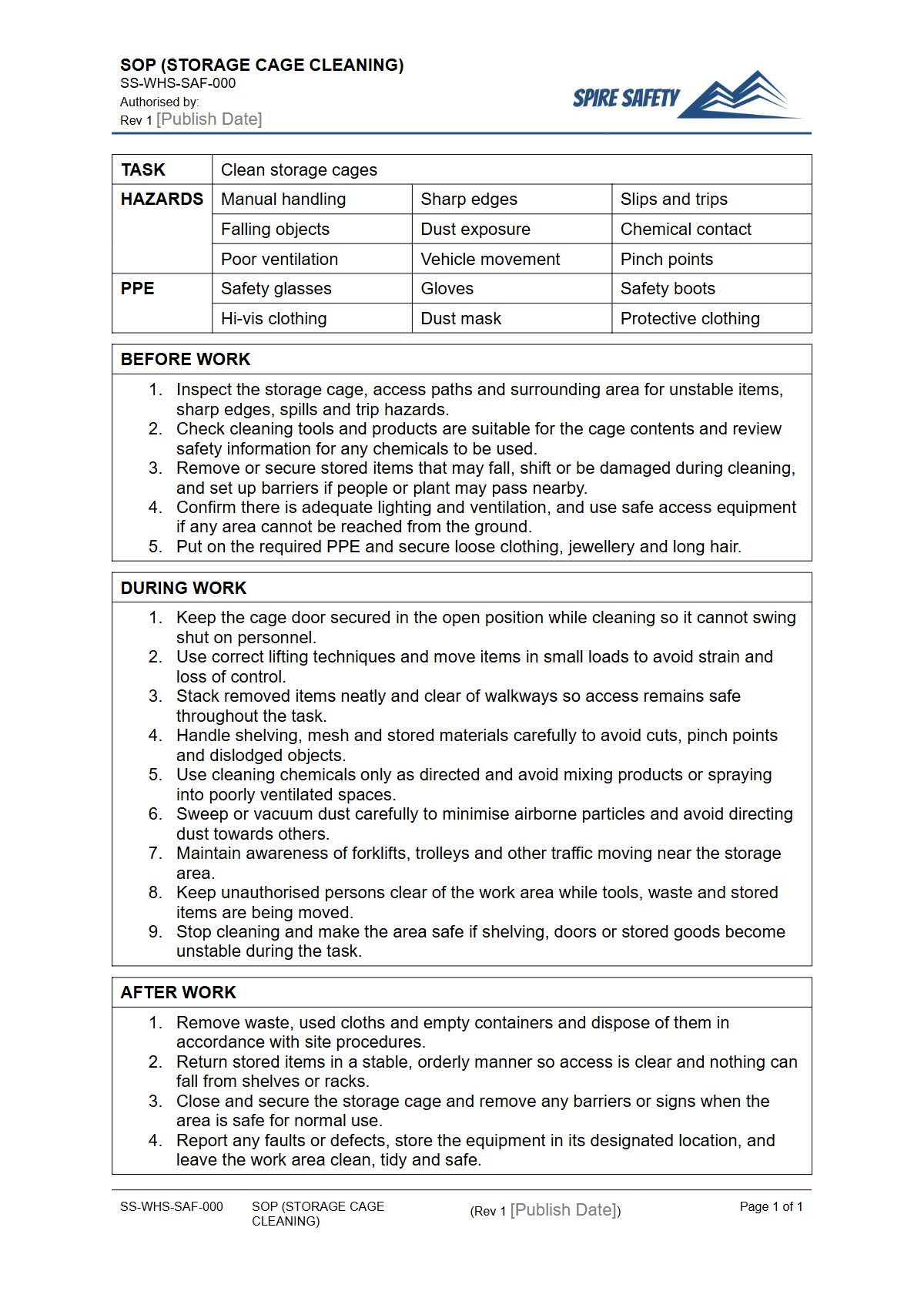
Download our free Safe Operating Procedure (Storage Cage Cleaning) template to manage workplace risks. This customisable document helps formalise your process.
Free Safe Operating Procedure (Storage Cage Cleaning) Template
DOCX • 126 KB + PDF
Updated Oct 2026
No signup required
Purpose of the Free Safe Operating Procedure (Storage Cage Cleaning) Template
Get started with our Free Safe Operating Procedure (Storage Cage Cleaning) Template, designed to help Australian businesses formalise their cleaning processes. This document provides a structured framework for identifying hazards and implementing control measures for cleaning and maintaining various types of storage cages, such as those used in warehouses, retail back-of-house, or workshops.
Establishing a clear SOP is a fundamental step in fulfilling your duty of care and ensuring workers can perform the task safely and efficiently.
This Safe Operating Procedure (SOP) helps your organisation manage key risks associated with cage cleaning, including hazardous manual tasks (lifting, pushing, carrying), exposure to cleaning chemicals, slip and trip hazards from wet floors, and potential ergonomic injuries from awkward postures. By documenting a step-by-step process, required personal protective equipment (PPE), and emergency procedures, this template serves as a critical tool within your broader WHS management systems.
Video walkthrough
How to use the Free Safe Operating Procedure (Storage Cage Cleaning) Template
This template is provided in both DOCX and PDF formats for your convenience. The DOCX version is fully editable, allowing you to tailor it precisely to your operational needs.
To effectively implement this SOP, you should consult with the workers who actually perform the cleaning task. Their direct input is invaluable for identifying practical hazards and effective controls.
Important: It is vital to remember that this is a template, not a finished, ready-to-use document. You must customise it with details specific to your workplace, equipment, chemicals, and personnel.
We have provided prompts and sections based on Australian WHS principles, but the final responsibility for its accuracy and suitability rests with the Person Conducting a Business or Undertaking (PCBU). Ensure you conduct a site-specific risk assessment and reflect its findings in the final SOP.
For example, your process might involve specific equipment that requires its own safe work procedure. If you use compressed air to blow out debris, you would also need to reference your free Air Compressor SOP template to ensure all associated risks are controlled.
When to use it
A Safe Operating Procedure for storage cage cleaning should be used consistently whenever the task is performed. It is not a document to be filed away; it is an active tool for risk management.
It should be used for training new employees, conducting refresher training for existing staff, and as a reference before and during the task. It also serves as a baseline for workplace inspections and incident investigations.
The SOP becomes particularly critical when the cleaning task interacts with other high-risk activities. For instance, if cages need to be moved using powered mobile plant before cleaning can commence, workers must follow all relevant procedures, such as those outlined in a FREE Telehandler SOP Template, to ensure materials are handled safely.
The SOP should be reviewed periodically, and always after an incident or when a change in process, equipment, or chemicals occurs.
Who should use it
This template is designed for use by multiple people within an organisation. WHS managers, supervisors, and team leaders are responsible for developing, implementing, and reviewing the SOP in consultation with workers.
They use the finalised document to train staff, monitor compliance, and ensure a safe system of work is in place. Workers who perform the storage cage cleaning task are the primary end-users, relying on the SOP to guide their actions, understand the risks, and use controls and PPE correctly.
Effectively implemented SOPs are also a key piece of evidence reviewed during WHS compliance auditing, demonstrating that the business has a formalised process for managing operational risks. For organisations without a dedicated safety team, developing robust procedures for all key tasks can be challenging.
If you require assistance in creating tailored documentation, consider seeking professional WHS consulting services.
Storage cages are often found in busy logistics or processing environments alongside other complex equipment. To ensure a holistic approach to safety, it's beneficial to have documented procedures for all key machinery, such as our Conveyer System SOP, to manage interconnected risks.
You can find more templates and checklists in our complete free WHS resources library to build out your safety management system.
Common mistakes
Common mistakes to avoid
- Using a generic template without customising it for site-specific hazards and equipment.
- Failing to consult with workers who perform the task when drafting or reviewing the procedure.
- Not providing adequate training on the finalised SOP to all relevant employees.
- Forgetting to review and update the SOP after an incident or a change in the work process.
Legal references
Legal considerations
The following legal requirements may be relevant to this type of work.
- Work Health and Safety Act (Harmonised) — Provides the primary duties for protecting workers and other people from work health and safety risks.
- Work Health and Safety Regulations (Harmonised) — Sets out requirements supporting the management of workplace hazards and risks.
The following codes may be relevant to this type of work.
- Managing WHS Risks Code of Practice — Provides practical guidance on identifying hazards, assessing risks and applying effective controls.
- Work Health and Safety Consultation, Cooperation and Coordination Code of Practice — Provides practical guidance on consulting workers and coordinating with other duty holders.
- Managing the Work Environment and Facilities Code of Practice — Provides practical guidance on safe work environments, workplace facilities and related controls.
Did you know
Manual Tasks are a Major Risk
According to Safe Work Australia, hazardous manual tasks are the leading cause of work-related injuries in the country, accounting for a significant number of serious workers' compensation claims.
The Hierarchy of Control
When customising your SOP, always apply the hierarchy of control. Aim to eliminate or substitute hazards before relying on engineering controls, administrative actions (like an SOP), or PPE.
FAQ
Frequently asked questions
01What hazards are associated with cleaning storage cages?
02How often should a Safe Operating Procedure be reviewed?
03Is training required after implementing an SOP for storage cage cleaning?
04What should be included in a storage cage cleaning SOP?
Share this resource
Free Safe Operating Procedure (Storage Cage Cleaning) Template
Browse Categories
How To Use It
- 1Download and open in Word or PDF.
- 2Replace the placeholders with your business details.
- 3Get it reviewed by a WHS specialist before rollout.
Need it customised?
Our WHS consultants can adapt this template to your site, run a gap analysis, or audit what you already have in place.
Book a Free Consultation WHS consulting servicesor call 1300 156 382
Related templates
- Free Safe Operating Procedure (Store Closing Check) Template
- Free Safe Operating Procedure (Store Opening Check) Template
- Free Safe Operating Procedure (Stored Energy Release) Template
- Free Safe Operating Procedure (Storeroom Deep Cleaning) Template
- Free Safe Operating Procedure (Storm Drain Cleaning) Template
- Free Safe Operating Procedure (Storm Drain Inspection) Template