
Free Safe Operating Procedure (Storm Drain Cleaning) Template
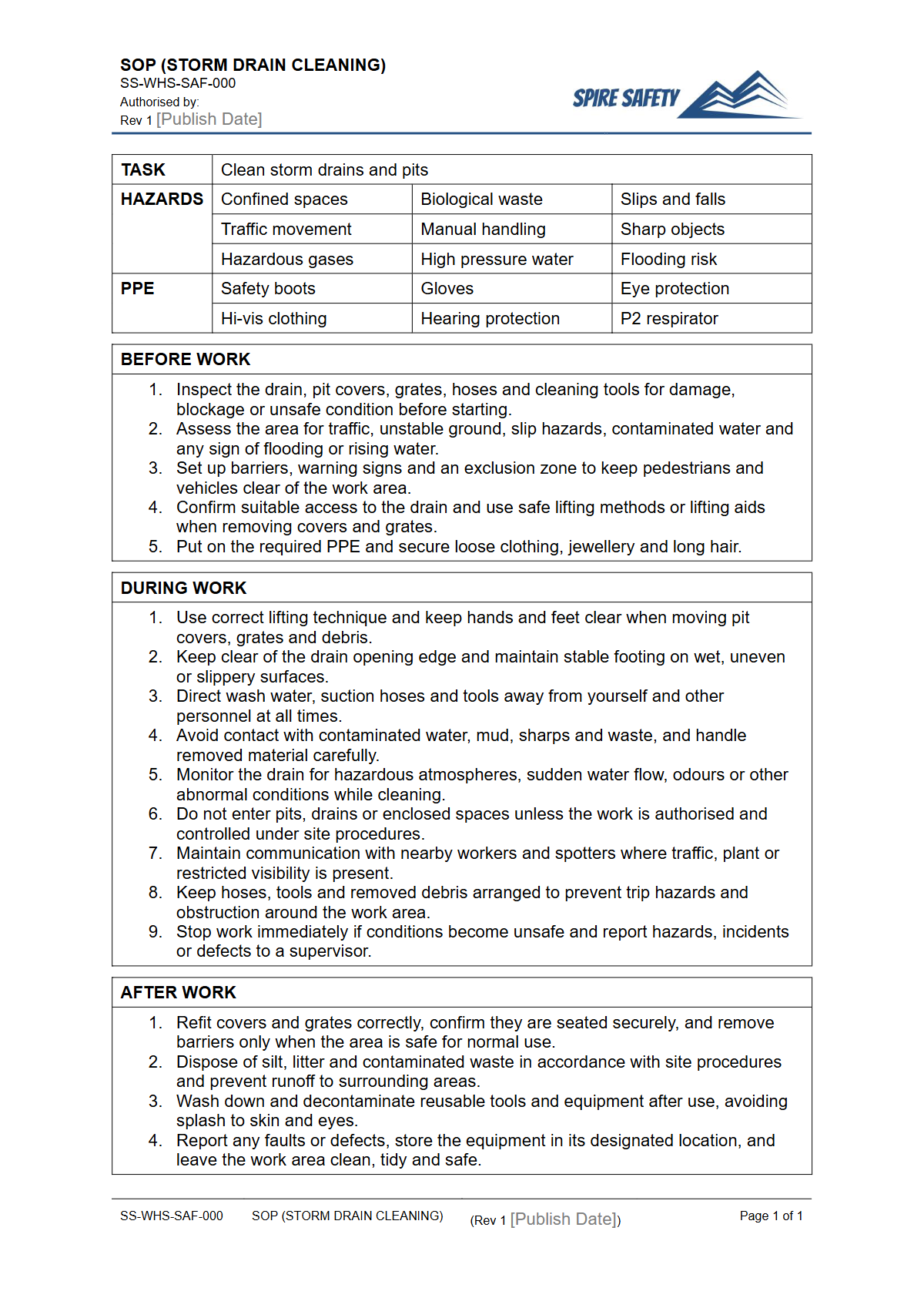
Download our Free Safe Operating Procedure for Storm Drain Cleaning to formalise safety steps for this high-risk task. Get your customisable template now.
Free Safe Operating Procedure (Storm Drain Cleaning) Template
DOCX • 126 KB + PDF
Updated Oct 2026
No signup required
Purpose of the Free Safe Operating Procedure (Storm Drain Cleaning) Template
Our Free Safe Operating Procedure (Storm Drain Cleaning) Template provides a structured framework for documenting the safety steps required for this potentially hazardous activity. Cleaning storm drains involves significant risks, including working in confined spaces, exposure to biological and chemical contaminants, hazardous manual tasks, and interaction with traffic.
This SOP template helps Persons Conducting a Business or Undertaking (PCBUs) outline a clear, step-by-step process to manage these risks and meet their primary duty of care.
Formalising your process helps ensure tasks are performed consistently and safely every time. An SOP is a fundamental building block of effective WHS management systems, demonstrating a commitment to proactive risk management and worker safety.
It serves as a vital tool for training, supervision, and incident investigation.
Video walkthrough
How to use the Free Safe Operating Procedure (Storm Drain Cleaning) Template
This document is a starting point designed to be adapted to your unique operational context. Before use, you must review and customise the content to align with your specific worksite, the equipment being used (such as high-pressure water jets or vacuum trucks), the training level of your workers, and relevant state or territory regulations.
Important: We are not a law firm. This template is a guide and must be customised to fit the specific needs and risks of your workplace.
Consultation with your workers and other stakeholders is a critical part of the risk management process and is required when implementing new safety procedures.
Key Hazard Controls to Consider
When customising this Safe Operating Procedure, focus on implementing robust controls for the primary hazards associated with storm drain cleaning. These include:
- Confined Space Entry: Detail procedures for risk assessment, entry permits, atmospheric testing (for oxygen levels, flammable gases, and toxic contaminants like hydrogen sulfide), and rescue plans.
- Traffic Management: Specify requirements for signage, barriers, spotters, and high-visibility clothing to protect workers from moving vehicles.
- Biological and Chemical Hazards: Outline the required Personal Protective Equipment (PPE), such as gloves, eye protection, respiratory protection, and waterproof clothing, as well as hygiene and decontamination procedures.
- Hazardous Manual Tasks: Address risks associated with lifting heavy grates or handling bulky equipment. For larger sites requiring mechanical aids, your procedures might reference other equipment-specific documents, such as a Telehandler SOP template.
When to use this Safe Operating Procedure
An SOP for storm drain cleaning should be used as a primary reference document before any related work begins. It is an essential resource for inducting and training new employees or contractors tasked with drain maintenance.
The procedure should also be reviewed and referenced during toolbox talks, as part of regular safety audits, and following any incident or near miss to identify areas for improvement.
If the work involves excavation or ground disturbance near the drainage system, you may need to supplement this SOP with other task-specific procedures, such as our FREE Trencher SOP Template.
Who should use this Safe Operating Procedure
This procedure is intended for use across multiple levels of an organisation:
- Workers and Contractors: To understand and follow the approved safe method for completing the task.
- Supervisors and Team Leaders: To induct, train, and monitor workers, ensuring the specified controls are implemented correctly. Regular verification is a key supervisory duty, which can be formalised through processes like WHS compliance auditing.
- Managers and PCBUs: To ensure a safe system of work has been established, documented, and communicated as part of their due diligence obligations.
For more complex sites or operations where multiple high-risk activities occur, you may benefit from engaging specialist WHS consulting to ensure your safety systems are integrated and effective. You can also explore our complete free WHS resources library for other templates and guides to support your safety management efforts.
Common mistakes
Common mistakes to avoid
- Failing to conduct atmospheric testing before and during entry into a confined space.
- Neglecting to implement a traffic management plan to protect workers from vehicles.
- Using incorrect or poorly maintained Personal Protective Equipment (PPE) for the specific hazards.
- Lacking a documented and practiced rescue plan for confined space work.
Legal references
Legal considerations
The following legal requirements may be relevant to this type of work.
- Work Health and Safety Act (Harmonised) — Provides the primary duties for protecting workers and other people from work health and safety risks.
- Work Health and Safety Regulations (Harmonised) — Sets out requirements supporting the management of workplace hazards and risks.
The following codes may be relevant to this type of work.
- Managing WHS Risks Code of Practice — Provides practical guidance on identifying hazards, assessing risks and applying effective controls.
- Work Health and Safety Consultation, Cooperation and Coordination Code of Practice — Provides practical guidance on consulting workers and coordinating with other duty holders.
- Managing the Work Environment and Facilities Code of Practice — Provides practical guidance on safe work environments, workplace facilities and related controls.
Did you know
Confined Space Classification
Many storm drains are legally defined as confined spaces because they have restricted entry/exit and are not designed for continuous human occupancy, mandating strict entry protocols under WHS regulations.
Invisible Danger
Decomposing organic matter in drains can produce hydrogen sulfide (H₂S), a toxic gas that is heavier than air. At low concentrations it smells like rotten eggs, but at high, deadly concentrations, it paralyses the olfactory nerves, rendering it odourless.
FAQ
Frequently asked questions
01What are the main hazards in storm drain cleaning?
02Is an SOP mandatory for cleaning storm drains in Australia?
03How often should a storm drain cleaning SOP be reviewed?
04Can I use this template for cleaning sanitary sewers?
Share this resource
Free Safe Operating Procedure (Storm Drain Cleaning) Template
Browse Categories
How To Use It
- 1Download and open in Word or PDF.
- 2Replace the placeholders with your business details.
- 3Get it reviewed by a WHS specialist before rollout.
Need it customised?
Our WHS consultants can adapt this template to your site, run a gap analysis, or audit what you already have in place.
Book a Free Consultation WHS consulting servicesor call 1300 156 382
Related templates
- Free Safe Operating Procedure (Storm Drain Inspection) Template
- Free Safe Operating Procedure (Stormwater Debris Clear) Template
- Free Safe Operating Procedure (Stormwater Inlet Clean) Template
- Free Safe Operating Procedure (Stormwater Pit Access) Template
- Free Safe Operating Procedure (Stormwater Pit Check) Template
- Free Safe Operating Procedure (Straddle Carrier) Template