
Free Safe Operating Procedure (Stormwater Pit Check) Template
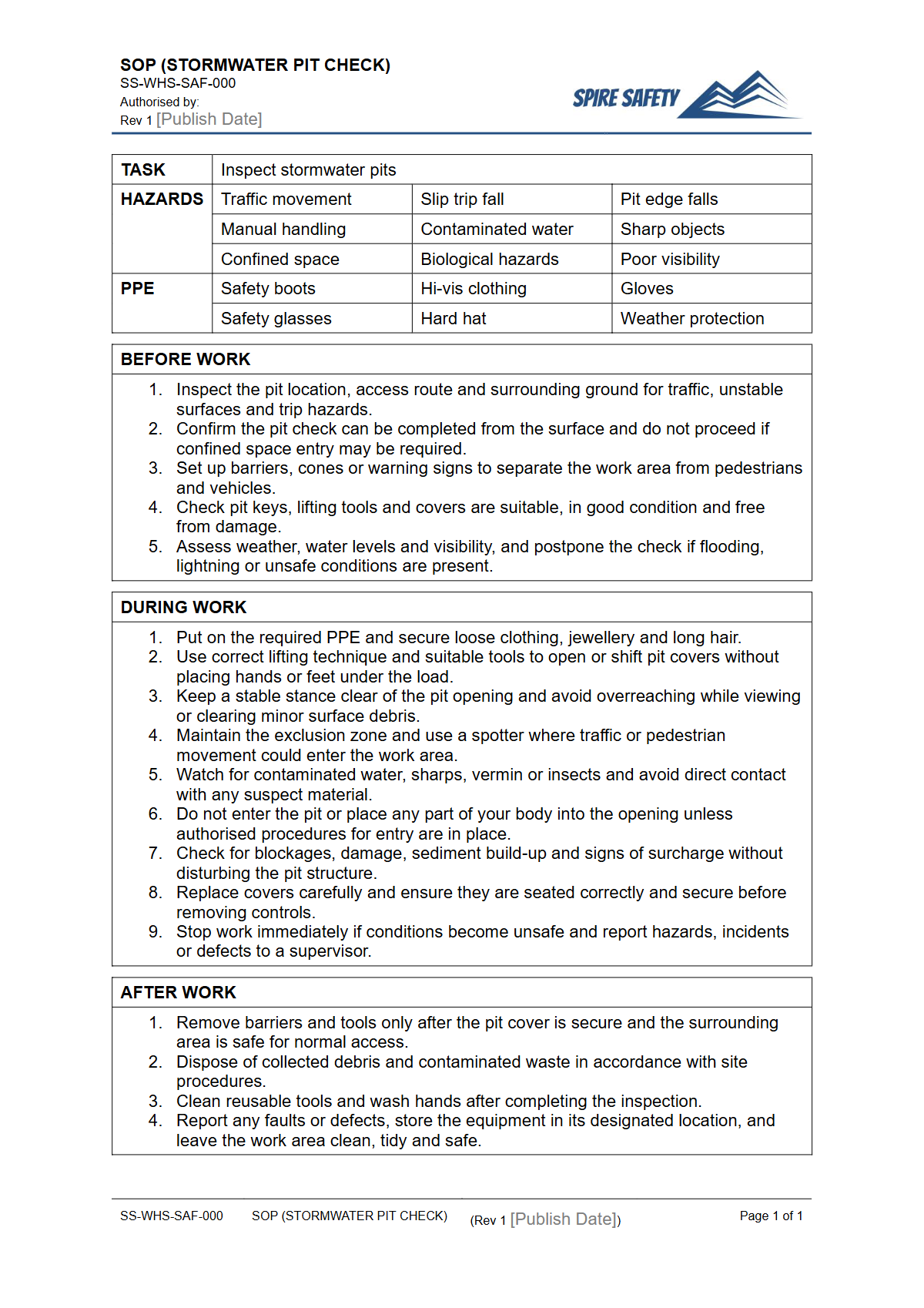
Download our free Safe Operating Procedure for stormwater pit checks. This template helps you document the risks and control measures for this common task.
Free Safe Operating Procedure (Stormwater Pit Check) Template
DOCX • 126 KB + PDF
Updated Oct 2026
No signup required
Purpose of the Free Safe Operating Procedure (Stormwater Pit Check) Template
This Free Safe Operating Procedure (Stormwater Pit Check) Template provides a structured framework for documenting the steps required to safely inspect and clear stormwater drainage pits. Regularly checking these pits is essential for preventing blockages, localised flooding, and environmental contamination.
However, the task involves significant hazards, including manual handling of heavy grates, potential exposure to hazardous substances, slips and trips, and the risk of working in a confined space. Using a formal SOP helps your organisation manage these risks by standardising the process, outlining required personal protective equipment (PPE), and ensuring all safety controls are implemented consistently.
A well-defined SOP is a cornerstone of a functional safety framework, demonstrating due diligence in managing workplace risks. It serves as a vital tool for training employees and provides a clear reference for supervisors overseeing the work.
Integrating specific procedures like this into broader WHS management systems ensures a systematic approach to safety across all operational tasks.
Video walkthrough
How to use the Free Safe Operating Procedure (Stormwater Pit Check) Template
This template, available in both DOCX and PDF formats, is designed as a starting point. The DOCX file is fully editable, allowing you to tailor the content to the specific equipment, environment, and risks present at your workplace.
It is crucial to adapt this document to reflect your site-specific conditions and legal obligations.
To use the template effectively:
- Review and Customise: A competent person should conduct a thorough risk assessment for the task at your location. Use the findings to populate and modify the sections on hazards, risks, and control measures.
- Specify Equipment: List the exact tools and equipment to be used, from grate lifters and hand tools to gas detectors if required.
- Detail PPE: Change the generic PPE recommendations to a specific list based on your risk assessment (e.g., specific glove type, respiratory protection).
- Train Your Team: Use the finalised SOP as a training document for all workers who will perform the task. Ensure they understand every step and the reasoning behind the safety controls. We cannot stress this enough: this document must be customised by you to suit your business operations.
While this SOP covers a specific maintenance task, many sites require procedures for machinery used in adjacent activities. For example, if excavation is part of the work, a safe operating procedure for trenchers would be necessary.
When to Use a Stormwater Pit Check SOP
A Safe Operating Procedure for stormwater pit checks should be used every time the task is performed. It is particularly important during:
- Scheduled Maintenance Programs: As part of a regular preventative maintenance plan to ensure drains are clear before peak rainfall seasons.
- Post-Weather Events: After heavy rain, storms, or high winds that may have washed debris into the drainage system.
- Responsive Clean-outs: When a blockage is suspected or identified.
- Site Audits: As part of environmental or safety inspections to verify drainage system functionality.
This procedure helps ensure that even routine checks are conducted with a high degree of safety awareness, preventing complacency and reducing the likelihood of incidents. Many maintenance tasks involve a range of equipment; for instance, some jobs may require portable power, making an air compressor SOP another valuable resource for your safety library.
Who Should Use It
This template is intended for use by any person or organisation responsible for property and infrastructure maintenance. Key users include:
- PCBU's (Persons Conducting a Business or Undertaking): To meet their primary duty of care to provide safe systems of work.
- Facilities and Maintenance Managers: To standardise procedures and manage risks associated with their team's tasks.
- WHS Managers and Advisors: To develop and implement safety documentation aligned with Australian WHS principles.
- Workers and Contractors: As a step-by-step guide to perform the task safely.
- Supervisors: For training, pre-work briefings (e.g., toolbox talks), and verifying that procedures are followed correctly.
The use of mechanical aids is a key control for many hazards. If heavy grates or other materials need to be moved, referencing a telehandler SOP can provide guidance on the safe use of lifting equipment.
Enhancing Safety with Audits and Continuous Improvement
Implementing an SOP is the first step. To ensure it remains effective, it should be reviewed regularly and whenever an incident occurs or a new hazard is identified. Regular WHS compliance audits can help verify that the procedures outlined in the SOP are being consistently followed in practice. This process of review and verification drives continuous improvement in your safety practices. You can find many more helpful documents in our free WHS resources library to build out your safety management system.
Common mistakes
Common mistakes to avoid
- Assuming a pit is not a confined space without a formal assessment.
- Failing to use mechanical lifting aids for heavy grates, leading to manual handling injuries.
- Not establishing an exclusion zone around the work area to protect against traffic or pedestrians.
- Neglecting to check for atmospheric hazards before reaching or leaning into the pit.
Legal references
Legal considerations
The following legal requirements may be relevant to this type of work.
- Work Health and Safety Act (Harmonised) — Provides the primary duties for protecting workers and other people from work health and safety risks.
- Work Health and Safety Regulations (Harmonised) — Sets out requirements supporting the management of workplace hazards and risks.
The following codes may be relevant to this type of work.
- Managing WHS Risks Code of Practice — Provides practical guidance on identifying hazards, assessing risks and applying effective controls.
- Work Health and Safety Consultation, Cooperation and Coordination Code of Practice — Provides practical guidance on consulting workers and coordinating with other duty holders.
- Managing the Work Environment and Facilities Code of Practice — Provides practical guidance on safe work environments, workplace facilities and related controls.
Did you know
Hidden Hazards
Decomposing organic matter in a blocked stormwater pit can produce hazardous gases like hydrogen sulphide and methane, creating a toxic and potentially explosive atmosphere.
Manual Handling Risk
Stormwater pit grates and covers can weigh over 100kg. Attempting to lift them manually is a leading cause of serious back and shoulder injuries in maintenance workers.
FAQ
Frequently asked questions
01What are the main hazards when checking a stormwater pit?
02Is inspecting a stormwater pit a confined space entry?
03How often should stormwater pits be checked?
04What PPE is required for a stormwater pit inspection?
Share this resource
Free Safe Operating Procedure (Stormwater Pit Check) Template
Browse Categories
How To Use It
- 1Download and open in Word or PDF.
- 2Replace the placeholders with your business details.
- 3Get it reviewed by a WHS specialist before rollout.
Need it customised?
Our WHS consultants can adapt this template to your site, run a gap analysis, or audit what you already have in place.
Book a Free Consultation WHS consulting servicesor call 1300 156 382
Related templates
- Free Safe Operating Procedure (Straddle Carrier) Template
- Free Safe Operating Procedure (Strapping Machine) Template
- Free Safe Operating Procedure (Street Garden Care) Template
- Free Safe Operating Procedure (Street Litter Patrol) Template
- Free Safe Operating Procedure (Street Sign Cleaning) Template
- Free Safe Operating Procedure (Street Sweeper) Template