
Free Safe Operating Procedure (Street Sign Cleaning) Template
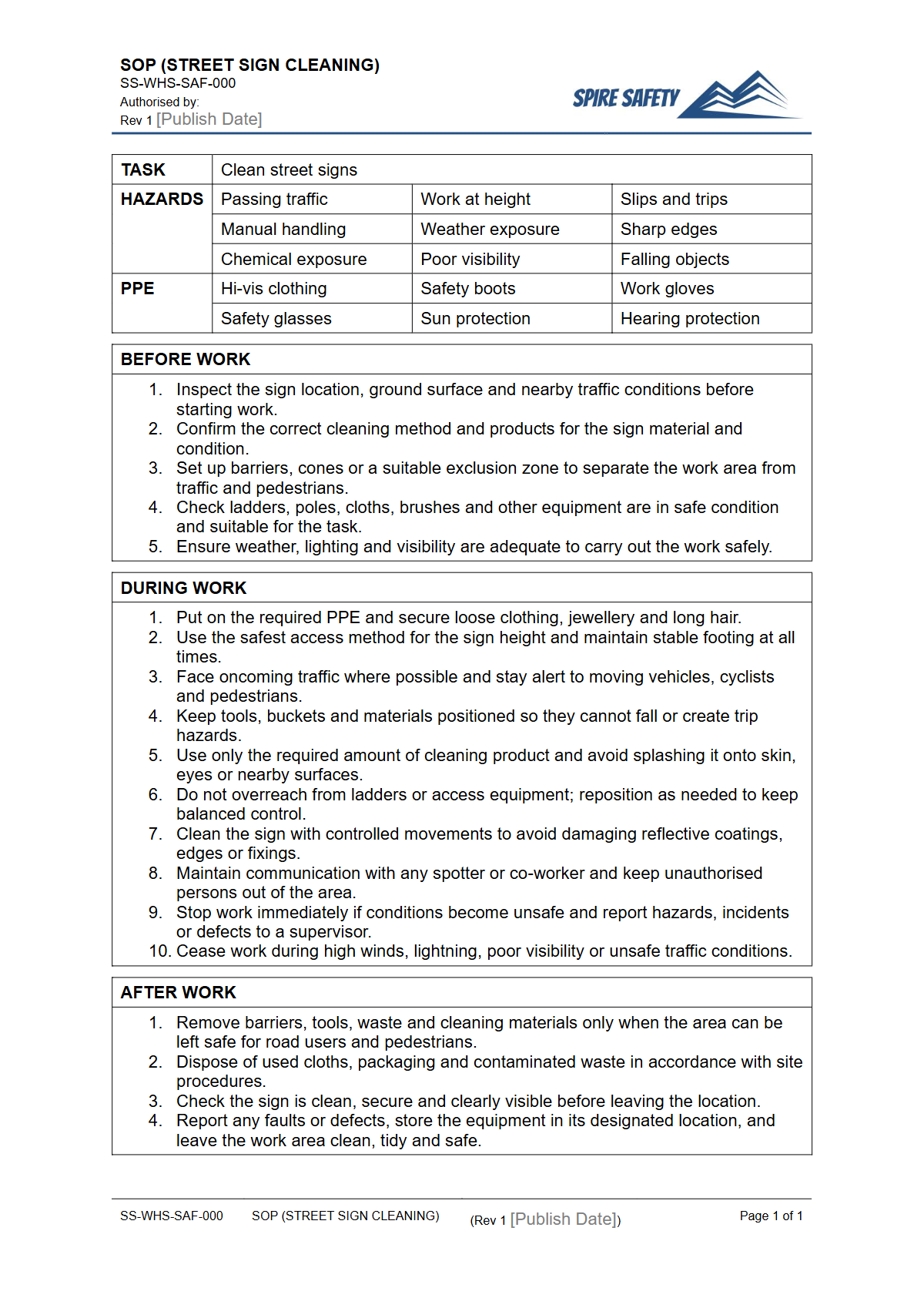
Download our free Safe Operating Procedure for street sign cleaning. This template provides a structured starting point for documenting your safety processes.
Free Safe Operating Procedure (Street Sign Cleaning) Template
DOCX • 126 KB + PDF
Updated Oct 2026
No signup required
Purpose of the Free Safe Operating Procedure (Street Sign Cleaning) Template
Street sign cleaning, while seemingly straightforward, involves significant risks including traffic hazards, exposure to chemicals, manual handling, and working near live utilities. This Free Safe Operating Procedure (Street Sign Cleaning) Template provides a structured framework for documenting a safe system of work for this common maintenance task.
Using a standardised SOP helps ensure that all workers follow the same approved steps, minimising their exposure to harm and helping the business meet its WHS obligations. It formalises pre-start checks, hazard controls, and emergency responses into a clear, repeatable process.
A well-developed SOP is a critical component of any safety framework. It serves as a practical tool for risk management, providing clear instructions that can be used for training, inductions, and competency assessments.
Integrating task-specific procedures like this into your broader safety framework demonstrates a systematic approach to health and safety. For businesses looking to formalise their safety framework, developing robust WHS management systems is a crucial step in achieving consistent and reliable safety outcomes.
Video walkthrough
How to use the Free Safe Operating Procedure (Street Sign Cleaning) Template
This Safe Operating Procedure template is available for immediate download in both DOCX and PDF formats. The DOCX file is fully editable, allowing you to adapt the content to your specific operational needs.
The PDF version is useful for quick printing and distribution once your customisations are complete.
Important: This document is a template, not a finished procedure. To be effective and support your safety duties, you must customise it to reflect the unique aspects of your work.
We provide this template as a starting point, but you must edit it to address the specific hazards, equipment (e.g., vehicles, ladders), chemicals, locations, and traffic conditions relevant to your workplace. Your final SOP should be developed in consultation with the workers who will be performing the task.
Key Sections to Customise
When customising the template, pay close attention to the following sections:
- Personal Protective Equipment (PPE): Specify the exact PPE required, such as AS/NZS compliant high-visibility clothing, safety glasses or goggles, chemical-resistant gloves, and safety footwear.
- Hazard Identification and Risk Control: List all potential hazards specific to your sites. This must include traffic, solar glare, aggressive insects or wildlife, overhead powerlines, and uneven ground. Document your chosen control measures for each hazard.
- Step-by-Step Procedure: Detail the entire process from start to finish. This should include setting up traffic controls, preparing cleaning solutions (referencing Safety Data Sheets), the cleaning method itself, and packing up the site safely.
- Associated Procedures: If street sign cleaning is part of a broader road maintenance program, you might need to reference other SOPs. For example, if roadworks are involved, a free Scraper SOP might be relevant for associated earthmoving tasks.
- Emergency Response: Outline clear procedures for incidents such as traffic accidents, chemical spills, first aid emergencies, or contact with live electrical lines. Include emergency contact numbers and the location of first aid kits and spill kits.
Once implemented, your SOP should be regularly reviewed to ensure it remains current and effective. Conducting periodic worksite observations is a good way to verify that the documented procedure is being followed correctly. These activities can form part of a broader safety verification program, which can be validated through internal or external WHS compliance auditing.
When to use a Safe Operating Procedure
An SOP for street sign cleaning should be used consistently as the primary reference for the task. It is essential for training new employees and conducting refresher courses for existing staff.
It should be readily available at the worksite for workers and supervisors to consult. This document is also a valuable tool for pre-start meetings and toolbox talks, allowing teams to quickly review hazards and controls before commencing work.
Following an incident or near-miss, the SOP should be reviewed as part of the investigation to identify any gaps or areas for improvement.
The SOP should also reference any specific equipment being used. While this SOP covers the general task, specific tools may require their own procedures.
For instance, if a petrol-powered pressure washer or an air compressor is used for cleaning, you should ensure separate SOPs are in place for their safe operation and maintenance.
Who should use it
This Safe Operating Procedure should be used by several key people within an organisation:
- Workers: The individuals performing the street sign cleaning must be trained in and follow the SOP to ensure their own safety and the safety of their colleagues and the public.
- Supervisors and Team Leaders: They are responsible for ensuring workers understand and adhere to the SOP, providing adequate supervision, and confirming that all required safety controls are in place before work begins.
- WHS Managers and Safety Officers: These professionals will typically lead the development, review, and customisation of the SOP, ensuring it aligns with legislation, industry best practice, and the organisation's overall safety system.
For organisations that may not have dedicated internal safety resources, engaging external expertise can be highly beneficial. A consultant can assist in developing not just one SOP, but a full suite of practical safety documentation tailored to your business needs, a core part of our WHS consulting services. If your sign maintenance tasks extend to repairs involving welding or cutting, you may need additional, specialised procedures like a FREE Oxy Acetylene SOP. You can find many more templates like this in our complete free WHS resources library.
Common mistakes
Common mistakes to avoid
- Failing to customise the generic template with site-specific hazards and controls.
- Neglecting to create and implement a compliant traffic management plan for the work area.
- Using cleaning chemicals without consulting the Safety Data Sheet (SDS) for handling and PPE requirements.
- Not providing adequate training to workers on the final, customised Safe Operating Procedure.
Legal references
Legal considerations
The following legal requirements may be relevant to this type of work.
- Work Health and Safety Act (Harmonised) — Provides the primary duties for protecting workers and other people from work health and safety risks.
- Work Health and Safety Regulations (Harmonised) — Sets out requirements supporting the management of workplace hazards and risks.
The following codes may be relevant to this type of work.
- Managing WHS Risks Code of Practice — Provides practical guidance on identifying hazards, assessing risks and applying effective controls.
- Work Health and Safety Consultation, Cooperation and Coordination Code of Practice — Provides practical guidance on consulting workers and coordinating with other duty holders.
- Managing the Work Environment and Facilities Code of Practice — Provides practical guidance on safe work environments, workplace facilities and related controls.
Did you know
Reflective Sheeting
Modern road signs use retroreflective sheeting containing microscopic glass beads or prisms. This technology bounces light directly back to its source, like a car's headlights, making the sign appear brightly lit to the driver at night.
Roadside Worker Risks
Working near traffic is one of the highest-risk activities for maintenance crews. Implementing proper traffic management and maintaining high visibility are the most critical controls to prevent serious injury or fatality.
FAQ
Frequently asked questions
01What should an SOP for street sign cleaning include?
02Is this template compliant with Australian WHS laws?
03How often should a Safe Operating Procedure be reviewed?
04Who is responsible for creating and implementing an SOP?
Share this resource
Free Safe Operating Procedure (Street Sign Cleaning) Template
Browse Categories
How To Use It
- 1Download and open in Word or PDF.
- 2Replace the placeholders with your business details.
- 3Get it reviewed by a WHS specialist before rollout.
Need it customised?
Our WHS consultants can adapt this template to your site, run a gap analysis, or audit what you already have in place.
Book a Free Consultation WHS consulting servicesor call 1300 156 382
Related templates
- Free Safe Operating Procedure (Street Sweeper) Template
- Free Safe Operating Procedure (Stud Tensioning) Template
- Free Safe Operating Procedure (Stud Welder) Template
- Free Safe Operating Procedure (Stump Grinder Operation) Template
- Free Safe Operating Procedure (Stump Pulling) Template
- Free Safe Operating Procedure (Submersible Pump) Template