
Free Safe Operating Procedure (Stud Welder) Template
Develop a clear, step-by-step process for using stud welders safely in your workplace. Download our free Safe Operating Procedure template to get started.
Free Safe Operating Procedure (Stud Welder) Template
DOCX • 126 KB + PDF
Updated Oct 2026
No signup required
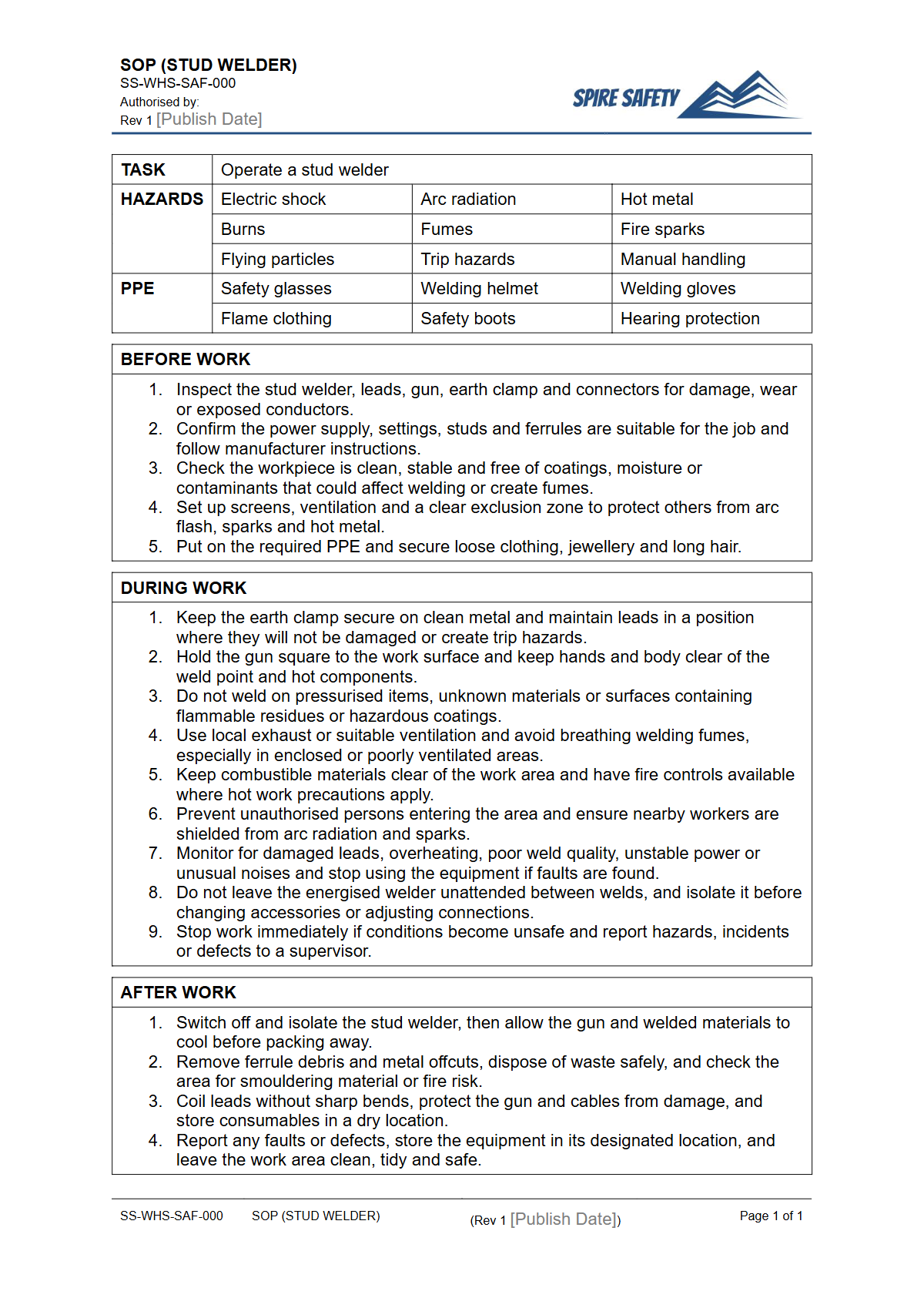
Purpose of the Free Safe Operating Procedure (Stud Welder) Template
A stud welder is a powerful tool used to attach fasteners to metal surfaces, but its operation involves significant hazards, including electric shock, severe burns, arc flash, and exposure to harmful fumes. This free Safe Operating Procedure (Stud Welder) Template provides a structured framework for documenting the required steps to operate this equipment safely.
Using a formal SOP helps standardise your processes, train workers effectively, and demonstrate due diligence in managing workplace risks. Aligned with Australian WHS principles, this template helps you control hazards associated with hot work and electrical equipment.
The document outlines key safety areas, including pre-operational checks, step-by-step operating instructions, and post-operational cleaning and storage. It serves as a critical component of your safety management system, ensuring that all operators follow a consistent, pre-approved method for every task.
Much like our FREE Oxy Acetylene SOP Template, this resource focuses on a specific high-risk task, providing clarity and reducing the chance of incidents caused by human error or inconsistent practices.
Video walkthrough
How to use the Free Safe Operating Procedure (Stud Welder) Template
This template is provided in both DOCX and PDF formats for your convenience. The DOCX file is fully editable, allowing you to tailor the content to the specific requirements of your worksite and the stud welder models you use. To implement it effectively, follow these steps:
- Download: Choose your preferred format and save the file.
- Review: A competent person, such as a supervisor or WHS manager, should review the template against your existing equipment and processes.
- Customise: Add or remove steps, specify the exact model of stud welder, detail the required Personal Protective Equipment (PPE), and incorporate any site-specific safety rules or emergency procedures.
- Train: Use the finalised SOP as a training tool for all workers who will operate the stud welder. Ensure they understand every step and have demonstrated competency.
- Implement: Make the SOP readily accessible to operators in the work area.
It is crucial to remember that this is a template, not a finished document. We've designed it as a strong starting point, but you must adapt every section to reflect the specific stud welders, tasks, and unique environmental conditions at your worksite.
Properly integrated SOPs are a cornerstone of robust WHS management systems, providing the documented proof of your controlled processes.
Key Elements Covered in the Template
Our template is logically structured to guide an operator through the entire task safely. It includes sections for:
- Required PPE: Specifies essential gear like welding helmets, leather gloves, and flame-retardant clothing.
- Pre-Operational Safety Checks: Details inspections for the welder, cables, clamps, and work area to ensure everything is in safe working order before starting.
- Step-by-Step Operating Procedure: A numbered sequence describing how to safely set up the machine, perform a test weld, and carry out the primary task.
- Post-Operational Tasks: Outlines procedures for shutting down the machine, cleaning the equipment, and storing it correctly.
- Emergency Procedures: Provides guidance on responding to fires, electric shock, or other potential emergencies.
When to use a Stud Welder SOP
A Safe Operating Procedure for a stud welder should be used consistently as a reference and control measure in your workplace. It is not a document to be filed away and forgotten.
Its primary applications include worker training and induction, pre-start meetings or toolbox talks, and periodic competency assessments. It also serves as a vital reference point during incident investigations to determine if procedural deviations contributed to the event.
For any workshop task involving powered equipment, from stud welding to cutting, having a clear SOP is essential. A document like our FREE Circular Saw SOP Template follows the same principle of standardising safety for a specific tool.
Who should use it
The responsibility for using and enforcing a Stud Welder SOP extends across multiple roles within an organisation. Workers and operators are the primary users, as they must follow the documented steps to perform their work safely.
Supervisors and team leaders are responsible for ensuring workers are trained on the SOP and adhere to it during operations. Managers and Persons Conducting a Business or Undertaking (PCBUs) hold the ultimate responsibility for ensuring that adequate safe systems of work, such as SOPs, are developed, implemented, and regularly reviewed.
The effectiveness of these procedures is often a key focus during a formal WHS compliance auditing process.
This document complements other critical safety tools, such as risk assessments and Safe Work Method Statements (SWMS), where required for high-risk construction work. A comprehensive approach ensures all equipment, including supporting machinery like that covered in our Free Air Compressor SOP Template, is operated under a formalised safety process.
Explore our complete free WHS resources library for more templates to support your safety management system.
Common mistakes
Common mistakes to avoid
- Using the SOP for a different model of stud welder without customisation.
- Neglecting to inspect cables and earth clamps for damage before each use.
- Failing to ensure adequate ventilation or local exhaust extraction to control welding fumes.
- Not using the correct personal protective equipment (PPE), especially auto-darkening helmets and leather gloves.
Legal references
Legal considerations
The following legal requirements may be relevant to this type of work.
- Work Health and Safety Act (Harmonised) — Provides the primary duties for protecting workers and other people from work health and safety risks.
- Work Health and Safety Regulations (Harmonised) — Sets out requirements supporting the management of workplace hazards and risks.
The following codes may be relevant to this type of work.
- Managing WHS Risks Code of Practice — Provides practical guidance on identifying hazards, assessing risks and applying effective controls.
- Work Health and Safety Consultation, Cooperation and Coordination Code of Practice — Provides practical guidance on consulting workers and coordinating with other duty holders.
- Managing the Work Environment and Facilities Code of Practice — Provides practical guidance on safe work environments, workplace facilities and related controls.
Did you know
Welding Fume Classification
In 2017, the International Agency for Research on Cancer (IARC) reclassified welding fumes from 'possibly carcinogenic' to 'carcinogenic to humans' (Group 1), highlighting the critical need for effective ventilation and respiratory protection.
Arc Eye
The intense ultraviolet (UV) radiation from a welding arc can cause a painful condition called photokeratitis, or 'arc eye,' even from brief, unprotected exposure. Symptoms often don't appear for several hours and feel like sand in the eyes.
FAQ
Frequently asked questions
01What PPE is required for stud welding?
02How often should a Stud Welder SOP be reviewed?
03Is a Safe Work Method Statement (SWMS) required for stud welding?
04What are the main hazards of stud welding?
Share this resource
Free Safe Operating Procedure (Stud Welder) Template
Browse Categories
How To Use It
- 1Download and open in Word or PDF.
- 2Replace the placeholders with your business details.
- 3Get it reviewed by a WHS specialist before rollout.
Need it customised?
Our WHS consultants can adapt this template to your site, run a gap analysis, or audit what you already have in place.
Book a Free Consultation WHS consulting servicesor call 1300 156 382
Related templates
- Free Safe Operating Procedure (Stump Grinder Operation) Template
- Free Safe Operating Procedure (Stump Pulling) Template
- Free Safe Operating Procedure (Submersible Pump) Template
- Free Safe Operating Procedure (Substation Access) Template
- Free Safe Operating Procedure (Substation Cleaning) Template
- Free Safe Operating Procedure (Suction Unit) Template