
Free Safe Operating Procedure (Substation Access) Template
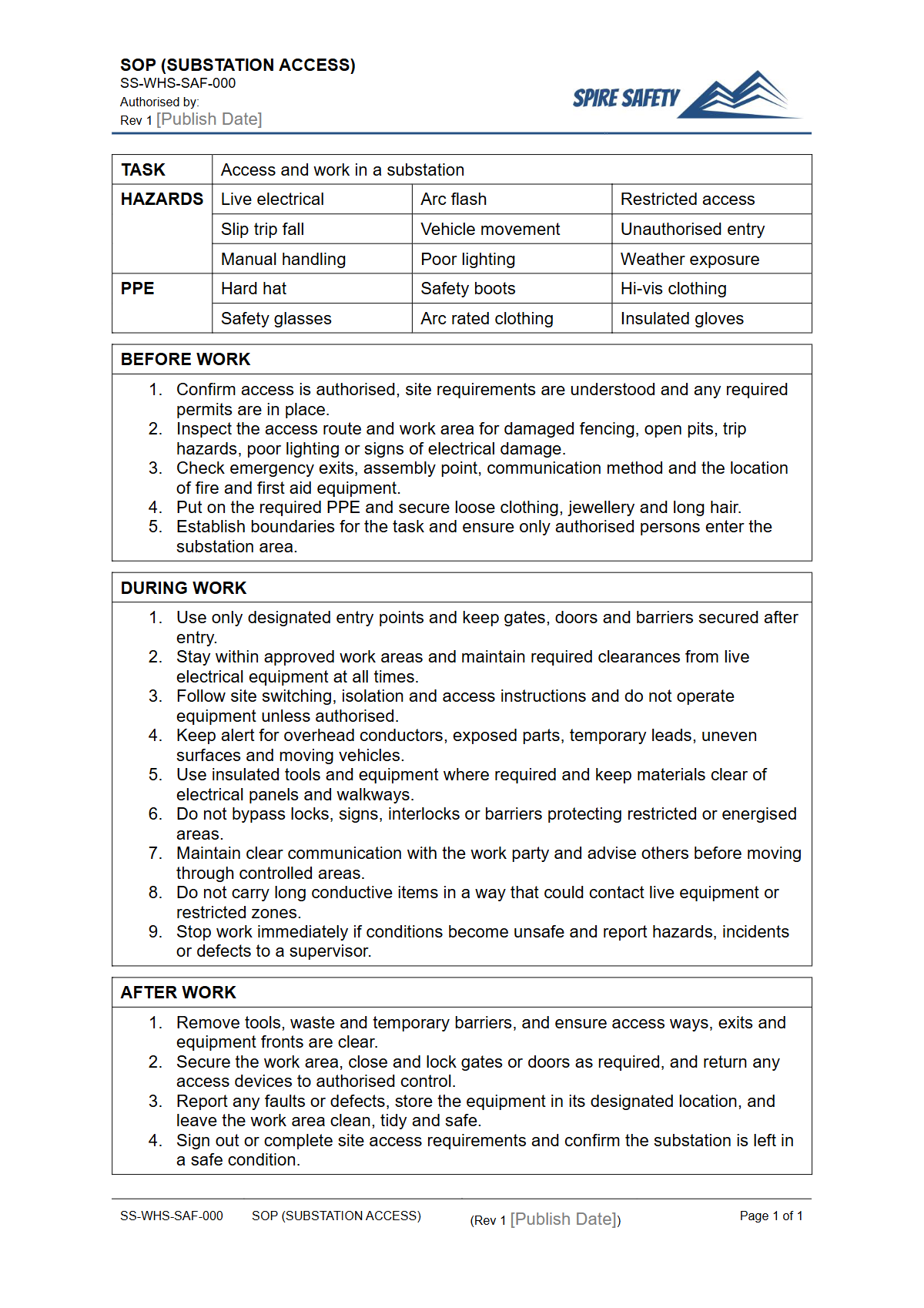
Download our free Safe Operating Procedure (Substation Access) template. This customisable DOCX and PDF helps you document controls for high-voltage areas.
Free Safe Operating Procedure (Substation Access) Template
DOCX • 126 KB + PDF
Updated Oct 2026
No signup required
Purpose of the Free Safe Operating Procedure (Substation Access) Template
Working in or near electrical substations is a high-risk activity that exposes workers to severe hazards, including electrocution, arc flash, and explosions. This Free Safe Operating Procedure (Substation Access) Template provides a structured starting point for documenting the essential safety controls required to manage these risks.
The purpose of a formal SOP is to establish a clear, repeatable, and safe system of work for all personnel who need to enter these controlled environments. By defining every step from initial planning to completion of work, the SOP helps ensure that all precautions are taken, every time.
This template is designed to be integrated into your organisation's broader safety framework. A robust SOP is a fundamental part of effective WHS management systems, demonstrating a commitment to proactively managing workplace hazards.
It provides a clear process for training, authorising, and supervising workers, forming a key piece of evidence that you are meeting your duty of care under Australian WHS legislation.
Video walkthrough
How to use the Free Safe Operating Procedure (Substation Access) Template
This document is provided in both DOCX and PDF formats to serve as a foundation for your site-specific procedure. To use it effectively, you must adapt it to the unique conditions of your workplace. Follow these steps:
- Download: Choose the DOCX file for easy editing.
- Customise: Systematically review each section and replace the placeholder text with information specific to your substation. This includes site addresses, specific equipment models, voltage levels, responsible personnel, and local emergency contacts.
- Risk Assessment: Incorporate the findings from your formal risk assessment for substation access. Detail the identified hazards and the specific control measures you have implemented.
- Review and Approve: Have the draft procedure reviewed by competent persons, such as senior electrical engineers and WHS professionals. Once finalised, it must be formally approved by management.
- Train: Ensure all personnel required to enter the substation are thoroughly trained on the finalised SOP before it is implemented.
Important: This is a template, not a finished document. We have no knowledge of your specific site, equipment, or personnel.
You must take responsibility for customising this document to ensure it is comprehensive and accurate for your workplace. For activities taking place near the substation, like excavation, you might also require other specific procedures, such as those found in a FREE Trencher SOP Template.
When to use this Safe Operating Procedure
A Substation Access SOP should be used before and during any planned entry into a high-voltage switchyard or substation enclosure. It is not just for major maintenance; it applies to a range of activities to ensure a consistent standard of safety is maintained. This includes, but is not limited to:
- Routine visual inspections and equipment checks.
- Scheduled preventative maintenance on switchgear, transformers, and control panels.
- Diagnostic testing and data collection.
- Corrective maintenance and repair work.
- Electrical switching operations.
- Supervised access for non-electrical personnel (e.g., grounds maintenance, pest control).
- Emergency response and fault finding.
Establishing clear procedures for all equipment, even ancillary systems, is a hallmark of a mature safety system. This might include documenting processes for workshop equipment, as outlined in our Free Air Compressor SOP Template, to ensure consistency across all operational areas.
Who should use it
Access to electrical substations must be strictly limited to 'Authorised' and 'Competent Persons' who have the necessary skills, knowledge, and experience to work safely in a high-voltage environment. This typically includes:
- Electrical Engineers: For design, planning, and complex problem-solving.
- High Voltage (HV) Electricians: For performing switching, isolation, and maintenance tasks.
- Technicians: For testing, monitoring, and maintaining protection and control systems.
- WHS Advisors: For observing work, conducting safety audits, and verifying compliance with the procedure.
A person's competency must be verified before they are granted authorisation. This involves checking qualifications, licenses, and previous experience, and may include a formal Verification of Competency (VOC) assessment.
Regular WHS compliance auditing is essential to confirm that only authorised personnel are accessing these areas and that the established procedures are being followed correctly.
For highly complex or unusual substation configurations, seeking external expertise can provide an additional layer of assurance. Specialised WHS consulting can help you develop and validate robust procedures for your most critical risks.
You can also explore our complete free WHS resources library for other templates to support your safety management system.
Common mistakes
Common mistakes to avoid
- Assuming all authorised personnel remain competent without regular verification or refresher training.
- Failing to conduct a job-specific risk assessment before every entry, relying only on the generic SOP.
- Using generic Lock-Out Tag-Out (LOTO) procedures not specific to the switchgear involved.
- Inadequate specification or pre-use inspection of personal protective equipment (PPE), especially arc-rated clothing.
Legal references
Legal considerations
The following legal requirements may be relevant to this type of work.
- Work Health and Safety Act (Harmonised) — Provides the primary duties for protecting workers and other people from work health and safety risks.
- Work Health and Safety Regulations (Harmonised) — Sets out requirements supporting the management of workplace hazards and risks.
The following codes may be relevant to this type of work.
- Managing WHS Risks Code of Practice — Provides practical guidance on identifying hazards, assessing risks and applying effective controls.
- Work Health and Safety Consultation, Cooperation and Coordination Code of Practice — Provides practical guidance on consulting workers and coordinating with other duty holders.
- Managing the Work Environment and Facilities Code of Practice — Provides practical guidance on safe work environments, workplace facilities and related controls.
Did you know
Arc Flash Temperatures
An electrical arc flash can generate temperatures up to 20,000°C, which is four times hotter than the surface of the sun. This underscores the critical need for correct procedures and arc-rated PPE.
Human Body & Electricity
It only takes about 100 milliamperes (mA) of electrical current passing through the heart to cause ventricular fibrillation, a fatal arrhythmia. Safe isolation is the most effective control measure.
FAQ
Frequently asked questions
01What is the difference between an SOP and a SWMS for substation access?
02Who is considered a 'competent person' for entering a substation?
03Does this template cover arc flash protection requirements?
04How often should a substation access SOP be reviewed?
Share this resource
Free Safe Operating Procedure (Substation Access) Template
Browse Categories
How To Use It
- 1Download and open in Word or PDF.
- 2Replace the placeholders with your business details.
- 3Get it reviewed by a WHS specialist before rollout.
Need it customised?
Our WHS consultants can adapt this template to your site, run a gap analysis, or audit what you already have in place.
Book a Free Consultation WHS consulting servicesor call 1300 156 382
Related templates
- Free Safe Operating Procedure (Substation Cleaning) Template
- Free Safe Operating Procedure (Suction Unit) Template
- Free Safe Operating Procedure (Sump Pump) Template
- Free Safe Operating Procedure (Surface Degreasing) Template
- Free Safe Operating Procedure (Surface Disinfection) Template
- Free Safe Operating Procedure (Surface Etching) Template