
Free Safe Operating Procedure (Surface Degreasing) Template
Download our free Safe Operating Procedure for surface degreasing to manage hazards effectively. This customisable template helps you outline safe work methods.
Free Safe Operating Procedure (Surface Degreasing) Template
DOCX • 126 KB + PDF
Updated Oct 2026
No signup required
Purpose of the Free Safe Operating Procedure (Surface Degreasing) Template
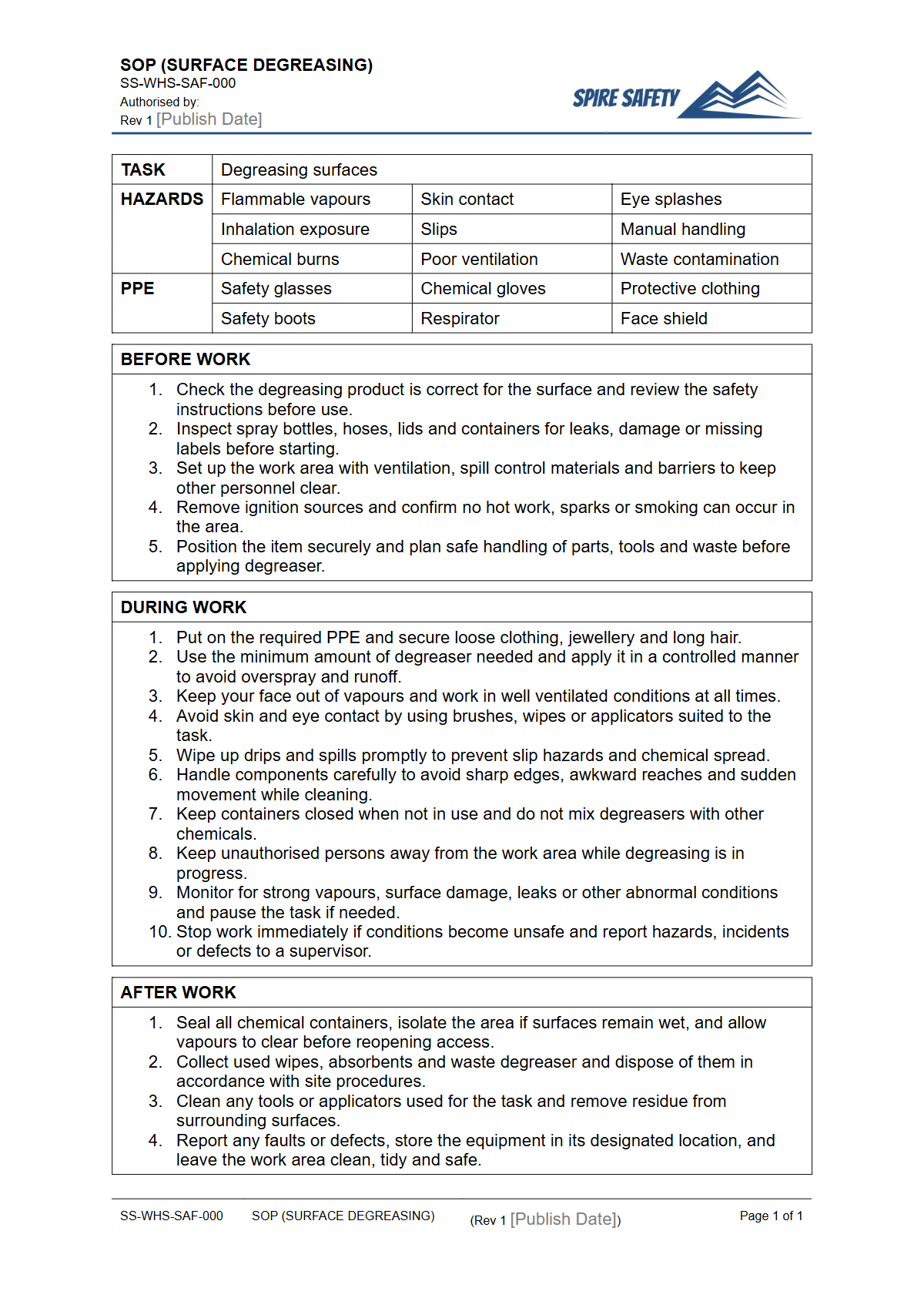
This free Safe Operating Procedure (Surface Degreasing) Template provides a structured starting point for documenting the process of cleaning and preparing surfaces using chemical degreasers. Surface degreasing, while a common task in workshops, manufacturing, and maintenance settings, involves significant risks, including chemical exposure, fire or explosion, and skin or respiratory irritation.
Using a detailed Safe Operating Procedure (SOP) is a critical step in managing these hazards effectively.
The purpose of this document is to help you clearly outline the required steps, identify potential hazards at each stage, and specify the control measures needed to ensure worker safety. This includes detailing the correct Personal Protective Equipment (PPE), ventilation requirements, safe chemical handling practices, and emergency procedures.
Formalising your process helps standardise safe work behaviours across your team and demonstrates a commitment to health and safety. Similar principles apply to other hazardous tasks, as seen in our free Oxy Acetylene SOP template.
Video walkthrough
How to use the Free Safe Operating Procedure (Surface Degreasing) Template
To get the most value from this Safe Operating Procedure (Surface Degreasing) Template, it is essential that you customise it for your specific operational context. The downloaded document serves as a comprehensive framework, but workplace safety depends on tailoring it to the exact chemicals, equipment, and environment at your site.
You must consult the Safety Data Sheet (SDS) for each degreasing product you use and incorporate its specific recommendations into the SOP.
We strongly advise that a competent person, such as a WHS manager or an experienced supervisor, leads the customisation process. This involves walking through the task on-site, consulting with the workers who perform it, and ensuring every step accurately reflects your established safe work method.
Integrating this SOP into your broader WHS management systems ensures it is used consistently for training, inductions, and risk assessments.
What's included in the template?
Our template is structured to align with Australian WHS practice and includes sections for:
- Defining the task and its scope.
- Listing required PPE (e.g., solvent-resistant gloves, safety glasses, respirators).
- Identifying hazards associated with the task (e.g., chemical, fire, electrical, ergonomic).
- A step-by-step procedure from pre-operational checks to task completion and clean-up.
- Waste disposal and emergency response protocols.
- A section for review and authorisation signatures.
Regular reviews are crucial to keeping your SOPs effective and relevant. Scheduling periodic reviews as part of your WHS compliance auditing program ensures that your procedures stay up-to-date with any changes in chemicals, equipment, or regulations.
When to use a Safe Operating Procedure
An SOP for surface degreasing should be used consistently before the task is undertaken. It is an essential tool for worker training and for inducting new employees or contractors who may perform the task.
It should also be a key reference document during toolbox talks and when conducting a risk assessment for the activity. Following an incident or near-miss related to degreasing, the SOP should be reviewed and updated to prevent a recurrence. A robust SOP is just as important for chemical tasks as it is for equipment-based ones, like those covered in our free Air Compressor SOP.
Who should use it
This Safe Operating Procedure template is designed for use by a range of personnel within an organisation. WHS Managers and Safety Officers will use it to establish and formalise safe work methods. Supervisors and Team Leaders are responsible for implementing the SOP, ensuring their teams are trained on its contents, and monitoring its application in the workplace. The end-users—the workers and operators performing the degreasing—should treat the SOP as their primary guide for completing the job safely. When in doubt about chemical risks or control measures, engaging external WHS consulting can provide valuable expertise. The principles of hazard identification and control found in this SOP can be adapted for other processes involving hazardous liquids, such as the process detailed in our free Safe Operating Procedure for a deep fryer. Explore our complete free WHS resources library for more templates to support your safety management system.
Common mistakes
Common mistakes to avoid
- Using the wrong type of Personal Protective Equipment (PPE) for the specific chemical solvent.
- Failing to ensure adequate ventilation, leading to the build-up of harmful or flammable vapours.
- Improper storage and disposal of flammable degreasing agents and chemical-soaked rags.
- Neglecting to read and follow the specific guidance in the Safety Data Sheet (SDS) for the product.
Legal references
Legal considerations
The following legal requirements may be relevant to this type of work.
- Work Health and Safety Act (Harmonised) — Provides the primary duties for protecting workers and other people from work health and safety risks.
- Work Health and Safety Regulations (Harmonised) — Sets out requirements supporting the management of workplace hazards and risks.
The following codes may be relevant to this type of work.
- Managing WHS Risks Code of Practice — Provides practical guidance on identifying hazards, assessing risks and applying effective controls.
- Work Health and Safety Consultation, Cooperation and Coordination Code of Practice — Provides practical guidance on consulting workers and coordinating with other duty holders.
- Managing the Work Environment and Facilities Code of Practice — Provides practical guidance on safe work environments, workplace facilities and related controls.
Did you know
Ventilation is Critical
Many degreasing solvents release Volatile Organic Compounds (VOCs). In poorly ventilated areas, these vapours can accumulate to levels that are not only toxic to inhale but can also create a serious fire or explosion hazard.
Not All Gloves Are Equal
The type of glove material required depends entirely on the chemical being handled. A standard latex or nitrile glove may quickly degrade or be permeated by certain solvents, offering false security and no real protection.
FAQ
Frequently asked questions
01What should be included in a Safe Operating Procedure for surface degreasing?
02Are degreasing solvents hazardous?
03How often should an SOP for surface degreasing be reviewed?
04Do I need a separate SOP for each type of degreaser used?
Share this resource
Free Safe Operating Procedure (Surface Degreasing) Template
Browse Categories
How To Use It
- 1Download and open in Word or PDF.
- 2Replace the placeholders with your business details.
- 3Get it reviewed by a WHS specialist before rollout.
Need it customised?
Our WHS consultants can adapt this template to your site, run a gap analysis, or audit what you already have in place.
Book a Free Consultation WHS consulting servicesor call 1300 156 382
Related templates
- Free Safe Operating Procedure (Surface Disinfection) Template
- Free Safe Operating Procedure (Surface Etching) Template
- Free Safe Operating Procedure (Surface Grinder) Template
- Free Safe Operating Procedure (Surface Profile Gauge) Template
- Free Safe Operating Procedure (Suspension Strut Change) Template
- Free Safe Operating Procedure (Swaging Machine) Template