
Free Safe Operating Procedure (Surface Grinder) Template
Download our free Safe Operating Procedure for surface grinders to standardise workshop practices. This template helps you define step-by-step controls.
Free Safe Operating Procedure (Surface Grinder) Template
DOCX • 126 KB + PDF
Updated Oct 2026
No signup required
Purpose of the Free Safe Operating Procedure (Surface Grinder) Template
Operating a surface grinder requires precision and a strict adherence to safety protocols. To help standardise this process, Spire Safety offers this free Safe Operating Procedure (Surface Grinder) template.
It provides a structured framework for documenting the required steps to operate the equipment safely, minimising risks to operators and bystanders in your workshop. A well-documented SOP is a cornerstone of an effective safety management system, translating risk assessment findings into practical, step-by-step instructions that guide workers.
Using this template helps ensure every operator follows a consistent, safe method, reducing the chance of incidents caused by human error. Integrating clear SOPs into your daily operations is a key part of building robust WHS management systems.
Video walkthrough
How to use the Free Safe Operating Procedure (Surface Grinder) Template
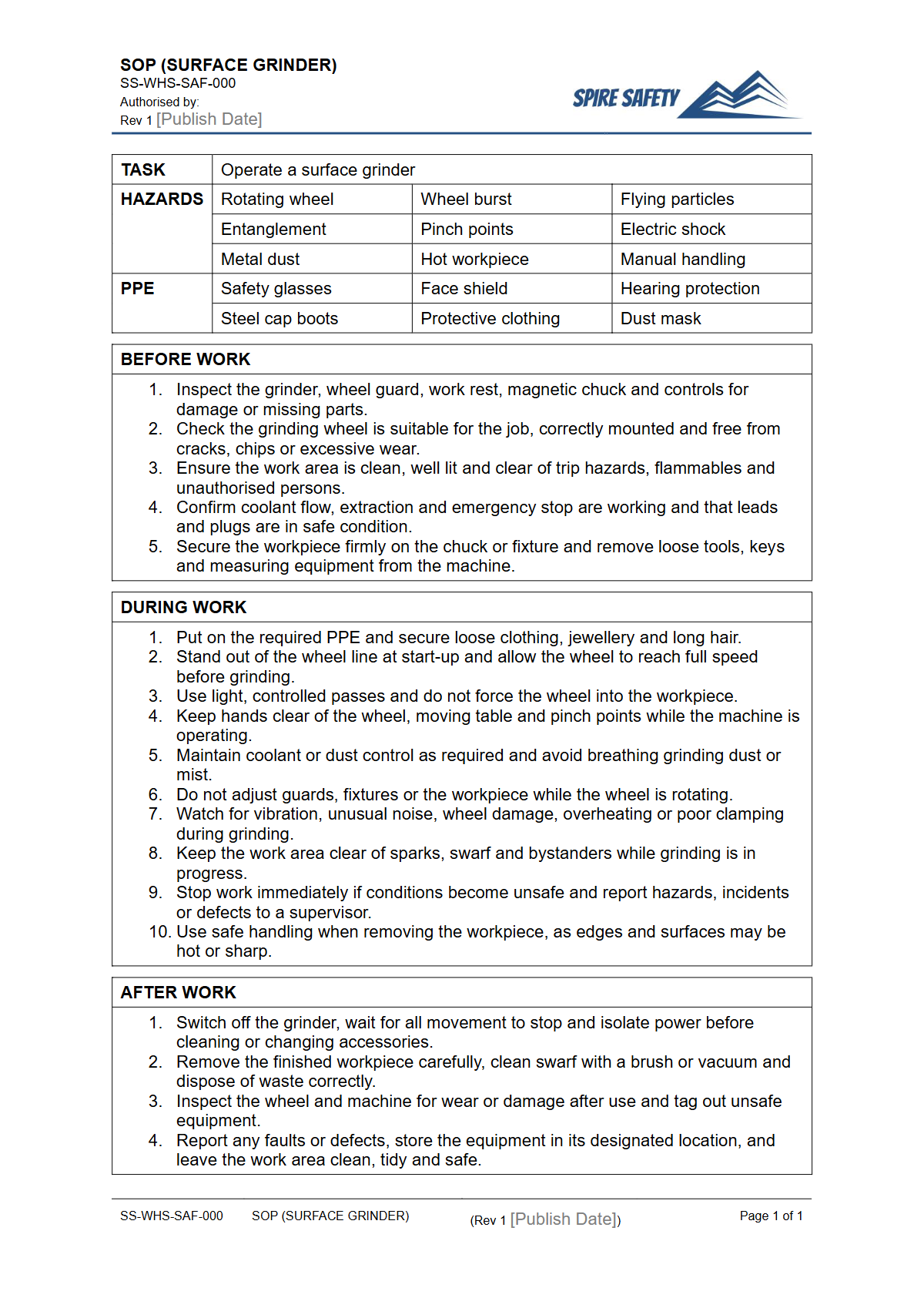
Download the template in your preferred format (DOCX for editing or PDF for reference) and begin customising it for your workplace. The document is structured with sections for Personal Protective Equipment (PPE), potential hazards, pre-start checks, operational steps, and shutdown procedures.
You must adapt the content to reflect the specific make and model of your surface grinder, the materials you work with, and the unique environmental factors of your workshop. A generic procedure is not sufficient; this template is a starting point which we have designed for you to edit and make your own.
For other high-risk thermal processes, you might also need a specific FREE Oxy Acetylene SOP to manage those distinct hazards.
When to use a Surface Grinder SOP
A Safe Operating Procedure should be developed and implemented before any worker is permitted to operate a surface grinder. It serves as a primary training document for new operators and a critical reference for experienced staff.
It's also an essential tool for conducting refresher training or for reviewing procedures following a near-miss or incident. Furthermore, documented procedures are a key piece of evidence during safety inspections or a formal WHS compliance auditing process.
Regularly reviewing and updating your SOPs ensures they remain relevant and effective, especially when new equipment is introduced or processes change.
Who should use this SOP Template
This template is intended for use by Persons Conducting a Business or Undertaking (PCBUs), workshop managers, and safety officers responsible for establishing safe systems of work. Supervisors should use the finalised document to train and oversee operators, ensuring the documented procedures are followed correctly.
Operators themselves are the end-users, relying on the SOP for clear, unambiguous instructions on how to perform their tasks safely. Managers looking to standardise procedures for other fixed plant can adapt the principles used here or use a specific template, such as our Free Air Compressor SOP.
Key Elements of a Surface Grinder SOP
A comprehensive SOP for a surface grinder must detail every phase of its use. This template guides you through documenting critical information, including required PPE like safety glasses and hearing protection, a list of identified hazards (e.g., wheel bursts, entanglement, dust inhalation), and emergency shutdown instructions.
It provides clear sections for pre-start checks, such as inspecting the wheel for damage and ensuring guards are secure. The core of the document is the step-by-step operating sequence, followed by post-operation clean-up and shutdown tasks. This structured approach is also beneficial for portable equipment, as shown in our FREE Circular Saw SOP Template.
Beyond the Template: Implementation and Review
Creating the document is only the first step. Effective implementation involves training all operators on the procedure and verifying their understanding and competence.
Supervisors must ensure the SOP is readily available near the equipment and that its steps are consistently followed in practice. The SOP is a living document that should be reviewed and updated periodically or in response to any changes in the workplace.
For more tools to build out your safety system, browse our complete free WHS resources library for additional checklists, forms, and procedure templates.
Common mistakes
Common mistakes to avoid
- Using a grinding wheel that is cracked, chipped, or has exceeded its expiry date.
- Grinding on the side of a conventional flat grinding wheel, which is not designed for side pressure.
- Applying excessive force, which can overheat the workpiece and stress or break the wheel.
- Operating the grinder without correct guarding in place or without wearing appropriate PPE, especially safety glasses or a face shield.
Legal references
Legal considerations
The following legal requirements may be relevant to this type of work.
- Work Health and Safety Act (Harmonised) — Provides the primary duties for protecting workers and other people from work health and safety risks.
- Work Health and Safety Regulations (Harmonised) — Sets out requirements supporting the management of workplace hazards and risks.
The following codes may be relevant to this type of work.
- Managing WHS Risks Code of Practice — Provides practical guidance on identifying hazards, assessing risks and applying effective controls.
- Work Health and Safety Consultation, Cooperation and Coordination Code of Practice — Provides practical guidance on consulting workers and coordinating with other duty holders.
- Managing the Work Environment and Facilities Code of Practice — Provides practical guidance on safe work environments, workplace facilities and related controls.
Did you know
Wheel Speed Matters
The periphery of a standard 200mm grinding wheel spinning at 3,000 RPM is travelling at over 110 km/h. This is why wheel integrity and proper guarding are critical safety measures.
The Ring Test
Before mounting a new wheel, experienced operators perform a 'ring test' by tapping it gently with a non-metallic object. A clear, ringing sound suggests the wheel is free from cracks, while a dull thud indicates a potential fracture.
FAQ
Frequently asked questions
01What is the main purpose of a Safe Operating Procedure for a surface grinder?
02Does this template cover all types of surface grinders?
03Who is responsible for writing the surface grinder SOP?
04How often should a surface grinder SOP be reviewed?
Share this resource
Free Safe Operating Procedure (Surface Grinder) Template
Browse Categories
How To Use It
- 1Download and open in Word or PDF.
- 2Replace the placeholders with your business details.
- 3Get it reviewed by a WHS specialist before rollout.
Need it customised?
Our WHS consultants can adapt this template to your site, run a gap analysis, or audit what you already have in place.
Book a Free Consultation WHS consulting servicesor call 1300 156 382
Related templates
- Free Safe Operating Procedure (Surface Profile Gauge) Template
- Free Safe Operating Procedure (Suspension Strut Change) Template
- Free Safe Operating Procedure (Swaging Machine) Template
- Free Safe Operating Procedure (Swing Stage) Template
- Free Safe Operating Procedure (Switchboard Testing) Template
- Free Safe Operating Procedure (Synthetic Sling Use) Template