
Free Safe Operating Procedure (Swaging Machine) Template
Streamline your workshop safety with our free Safe Operating Procedure for swaging machines. Download your customisable template in DOCX or PDF today.
Free Safe Operating Procedure (Swaging Machine) Template
DOCX • 126 KB + PDF
Updated Oct 2026
No signup required
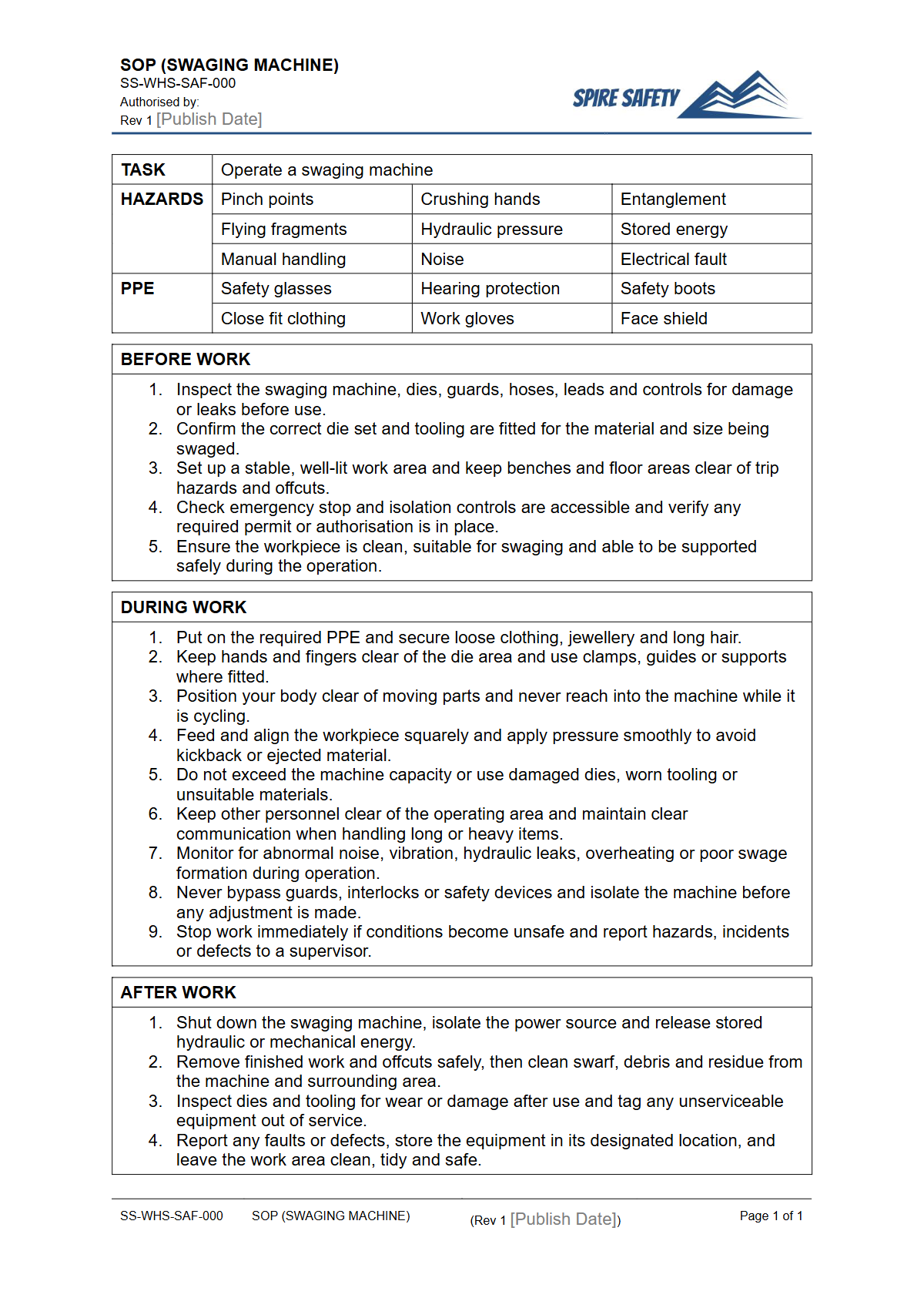
Purpose of the Free Safe Operating Procedure (Swaging Machine) Template
Operating a swaging machine involves significant risks, including entanglement, crushing, and high-pressure fluid injection. This Safe Operating Procedure (SOP) template provides a structured framework to document the step-by-step process for using this equipment safely.
It is designed to help your organisation control hazards, standardise operating methods, and ensure all workers are aware of the required safety protocols. A well-developed SOP is a critical component of effective WHS management systems, serving as a key reference for training, risk assessment, and incident investigation.
Video walkthrough
How to use the Free Safe Operating Procedure (Swaging Machine) Template
This document is a starting point, not a finished product. To use it effectively, you must adapt it to the specific make and model of the swaging machine at your workplace, as well as the unique environment and tasks it is used for.
Download the DOCX version for easy editing.
Customisation Steps:
- Consult Your Team: Involve the workers who actually operate the machine. Their hands-on experience is invaluable for identifying practical steps and unrecognised hazards.
- Add Specifics: Insert details unique to your machine, including its location, serial number, required die sets, pressure settings, and specific pre-start checks.
- Review and Approve: Once customised, the SOP should be reviewed and approved by a supervisor or manager to ensure it aligns with your organisation's safety policies.
- Train and Implement: Use the finalised SOP as a basis for training all relevant personnel. Ensure it is readily accessible near the machine.
If you require expert assistance in developing or reviewing your workplace-specific procedures, our team offers specialised WHS consulting services to help ensure your documentation is robust and practical.
Key Elements of a Swaging Machine Safe Operating Procedure
A comprehensive SOP for a swaging machine should cover several critical areas to be effective. The template guides you through each section, prompting you to detail the necessary safety measures.
These sections typically include the required Personal Protective Equipment (PPE), pre-operational safety checks, step-by-step instructions for the task, post-operational shutdown procedures, and emergency protocols. For machinery that often works in conjunction with swaging equipment, such as air-powered tools, consider documenting their safe use as well with a dedicated free Air Compressor SOP.
Important Sections to Detail:
- Hazard Identification: List all potential hazards, such as moving parts, hydraulic pressure, noise, and sharp edges.
- Control Measures: For each hazard, specify the controls in place, like machine guarding, exclusion zones, and mandatory PPE.
- Operating Sequence: Clearly outline the safe sequence of actions, from selecting the correct die set to applying pressure and inspecting the finished product.
- Emergency Procedures: Detail the steps for emergency shutdown, first aid response for common injuries, and who to contact.
When to Use This Safe Operating Procedure
The Swaging Machine SOP is not a one-time document. It should be a living part of your daily operations and safety management cycle.
It must be used before any worker operates the equipment for the first time, serving as a foundation for their practical training and competency assessment. It is also an essential tool for refresher training to prevent skill fade and the development of unsafe habits.
Furthermore, the SOP should be reviewed and updated following any incident or near-miss, or when changes are made to the machine, process, or surrounding work environment. Regular reviews, often as part of a scheduled WHS compliance auditing program, ensure the procedure remains current and effective.
Who Should Use This Safe Operating Procedure
This procedure is intended for anyone who interacts with the swaging machine. This primarily includes the machine operators, who must follow its instructions to perform their tasks safely.
Supervisors and managers should also be familiar with the SOP to enforce its requirements, conduct safety observations, and lead incident investigations. Additionally, WHS personnel and trainers will use the document to develop training programs, conduct risk assessments, and verify that safety protocols are being followed.
For workshops with a wide array of machinery, it is beneficial to maintain a consistent format across all procedures, such as those found in our FREE Injection Molding Machine SOP (Safe Operating Procedure) Template, to ensure clarity and ease of use for all staff.
By thoroughly documenting safe work methods for all plant and equipment, you build a stronger safety culture. You can find many more templates and checklists to support your safety management efforts in our complete free WHS resources library.
Common mistakes
Common mistakes to avoid
- Using the template without customising it for the specific machine model and workplace hazards.
- Failing to consult with machine operators when drafting or reviewing the procedure.
- Treating the SOP as a "set and forget" document instead of a live tool for training and review.
- Neglecting to specify correct die sets and pressure settings for different hose or cable types.
Legal references
Legal considerations
The following legal requirements may be relevant to this type of work.
- Work Health and Safety Act (Harmonised) — Provides the primary duties for protecting workers and other people from work health and safety risks.
- Work Health and Safety Regulations (Harmonised) — Sets out requirements supporting the management of workplace hazards and risks.
The following codes may be relevant to this type of work.
- Managing WHS Risks Code of Practice — Provides practical guidance on identifying hazards, assessing risks and applying effective controls.
- Work Health and Safety Consultation, Cooperation and Coordination Code of Practice — Provides practical guidance on consulting workers and coordinating with other duty holders.
- Managing the Work Environment and Facilities Code of Practice — Provides practical guidance on safe work environments, workplace facilities and related controls.
Did you know
Immense Force
Many industrial swaging machines use hydraulic systems capable of generating immense force, often exceeding 50 tonnes, to deform metal fittings onto hoses or cables in seconds.
Cold Forging
Swaging is a type of 'cold forging' process, meaning it shapes the metal at or near room temperature without heating it. This process increases the material's strength and improves its surface finish.
FAQ
Frequently asked questions
01What are the main hazards associated with a swaging machine?
02How often should a Swaging Machine SOP be reviewed?
03Is competency-based training required in addition to an SOP for swaging machines?
04What PPE is typically needed for operating a swaging machine?
Share this resource
Free Safe Operating Procedure (Swaging Machine) Template
Browse Categories
How To Use It
- 1Download and open in Word or PDF.
- 2Replace the placeholders with your business details.
- 3Get it reviewed by a WHS specialist before rollout.
Need it customised?
Our WHS consultants can adapt this template to your site, run a gap analysis, or audit what you already have in place.
Book a Free Consultation WHS consulting servicesor call 1300 156 382
Related templates
- Free Safe Operating Procedure (Swing Stage) Template
- Free Safe Operating Procedure (Switchboard Testing) Template
- Free Safe Operating Procedure (Synthetic Sling Use) Template
- Free Safe Operating Procedure (Table Clearing) Template
- Free Safe Operating Procedure (Tag Line Use) Template
- Free Safe Operating Procedure (Tagging Gun Use) Template