
Free Safe Operating Procedure (Tag Line Use) Template
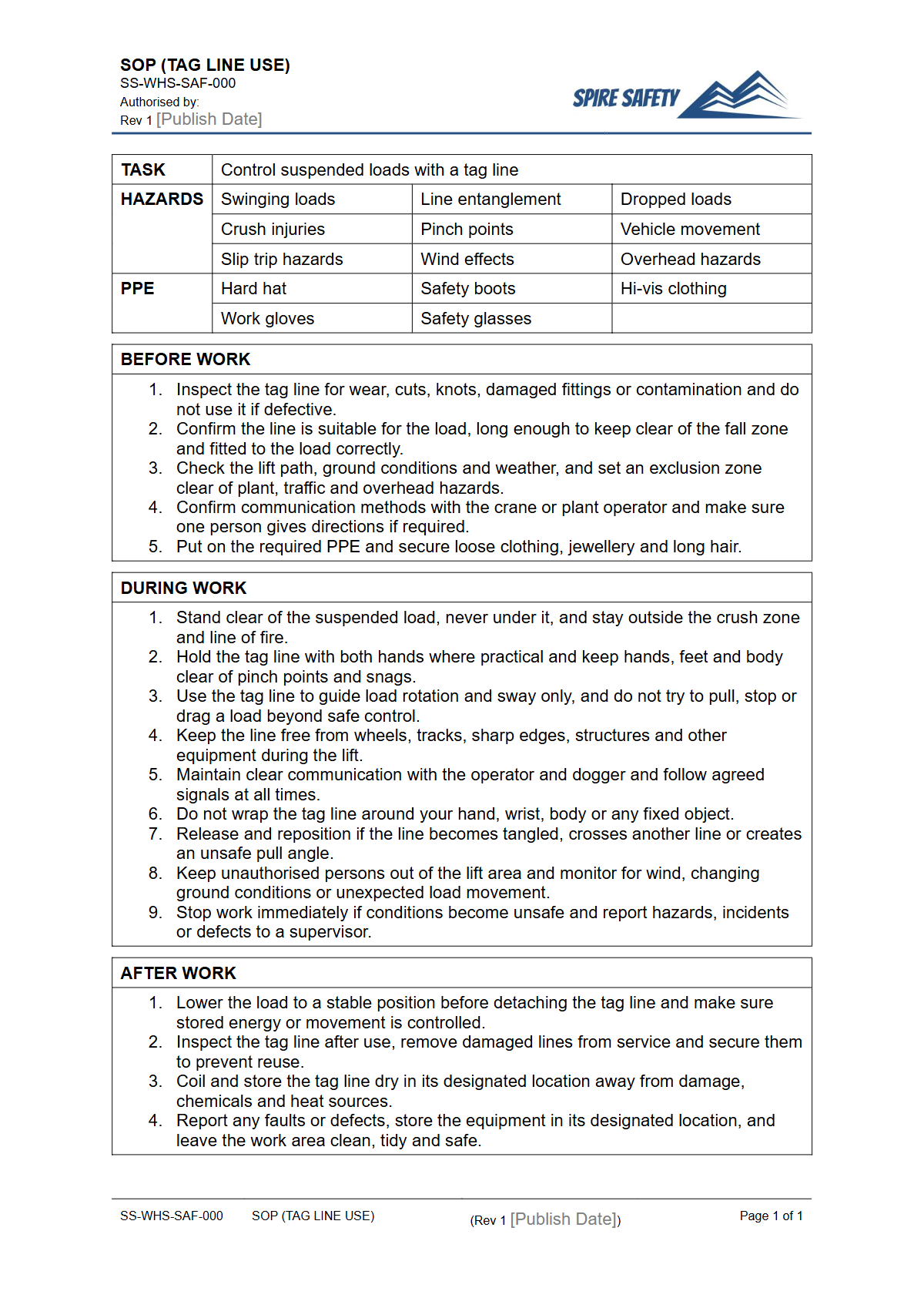
Our free Safe Operating Procedure for tag line use template provides a structured framework for managing lifting risks.
Free Safe Operating Procedure (Tag Line Use) Template
DOCX • 126 KB + PDF
Updated Oct 2026
No signup required
Purpose of the Free Safe Operating Procedure (Tag Line Use) Template
This Free Safe Operating Procedure (Tag Line Use) Template is designed to help persons conducting a business or undertaking (PCBUs) document the required steps for safely using tag lines during lifting and rigging operations. Tag lines are essential for controlling suspended loads, preventing them from swinging, rotating, or coming into contact with other objects, which can lead to serious incidents.
By establishing a clear, documented procedure, you can train workers, standardise practices, and demonstrate your commitment to managing workplace hazards effectively. This SOP serves as a critical component of a broader WHS management system, helping to minimise risks associated with crane operations and material handling.
Video walkthrough
How to use the Free Safe Operating Procedure (Tag Line Use) Template
This Safe Operating Procedure for tag line use is provided as a user-friendly template in both DOCX and PDF formats. To implement it effectively, you must tailor it to the specific conditions of your workplace.
This involves conducting a site-specific risk assessment, identifying the types of loads handled, the equipment used (like cranes or telehandlers referenced in our FREE Telehandler SOP Template), and the environmental conditions. Fill in the blank sections with details relevant to your operations, including roles, responsibilities, and emergency procedures.
Important: Customise to Your Workplace
This document is a template and must be customised to suit the specific needs and risks of your workplace. We are not responsible for the implementation or compliance of the final document.
A generic procedure is not a substitute for a site-specific risk assessment and consultation with your workers.
When to use it
A documented Safe Operating Procedure for tag line use should be implemented whenever lifting operations involve suspended loads that have the potential to swing or become uncontrollable. This is particularly crucial in environments with wind, confined spaces, or where workers are in close proximity to the load's travel path.
It should be used as a key training document during worker inductions and as a reference for pre-start meetings or toolbox talks before any relevant lifting task begins. Regular reviews and WHS compliance auditing ensure the procedure remains effective and relevant, especially after an incident or when new equipment is introduced.
Who should use it
This SOP is intended for all personnel involved in lifting operations. This includes crane operators, doggers, riggers, spotters, and any workers responsible for handling tag lines.
Supervisors and managers should also use this document to ensure that work is being conducted according to the established procedure and to facilitate training and competency assessments. Safety officers and WHS representatives will find it a useful tool for conducting inspections and verifying that control measures are in place and effective, and can be supported by expert WHS consulting when complex scenarios arise.
Key Elements of a Tag Line SOP
A comprehensive SOP for tag line use should cover several critical areas to be effective. These include:
- Pre-operational Checks: Inspecting the condition of tag lines, ensuring they are of adequate length and strength, and free from knots or damage.
- Safe Attachment: Detailing the correct methods for attaching tag lines to the load, ensuring they do not foul the lifting gear.
- Communication: Defining the hand signals or radio communication protocols between the operator and the ground crew.
- Personnel Positioning: Specifying safe zones for workers handling tag lines, keeping them clear of the drop zone and potential swing path.
- Load Control Techniques: Outlining how to apply tension to the tag line to guide the load without destabilising it.
- Emergency Procedures: Steps to take if control of the load is lost or another emergency occurs.
Integrating these elements transforms the template from a basic document into a robust safety tool. To see how procedures are structured for different equipment, you can review other examples like our free Air Compressor SOP. By customising this template with your site-specific details, you create a valuable resource for your team.
You can find more templates and checklists in our free WHS resources library to build out your safety management system.
Common mistakes
Common mistakes to avoid
- Using a tag line that is too short, forcing the handler to be too close to the load.
- Wrapping the tag line around hands, wrists, or other body parts instead of holding it securely.
- Failing to inspect the tag line for knots, frays, or chemical damage before use.
- Assigning an untrained worker to manage the tag line during a critical lift.
Legal references
Legal considerations
The following legal requirements may be relevant to this type of work.
- Work Health and Safety Act (Harmonised) — Provides the primary duties for protecting workers and other people from work health and safety risks.
- Work Health and Safety Regulations (Harmonised) — Sets out requirements supporting the management of workplace hazards and risks.
The following codes may be relevant to this type of work.
- Managing WHS Risks Code of Practice — Provides practical guidance on identifying hazards, assessing risks and applying effective controls.
- Work Health and Safety Consultation, Cooperation and Coordination Code of Practice — Provides practical guidance on consulting workers and coordinating with other duty holders.
- Managing the Work Environment and Facilities Code of Practice — Provides practical guidance on safe work environments, workplace facilities and related controls.
Did you know
The Danger Zone
The area directly under a suspended load is often called the 'drop zone' or 'line of fire'. No worker, including the tag line handler, should ever be positioned within this zone during a lift.
Wind Factor
Even moderate wind can exert significant force on a load with a large surface area, making tag lines a non-negotiable control measure for maintaining stability and preventing incidents.
FAQ
Frequently asked questions
01What is a tag line in lifting operations?
02Is a Safe Operating Procedure for tag lines legally required in Australia?
03What material should a tag line be made from?
04Who is responsible for holding the tag line?
Share this resource
Free Safe Operating Procedure (Tag Line Use) Template
Browse Categories
How To Use It
- 1Download and open in Word or PDF.
- 2Replace the placeholders with your business details.
- 3Get it reviewed by a WHS specialist before rollout.
Need it customised?
Our WHS consultants can adapt this template to your site, run a gap analysis, or audit what you already have in place.
Book a Free Consultation WHS consulting servicesor call 1300 156 382
Related templates
- Free Safe Operating Procedure (Tagging Gun Use) Template
- Free Safe Operating Procedure (Tailgate Delivery) Template
- Free Safe Operating Procedure (Tanning Bed Cleaning) Template
- Free Safe Operating Procedure (Tea Urn Cleaning) Template
- Free Safe Operating Procedure (Temperature Calibrator) Template
- Free Safe Operating Procedure (Temporary Handrail) Template