
Free Safe Operating Procedure (Tagging Gun Use) Template
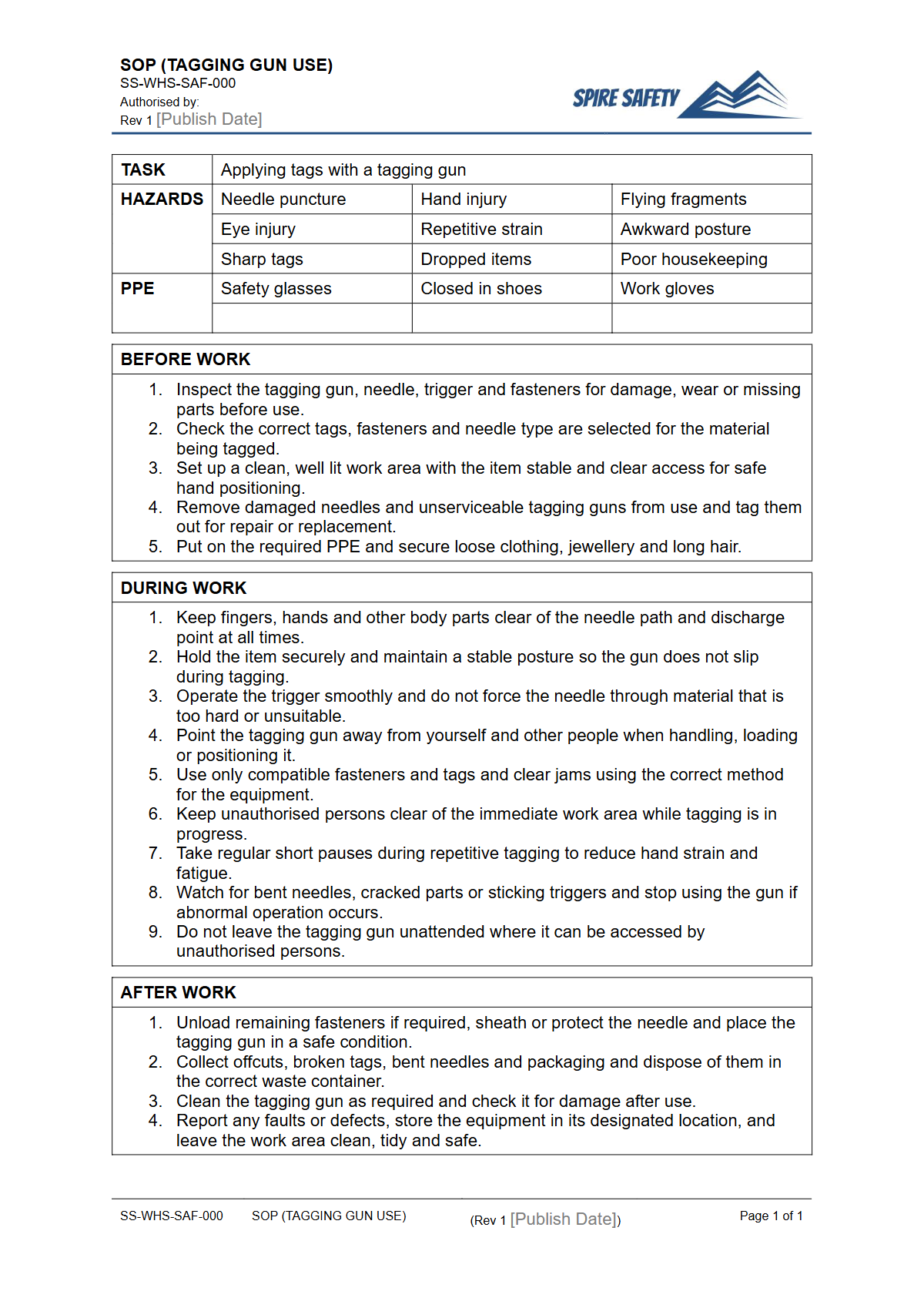
Document the safe use of tagging guns in your retail or warehouse setting. Download our free Safe Operating Procedure (Tagging Gun Use) template today.
Free Safe Operating Procedure (Tagging Gun Use) Template
DOCX • 126 KB + PDF
Updated Oct 2026
No signup required
Purpose of the Free Safe Operating Procedure (Tagging Gun Use) Template
A tagging gun is a common tool in retail, warehousing, and manufacturing, but its seemingly simple operation carries risks such as needle-stick injuries and repetitive strain. This free Safe Operating Procedure (Tagging Gun Use) template provides a structured framework for documenting the required steps to use this equipment safely.
Implementing a clear SOP helps to standardise work practices, reduce the likelihood of incidents, and provides a reliable training tool for new and existing employees. A documented procedure ensures that all workers understand the hazards and the control measures necessary to protect themselves and others.
By formalising these steps, your organisation can demonstrate a commitment to proactive safety management. This procedure is an administrative control that forms a critical part of your overall safety system.
It details pre-start checks, safe operational steps, and shutdown procedures, creating a consistent approach across all shifts and teams. Using a standardised template also supports operational efficiency by minimising errors and equipment downtime caused by improper use.
Video walkthrough
How to use the Free Safe Operating Procedure (Tagging Gun Use) Template
This Safe Operating Procedure template is provided in both DOCX and PDF formats for your convenience. The DOCX version is fully editable, allowing you to tailor the content to your specific operational environment.
It's designed as a robust starting point, aligned with Australian WHS principles, for you to build upon.
To effectively use this document, follow these steps:
- Download the DOCX file.
- Insert your company name, logo, and other identifying information in the designated fields.
- Review each section of the SOP, including PPE requirements, operational steps, and emergency procedures.
- Adjust the content to reflect the specific models of tagging guns used at your workplace, the types of materials they are used on, and any unique environmental factors.
- Consult with workers and supervisors who regularly use the equipment to ensure the procedure is practical and reflects actual work practices.
- Once finalised, seek approval from the relevant manager or PCBU.
Note: It is crucial to customise this document for your specific workplace. We have provided a solid foundation based on recognised safety practices, but you must add your own site-specific details, equipment models, and procedural nuances to ensure it is relevant and effective for your team.
When to use a Safe Operating Procedure
An SOP for tagging gun use should be integrated into your daily operations. It is not a document to be filed away and forgotten.
Use it during the induction and training of new employees to ensure they learn the correct, safe method from the outset. It should also be a key resource for periodic refresher training to prevent complacency and reinforce safe work habits.
Supervisors can use the SOP as a benchmark for observing work practices and providing constructive feedback.
Furthermore, these documented procedures are essential evidence during safety assessments. A robust library of SOPs demonstrates a systematic approach to risk management, which is a key focus during any WHS compliance auditing process.
Having a clear, accessible procedure for common tasks like this is fundamental to building a strong safety culture.
Who should use this template
This Safe Operating Procedure template is designed for any person conducting a business or undertaking (PCBU) where tagging guns are used. This includes business owners, managers, and supervisors in sectors such as retail, clothing manufacturing, warehousing, logistics, and dry cleaning.
Health and Safety Representatives (HSRs) and WHS advisors will also find it a valuable tool for developing and implementing risk controls.
Effectively managing workplace safety involves creating a comprehensive framework of policies and procedures. This SOP is just one component of a broader safety strategy.
For warehouses and logistics centres, this might sit alongside our free Conveyer System SOP to cover multiple key operational risks. Integrating task-specific procedures like this into your broader WHS management systems ensures a consistent and holistic approach to safety.
Additional Controls and Procedures
Beyond the SOP itself, consider ergonomic factors to mitigate the risk of Repetitive Strain Injury (RSI). Encourage workers to take regular breaks, stretch their hands and wrists, and ensure workstations are set up to minimise awkward postures.
Maintenance is also critical; a poorly maintained tagging gun with a dull needle requires more force, increasing risk. Your procedure should include a schedule for inspection and needle replacement.
Developing clear procedures for all high-risk equipment is best practice. Just as this SOP details the process for a tagging gun, you should have similar documents for other tools.
For example, a workshop might use our FREE Circular Saw SOP Template to manage different but equally significant hazards. Exploring our entire free WHS resources library can help you identify and download other templates to build out your procedural documentation.
Common mistakes
Common mistakes to avoid
- Pointing the needle towards any part of the body, especially hands and fingers, while operating or clearing jams.
- Using excessive force to push the needle through tough materials, increasing the risk of slips and injury.
- Failing to replace dull or bent needles, which can damage products and require more force to use.
- Leaving a loaded tagging gun unattended where untrained personnel or members of the public can access it.
Legal references
Legal considerations
The following legal requirements may be relevant to this type of work.
- Work Health and Safety Act (Harmonised) — Provides the primary duties for protecting workers and other people from work health and safety risks.
- Work Health and Safety Regulations (Harmonised) — Sets out requirements supporting the management of workplace hazards and risks.
The following codes may be relevant to this type of work.
- Managing WHS Risks Code of Practice — Provides practical guidance on identifying hazards, assessing risks and applying effective controls.
- Work Health and Safety Consultation, Cooperation and Coordination Code of Practice — Provides practical guidance on consulting workers and coordinating with other duty holders.
- Managing the Work Environment and Facilities Code of Practice — Provides practical guidance on safe work environments, workplace facilities and related controls.
Did you know
Ergonomic Design
Modern tagging guns are often designed with ergonomic grips and lighter trigger-pull mechanisms to help reduce the risk of musculoskeletal disorders associated with repetitive tasks.
The First Tagger
The original tagging gun, known as the 'Pistol Tagger,' was invented in the 1960s by the Dennison Manufacturing Company to revolutionise how retailers attached price tags to clothing.
FAQ
Frequently asked questions
01What are the main hazards of using a tagging gun?
02How often should operators be trained on tagging gun use?
03What personal protective equipment (PPE) is needed for using a tagging gun?
04What should be done if a tagging gun jams?
Share this resource
Free Safe Operating Procedure (Tagging Gun Use) Template
Browse Categories
How To Use It
- 1Download and open in Word or PDF.
- 2Replace the placeholders with your business details.
- 3Get it reviewed by a WHS specialist before rollout.
Need it customised?
Our WHS consultants can adapt this template to your site, run a gap analysis, or audit what you already have in place.
Book a Free Consultation WHS consulting servicesor call 1300 156 382
Related templates
- Free Safe Operating Procedure (Tailgate Delivery) Template
- Free Safe Operating Procedure (Tanning Bed Cleaning) Template
- Free Safe Operating Procedure (Tea Urn Cleaning) Template
- Free Safe Operating Procedure (Temperature Calibrator) Template
- Free Safe Operating Procedure (Temporary Handrail) Template
- Free Safe Operating Procedure (Temporary Power) Template