
Free Safe Operating Procedure (Temporary Power) Template
Manage electrical risks on your site with our free temporary power SOP template. Download this customisable document to formalise your safety processes.
Free Safe Operating Procedure (Temporary Power) Template
DOCX • 126 KB + PDF
Updated Oct 2026
No signup required
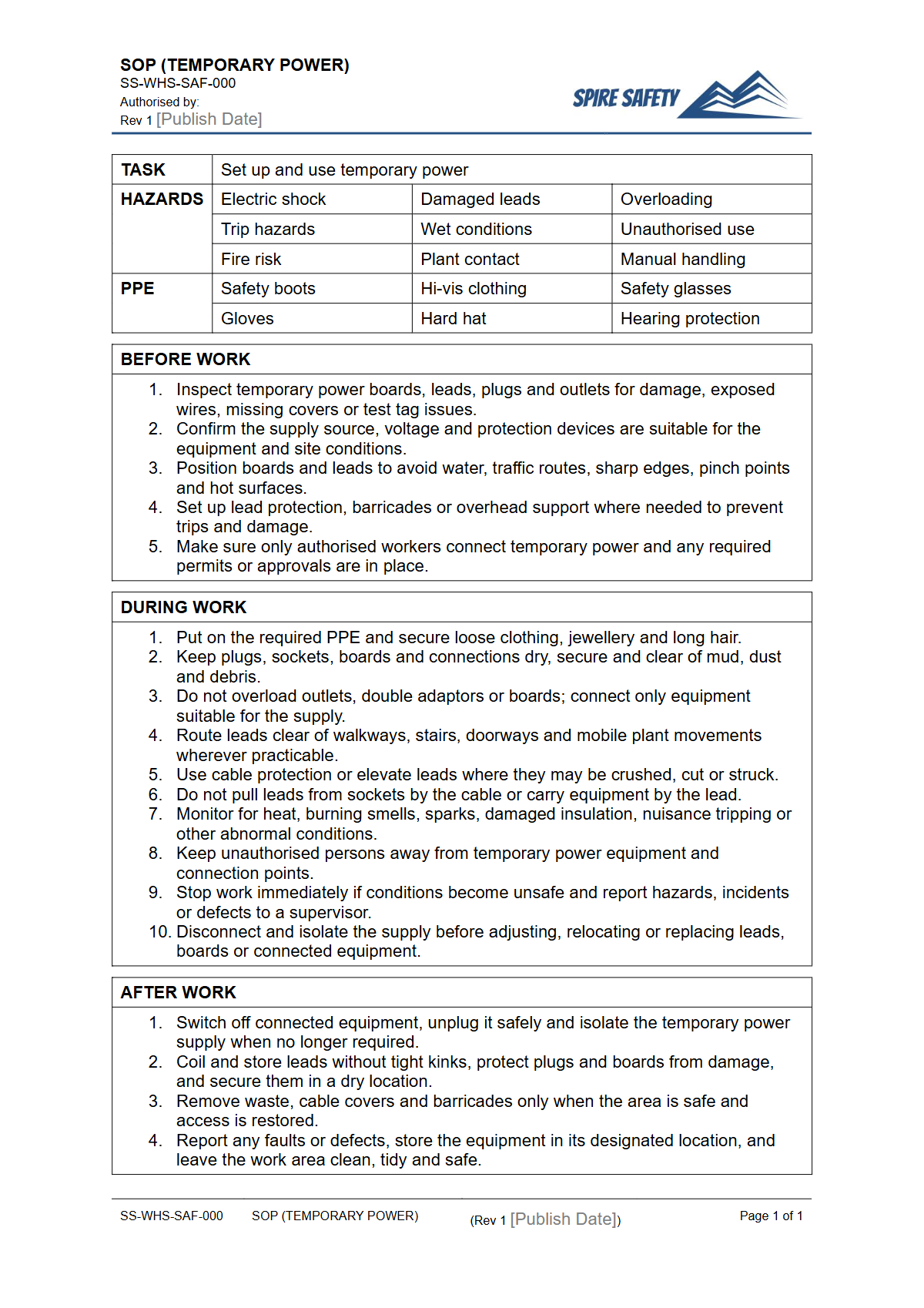
Purpose of the Free Safe Operating Procedure (Temporary Power) Template
Managing temporary electrical supplies on any work site—from construction and demolition to outdoor events and maintenance shutdowns—is a high-risk activity. Our Free Safe Operating Procedure (Temporary Power) Template provides a structured starting point for your organisation to formalise its safety protocols.
Using a standardised SOP helps ensure that all personnel follow a consistent, safe method for the selection, installation, use, and removal of temporary power equipment. This reduces the likelihood of incidents like electric shock, burns, fire, and equipment damage.
This document is designed to be integrated into your existing safety framework, serving as a key control measure for identified electrical hazards. A well-defined SOP is a fundamental component of effective risk management, demonstrating due diligence and forming a critical part of broader WHS management systems. It provides clear, actionable steps that simplify training, guide worker behaviour, and establish clear expectations for safety performance on site.
Video walkthrough
How to use the Free Safe Operating Procedure (Temporary Power) Template
This downloadable document is provided in DOCX and PDF formats for your convenience. The DOCX file is fully editable, allowing you to adapt it to the unique context of your business and specific site requirements.
To use the template effectively, you should conduct a site-specific risk assessment to identify all potential electrical hazards associated with your temporary power setup.
You must then modify the procedure to address these specific risks, detailing the exact equipment used (e.g., generators, switchboards, leads), the personnel responsible, and the inspection and testing protocols required for your jurisdiction. It is crucial to involve competent persons, such as licensed electricians and WHS advisors, in the review and customisation process.
For expert assistance in tailoring this or other procedural documents, consider engaging professional WHS consulting services.
IMPORTANT: This document is a template only. We have drafted it to align with the model WHS framework, but it must be customised to your specific workplace, equipment, and processes.
You are responsible for ensuring its suitability and compliance with the relevant legislation, Australian Standards, and codes of practice.
When should a Temporary Power SOP be used?
A Safe Operating Procedure for temporary power is essential whenever a non-permanent electrical supply is required to run tools, lighting, or other equipment. This applies to a wide range of industries and situations.
On construction and demolition sites, temporary power is standard, and its management is heavily regulated. This SOP provides the framework for meeting those requirements, from initial setup to final disconnection.
It's also critical for outdoor events, festivals, and film sets, where complex power distribution systems are assembled and disassembled under tight deadlines.
Furthermore, this procedure should be implemented during planned maintenance or refurbishment projects within existing facilities, where the permanent power supply may be isolated. It also applies to emergency response situations that require portable generators.
Regular checks of your documented safety processes are often a key part of WHS compliance auditing, making a formalised SOP a valuable piece of evidence for your safety system.
Who should use this Safe Operating Procedure?
This SOP should be understood and used by various personnel on site, depending on their roles and responsibilities. While a competent person (typically a licensed electrician) must be responsible for the installation and certification of the system, other workers have key duties.
- Site Managers and Supervisors: Must ensure the SOP is implemented, that workers are trained in its requirements, and that inspections are carried out as scheduled.
- WHS Officers/Advisors: Responsible for helping develop, review, and monitor the effectiveness of the SOP as part of the overall safety management system.
- Electricians and Competent Persons: Use the SOP as a guide for safe installation, testing, maintenance, and fault-finding, ensuring all work complies with AS/NZS 3000 and AS/NZS 3012.
- All Workers: Any worker who uses equipment powered by the temporary supply must be trained to conduct pre-start visual inspections of leads and connections, understand the emergency shutdown procedure, and know how to report faults or damage.
Training on this procedure should be included in site inductions and reinforced with task-specific training, similar to how you might document procedures in a free Trencher SOP template for plant operators. If you're looking for other procedural documents, you can browse our complete free WHS resources library for more templates.
Common mistakes
Common mistakes to avoid
- Using extension leads or power boards designed for domestic use in harsh industrial or construction environments.
- Failing to protect electrical leads from damage by suspending them overhead or using protective ramps.
- Connecting multiple power boards together ('daisy-chaining'), which can overload circuits and create a fire hazard.
- Allowing non-qualified personnel to install, modify, or repair temporary electrical systems.
Legal references
Legal considerations
The following legal requirements may be relevant to this type of work.
- Work Health and Safety Act (Harmonised) — Provides the primary duties for protecting workers and other people from work health and safety risks.
- Work Health and Safety Regulations (Harmonised) — Sets out requirements supporting the management of workplace hazards and risks.
The following codes may be relevant to this type of work.
- Managing WHS Risks Code of Practice — Provides practical guidance on identifying hazards, assessing risks and applying effective controls.
- Work Health and Safety Consultation, Cooperation and Coordination Code of Practice — Provides practical guidance on consulting workers and coordinating with other duty holders.
- Managing the Work Environment and Facilities Code of Practice — Provides practical guidance on safe work environments, workplace facilities and related controls.
Did you know
The Role of RCDs
Residual Current Devices (RCDs), also known as safety switches, are mandatory for most temporary power circuits. They are designed to disconnect power in a fraction of a second if a fault is detected, potentially preventing a fatal electric shock.
Construction Site Risks
According to Safe Work Australia, the construction industry consistently ranks among the highest for serious claims related to contact with electricity. This underscores the critical need for robust procedures when dealing with temporary power.
FAQ
Frequently asked questions
01What is a Safe Operating Procedure for temporary power?
02Is this temporary power SOP template compliant with Australian WHS laws?
03Who is responsible for inspecting temporary electrical installations?
04How often should temporary power setups be inspected?
Share this resource
Free Safe Operating Procedure (Temporary Power) Template
Browse Categories
How To Use It
- 1Download and open in Word or PDF.
- 2Replace the placeholders with your business details.
- 3Get it reviewed by a WHS specialist before rollout.
Need it customised?
Our WHS consultants can adapt this template to your site, run a gap analysis, or audit what you already have in place.
Book a Free Consultation WHS consulting servicesor call 1300 156 382
Related templates
- Free Safe Operating Procedure (Tender Boat Operation) Template
- Free Safe Operating Procedure (Tennis Court Cleaning) Template
- Free Safe Operating Procedure (Terminal Tractor) Template
- Free Safe Operating Procedure (Theatre Backstage Clean) Template
- Free Safe Operating Procedure (Thermal Imaging Camera) Template
- Free Safe Operating Procedure (Thermal Lance) Template